News
Galaxy patterns reveal missing link to Big Bang
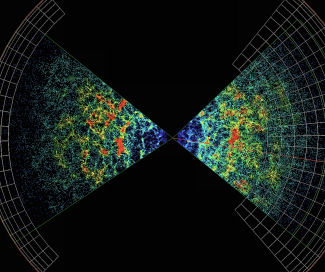
Australian astronomers from the Anglo-Australian Observatory, The Australian National University, CSIRO and the University of New South Wales, together with their UK colleagues, today announced that they have found the 'missing link' that directly relates modern galaxies like our own Milky Way to the Hot Big Bang that created our Universe 14 thousand million years ago.
Spitzer Finds Stellar "Incubators" With Massive Star Embryos
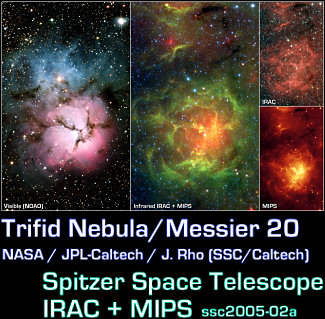
NASA's Spitzer Space Telescope has uncovered a hatchery for massive stars in a Messier favorite.
Hubble's Infrared Eyes Home in on Suspected Extrasolar Planet
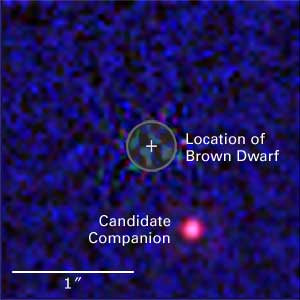
The Hubble Space Telescope's near-infrared vision is hot on the trail of a possible planetary companion to a relatively bright young brown dwarf located 225 light-years away in the southern constellation Hydra...
What does protein folding have to do with astronomy?

Not much perhaps but dipping a paw into another food group for a moment promotes good mental health and, in this case, good health in general. This is all about a novel distributed computing project by Stanford University that could help lead to cures for Alzheimer's, Mad Cow (BSE), CJD, ALS, Huntington's, and Parkinson's disease. We are posting it in the hope that people familiar with SETI@HOME might consider it as an alternative way to be of service...
Worldwide Astronomy 101 Anyone?

Free Astronomy Course Offered via Internet and Cable. Planetary Society and California State University Dominguez Hills Team Up on Distance Learning - Article by Susan Lendroth
An Extraspecial Camera for Extrasolar Planets

It hasn't found planets yet - but in its first year of operation, the instrument has already proved its worth...
Type 4's Revealed in This Week's Winning Review

Ed Moran covers the 22mm and 17mm Nagler T4 eyepieces and has captured the prize this week.
Portrait of a Star on the Edge

A new telescope array yields an unprecedented close-up of the bright star Regulus
SMART-1's first images from the Moon

ESA's SMART-1 captured its first close-range images of the Moon this January, during a sequence of test lunar observations from an altitude between 1000 and 5000 kilometers above the lunar surface.
Celestron introduces new line

The engineers have been hard at work on the new CPC Series and it appears they've been tweaking the price tags some, too...
A $300 deep sky imager gets some exposure...

This week's review winner passes along sage advice based on experience to make life easier for those who follow...
Dwarf Galaxy Gives Giant Surprise

An astronomer studying small irregular galaxies discovered a remarkable feature in one galaxy that may provide key clues to understanding how galaxies form and the relationship between the gas and the stars within galaxies.
Blazar Jets Push Closer to Cosmic Speed Limit

Astronomers using the National Science Foundation's Very Long Baseline Array (VLBA) have discovered jets of plasma blasted from the cores of distant galaxies at speeds within one-tenth of one percent of the speed of light, placing these plasma jets among the fastest objects yet seen in the Universe.
Star Cluster Buzzing With Pulsars

A dense globular star cluster near the center of our Milky Way Galaxy holds a buzzing beehive of rapidly-spinning millisecond pulsars, according to astronomers who discovered 21 new pulsars in the cluster using the National Science Foundation's 100-meter Robert C. Byrd Green Bank Telescope (GBT) in West Virginia. The cluster, called Terzan 5, now holds the record for pulsars, with 24, including three known before the GBT observations.
Steward Observatory Mirror Lab Awarded Contract for Large Synoptic Survey Telescope Mirror

This scope will employ an unusual triple mirror design...
Funding Member
