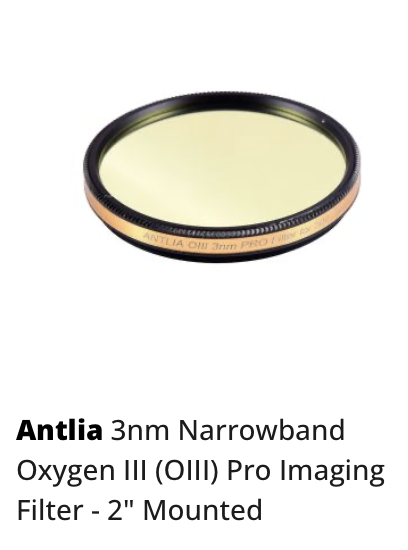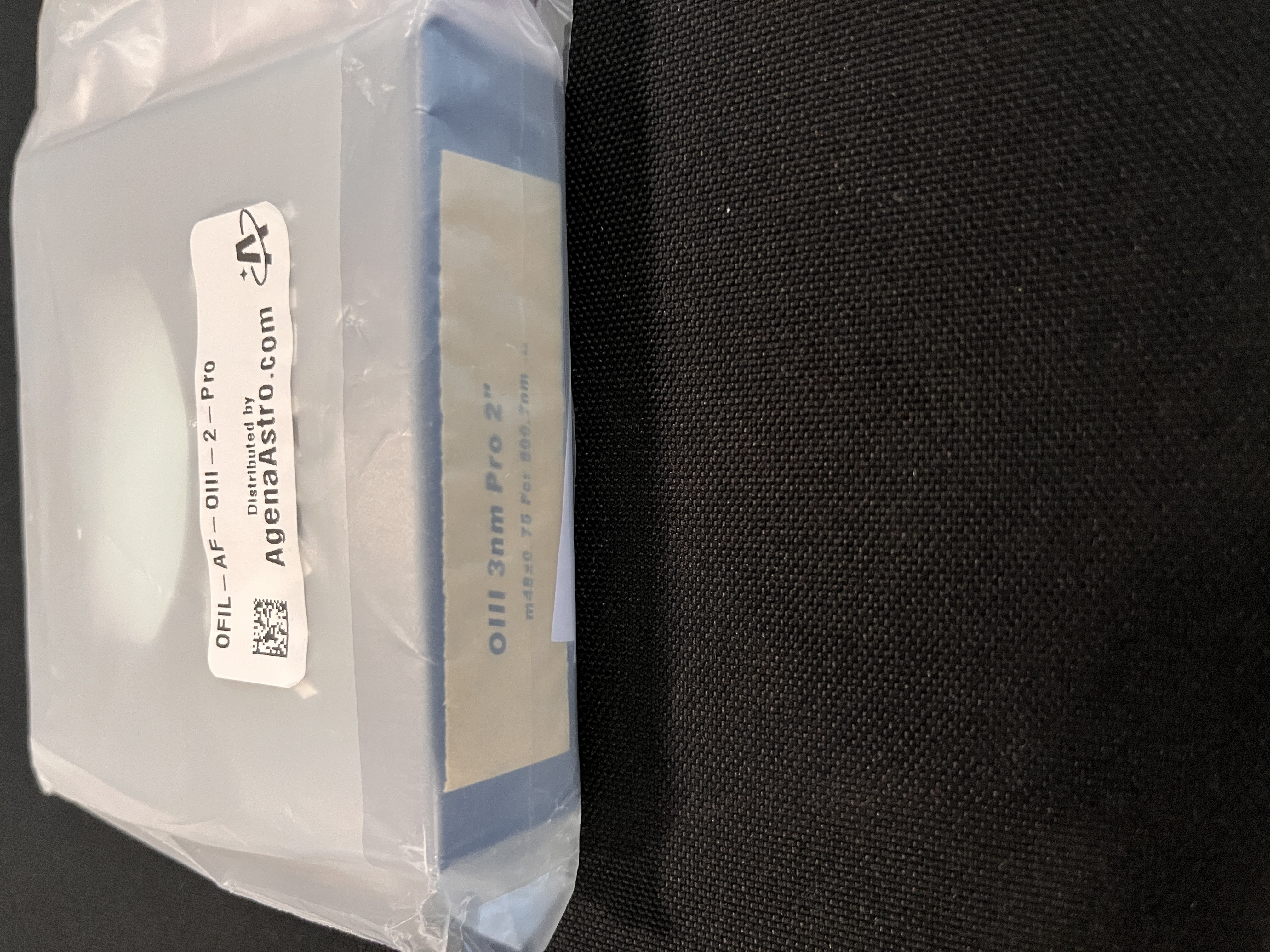
Antlia 3nm Narrowband Oxygen III (OIII) Pro Imaging Filter: *BRAND NEW-UNOPENED*
Please Log In to view the details for this classified ad.
Don't have an Astromart account? Click here to create one
The Antlia Oxygen III (OIII) 3nm filter is suitable for imaging of Oxygen III emissions from nebulas, planetary nebulas and supernova remnants. The 3nm bandwidth delivers a high transmission at a center wavelength of 500.7nm. The extreme narrowness in bandwidth enables astro-imaging from heavily light polluted locations and delivers improved contrast at darker sites. The filter effectively suppresses interference from other wavelengths, especially artificial mercury and sodium lamps. Antlia narrowband filters are designed to bring out the faintest features in nebulosity by reducing the unwanted background frequencies – the narrower the filter, the better. Conventional broader narrowband filters cause a heavy loss in transmission due to the strong CWL (Center Wavelength) shift. Antlia's OIII filter is designed to deliver 85% or higher transmission within 1nm of the center at the 500.7nm line which means that the 3nm Pro narrowband filter can guarantee high transmittance for working with both long focal ratios and fast optical systems. Blue-shift data shows that Antlia 3nm Pro filters can be used with nearly all systems as fast as f/3 with minimal loss in emission signal and meets the requirements of fast optics like Hyperstar and RASA. When Antlia designs filters for astronomy imaging systems, they look at how they will work together with optical systems, carefully designing the blocking and band-pass parameters to achieve an optimum result. The out-of-band blocking specification is rated OD5 (0.001%) which delivers an excellent signal-to-noise ratio and effective cut-off rate to minimize interference from other wavelengths. A sharp cut-off rate is a very important performance index since it is designed to sharply attenuate off-band wavelengths. The result is that the Antlia OIII filter delivers excellent contrast with extremely dark backgrounds whilst delivering a high transmission of the OIII signal. Such filters are more difficult to produce to a consistently high standard. The sharp cut-off also minimizes the effect of halos around stars, although halos may still be visible in some cases around bright stars as detailed above. In the production process, Antlia uses very strict quality control standards. Each filter is individually tested and scanned to ensure that the product meets their high-performance parameters. The end result is a filter that achieves excellent contrast but with a higher production cost. We believe the price to performance ratio compares more favorably than similar premium filters on the market.
Funding Member