
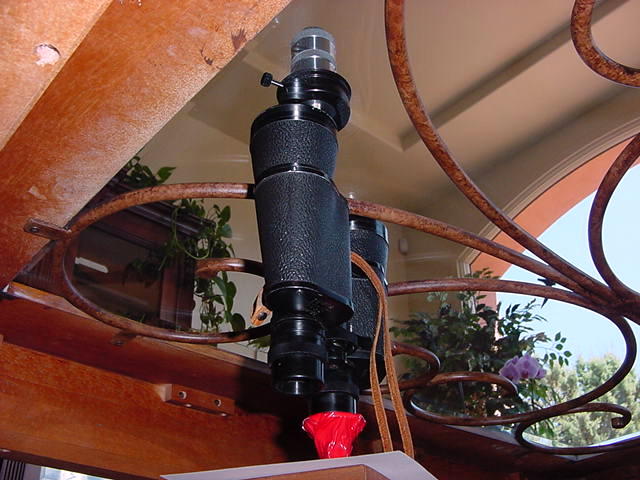
My wife and I have a glass-top coffee table in our living room. This gave me the inspiration for a way to move my laser around a binocular objective without changing its incident angle. After some experimenting, I found that a small hydraulic jack would hold the binoculars square against the underside of the glass so that I could slide the laser around on top of the glass over the objective. The padded jack seats against the unused eyepiece. A box under the tested side raises a piece of white paper close enough to the exit pupil to make measurements on the laser spot position in the field.
To keep the laser square against the top of the glass, I used a 2" to 1-1/4" adapter as a base. When I initially tightened the screw in the 1-1/4" adapter, just the play in the adapter was enough to cause the laser beam to be slightly off-axis. This can be checked by rotating the laser in place over the objective. If the laser axis is not precisely parallel to the optical axis of the binocular, the dot will rotate. Once I shimmed the adapter with thin strips of Scotch tape, the dot remained fixed in position as I rotated the laser.
With the binocular set up, I positioned the laser in the center of the objective and manually tilted it to locate the field edges on the paper. I found that as long as the laser was on-axis and centered over the objective, the holographic grid could also be used to show the true field. However, this was the only thing I used the grid for. Below is a picture taken under the table of my elderly Ofuna's ready for illumination testing.
Welcome to the discussion, Rick! (Mr. Shaffer is one of my mentors from whom I learned much of this stuff).
To keep the laser square against the top of the glass, I used a 2" to 1-1/4" adapter as a base. When I initially tightened the screw in the 1-1/4" adapter, just the play in the adapter was enough to cause the laser beam to be slightly off-axis. This can be checked by rotating the laser in place over the objective. If the laser axis is not precisely parallel to the optical axis of the binocular, the dot will rotate. Once I shimmed the adapter with thin strips of Scotch tape, the dot remained fixed in position as I rotated the laser.
With the binocular set up, I positioned the laser in the center of the objective and manually tilted it to locate the field edges on the paper. I found that as long as the laser was on-axis and centered over the objective, the holographic grid could also be used to show the true field. However, this was the only thing I used the grid for. Below is a picture taken under the table of my elderly Ofuna's ready for illumination testing.
Welcome to the discussion, Rick! (Mr. Shaffer is one of my mentors from whom I learned much of this stuff).
Attached Image:
