
The first test was to slide the laser around the objective to check for on-axis (center of field) illumination. The exit pupil dot should remain stationary in the center of the field during this test. If the dot moves as the laser nears an objective edge, it indicates aberration(s) that will affect the star image. If the dot disappears before the laser reaches an objective edge, it indicates vignetting and less than 100% illumination at the field center.
Once the on-axis work was done, I taped a shim onto the edge of the laser holder to incline it at a known angle relative to the optical axis. I used two shims, one 0.6mm thick including tape, and the other 1.2mm. The spacing between a shim edge and far base edge measured 45mm. This allows the tilt angle to be calculated: arctan(0.6/45)=0.76° for the thinner shim and arctan(1.2/45)=1.53° for the thicker.
An off-axis laser beam shifts the exit pupil dot away from the center of the field. Again, it should remain stationary as the laser is moved around the objective, providing the laser is not rotated while being moved. Knowing the incident angle of the laser and measuring the dot position on the paper allowed me to confirm the TFOV of each binocular.
As I moved the laser over the objective in the direction it was inclined, I found that the dot would disappear before it reached the objective edge, indicating some vignetting of the off-axis beam. However, there was no vignetting at the opposite objective edge and seldom along either perpendicular edge. This makes the lost objective area a crescent, which is difficult (for me) to calculate. To come up with % illumination, I estimated the usable objective area from sketches on graph paper. As a sanity check, if one half of the objective is contributing full illumination and the other more than 50% of its half, we know the total illumination must be better than 75%.
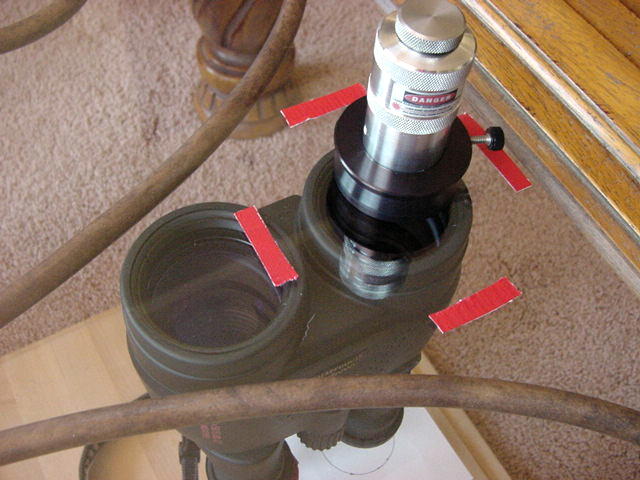
The next picture is of the Canon’s from the top of the table. The red tape marked the edges of the laser base with the beam at the objective edges.
Once the on-axis work was done, I taped a shim onto the edge of the laser holder to incline it at a known angle relative to the optical axis. I used two shims, one 0.6mm thick including tape, and the other 1.2mm. The spacing between a shim edge and far base edge measured 45mm. This allows the tilt angle to be calculated: arctan(0.6/45)=0.76° for the thinner shim and arctan(1.2/45)=1.53° for the thicker.
An off-axis laser beam shifts the exit pupil dot away from the center of the field. Again, it should remain stationary as the laser is moved around the objective, providing the laser is not rotated while being moved. Knowing the incident angle of the laser and measuring the dot position on the paper allowed me to confirm the TFOV of each binocular.
As I moved the laser over the objective in the direction it was inclined, I found that the dot would disappear before it reached the objective edge, indicating some vignetting of the off-axis beam. However, there was no vignetting at the opposite objective edge and seldom along either perpendicular edge. This makes the lost objective area a crescent, which is difficult (for me) to calculate. To come up with % illumination, I estimated the usable objective area from sketches on graph paper. As a sanity check, if one half of the objective is contributing full illumination and the other more than 50% of its half, we know the total illumination must be better than 75%.
The next picture is of the Canon’s from the top of the table. The red tape marked the edges of the laser base with the beam at the objective edges.
Attached Image:
