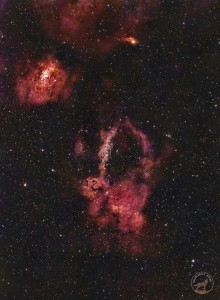

It finally stopped raining, so I was out last night checking some binocular targets, and was pleasantly surprised to find Mira (Omicron Cetus) at its maximum magnitude around 2.0!
To find it, follow the Messier Marathon path to M77, and go a bit farther. For the uninitiated, follow the "V" in Taurus straight down past 1&2 Tau to Menkar (Alpha Cetus), which, BTW, is an excellent, wide, gold-blue binocular double. Keep moving toward the horizon, and zig a little to the right to Gamma, then a little to the left to Delta. Retrace the line from Alpha to Delta and go the same distance to a bright yellow star - that's Mira!
It should be bright enough to shine through any haze lingering near the western horizon for a month or so before fading to magnitude 10 again, and then peaking again in 11 months.
Hugh Bartlett
Oakland, CA (37.8 deg. N.)
"Praise the Lord for the expanding grandeur of creation, worlds known and unknown, galaxies beyond galaxies, filling us with awe and challenging our imaginations." 2007 Reform Siddur
