Image of the day

Captured by
Ralph Ford

M31 with Redcat 51

My Account

New to Astromart?

Register an account...

Need Help?

2" diagonal internal restriction issue

Started by somaholiday, 05/27/2013 05:16PM
Posted 05/27/2013 05:16PM | Edited 05/27/2013 05:18PM Opening Post
Hi, It's come to my attention that some 2" diagonals have internal restrictions that are smaller than the maximum 2" eyepiece field stop of 46mm (the inside diameter of the eyepiece barrel itself). I have seen one with an internal safety stop in the chimney section (to prevent eyepiece from hitting mirror) that had an internal diameter of only 41mm.

In particular, if one has a large sct and intends to remove the stock sct thread adapter to avoid it's 38mm limitation, it seems a restrictive diagonal would defeat some of the intended purpose.

Just curious is others are aware of this and/or what your thoughts are... also if you are aware of any 2" diagonals that maintain a full 46mm+ inside diameter all the way through. I suspect Lumicons do, but I don't have their 2" version.
Posted 05/28/2013 06:39AM #1
I grabbed a couple 2" diagonals and did a quick eyeball measurement with a ruler. I got 45mm clear aperture for Astro-Physics, 44mm for TeleVue, and 41mm for William Optics. In all cases the restriction is at or near the internal safety stop (i.e. near the base of a 2" eyepiece). These are all older diagonals (5+ yrs old), so I can't say whether current production might be different.

For typical F-ratio scopes it will only impact the very edge of the field of view, and the light loss there won't be noticeable to most folks. In any case it will be difficult to get 100% illumination at the field edge if you've got a 46mm field stop in 2" barrel -- lots of light rays will end up hitting the inside of the eyepiece barrel either before or after the field stop -- the illumination at the field edge is already compromised by the eyepiece design. Of course, it would be nice if the diagonal did not contribute further light losses, but in practice if the eyepiece has 45% light loss at the field edge already, and the diagonal increases this to say 50% loss, its not going to be perceived as a large impact.
Posted 05/28/2013 11:04AM #2
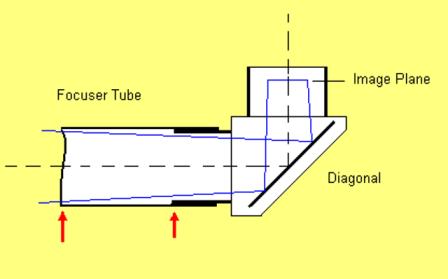
The true restriction is the inside of the nosepiece on the diagonal. In all cases, the light cone tapers from the front edge of the nosepiece to the eyepiece field stop. This distance is about 4" so there is considerable amount of taper of the cone. The light cone also has to pass the length of the focuser tube as well before it gets into the diagonal so this too can be a real restriction. If the focuser tube is 4" long, there is a total path length inside the focuser/diagonal that is 8" long. A similar situation exists in SCTs with the baffle tube.

In a 4" f6 scope for example, the widest maximum fully illuminated field is only 20mm or so at the eyepiece field stop.

hope this helps,
dan

Attached Image:

dhilts's attachment for post 147141
Posted 05/29/2013 02:51AM #3
Thanks for the replies. After some measuring, sketching, and thinking, I can see that the sct baffle tube necessarily causes under illumination at the field edge of widefield eyepieces, but that a narrow sct thread adaptor, diagonal nosepiece, or eyepiece stop, does have the potential to block additional light beyond that blocked by the baffle tube. I agree it'd be difficult to detect with the eye, but technically I think it does happen.

I sent the question to Williams Optics and Lumicon. Williams gave a terse response saying there were no performance issues with their diagonals and did not invite further conversation. In contrast, Lumicon responded with exact inside diameter measurements for their diagonals and invited any other questions I might have.

The Williams I have has a 43mm I.D. nosepiece and a 41mm I.D. eyepiece stop. Lumicon says their "enhanced" and "lumibright" diagonals have a 47mm nosepiece and another 47mm opening where the body meets the chimney which acts as the eyepiece stop.
Posted 05/30/2013 02:51PM #4
You'd have to use a very long focal length eyepiece or a fairly long one with a focal reducer for this to be a practical problem. On an f/10 SCT it is a non-issue. That's is why the "big backs" like the AP or the Eyeopener for the larger SCTs have no visible effect till you go to f/ls of eyepieces most of us never use--50mm and longer. wink

Uncle Rod

Time on your hands?
Waste it with Uncle Rod's Astro Blog!

http://uncle-rods.blogspot.com/
Posted 05/30/2013 06:24PM #5
Consider the following thought experiment:

Take a refractor, it doesn't matter what focal ratio but say the aperture is 100mm (just so the aperture is bigger than a 46mm field stop). For simplicity eliminate the diagonal, so that the eyepiece is inserted directly into the focuser, "pirate scope" style. Let the eyepiece be a 2" model with the max field stop, so 46mm inside diameter for the field stop/barrel.

Now imagine shrinking yourself down so you are a small fraction of a millimeter tall, and can walk around inside the OTA.

Stand at the left edge of the field stop and look towards the objective. How much of the objective can you see? Not all of it, cause the eyepiece barrel, which extends in front of you creates a "horizon". Roughly speaking, since the horizon is 23mm to the left of the optical axis, you can't see any part of the objective that lies more than 23mm to the left of the optical axis. So, there is a crescent shaped portion of the objective that cannot contribute light to the edge of the field at your position.

Now put a 41mm diameter eyepiece stop, or a 38mm adapter somewhere out in front of you. These thing necessarily "raise" the horizon and block an additional crescent shaped section of the objective, increasing the degree of under illumination at the field edge.

If the restriction is severe enough, you won't be able to see the objective at all, meaning the degree of under illumination at the edge has reached 100%.

Now begin floating to your right, towards the optical axis. Slowly more and more of the objective becomes visible over the horizon, however you may find that before the entire objective is visible, the end of the focus tube appears, and is now the thing creating a horizon and blocking a smaller section of the objective. You are now in an annulus of field that is unaffected by the barrel/other local restrictions, but is still under illuminated due to the focus tube. Moving further to the right, at some point the entire objective becomes visible. You are now at the edge of the fully illuminated portion of the field.

In this example the focus tube (or baffle in an sct) is what limits the size of the FULLY illuminated field, because it forms the last horizon, when moving towards the optical axis, before the entire objective becomes visible. However, the 38mm - 46mm restrictions closer to the field stop cause additional under illumination at the edge beyond what the focus tube would cause by itself because they form the relevant horizon when your standing at the field edge. So, removing anything smaller than 46mm gives you some additional light in an outer annulus of field. May not be detectable to the eye, but I think it's interesting.

Using the geometry of my 10" meade, the barrel of a 2" eyepiece allows over 75% of the secondary mirror to be visible from the edge of a 46mm field stop. With a 38mm adapter in place, less than half the secondary is visible from the same position.

I first did this by drawing the rays, but thought the shrinking idea would be easier to explain than the drawings. Let me know if this makes sense...