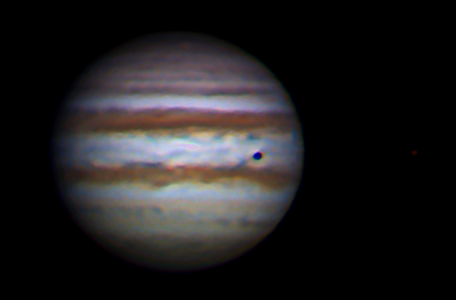
Image of the day

Captured by
John Roach

Jupiter IO Transit 12-10-26

My Account

New to Astromart?

Register an account...

Need Help?

Am I an SCT Guy or not ?

Started by brentc3114, 09/11/2009 12:52AM
Posted 09/11/2009 12:52AM Opening Post
:S I'm looking at purchasing a used SCT this week. In preparation I ordered "Choosing and using a new cat" by Rod Mosllise. Here is my question, my use is visual, I have a hard time locating objects in the light polluted sky, would I possibly be better served by a "push to" 10" DOb from Orion like this one : http://www.telescope.com/control/product/~category_id=dobsonians/~pcategory=telescopes/~product_id=27184 ?

When using a "push to" DOB say looking at Jupiter, how hard is it to keep something in view? My ST80 refractor on a Vixen ALT/AZ mount is stable but oh so irritating to keep centered on Jupiter-or any other object other than the moon. You can't relax and view the object because it just moved out of view of the narrow field of view (ortho eyepieces).

The SCT would have tracking which would be a luxury, and to be honest I really want a versatile instrument that can be used to view several things. Transport is not an issue because I drive a truck. How long would an object stay in the field of view at say 300 X with such a scope?

I know that SCT's have central obstructions, etc, and that depending on the persons opinion that one design can be better than the other-what I really want to know about is the useability of the scope....The only thing that I have learned from my ST80 that apeature RULES but it has to be portable.


Posted 09/11/2009 01:51AM | Edited 09/11/2009 01:58AM #1
I am sure there are those who will disagree but I dont enjoy having to manually follow anything. Truthfully if that were the only option I doubt I would have nearly as much enthusiasm for the hobby......and my pocketbook says I have a LOT of enthusasim lol

I can live without goto although I do prefer it.....but tracking? NOOOOO way. At the minimum slow motion controls or I just wont bother. Doesnt matter to me DOB, Newt, Refractor it has to have tracking for me to enjoy it.......

As to SCT's I enjoy my 11" immensely......The old saying still applies, the SCT doesnt do anything exceptionally well but it does everything well fits my opinion of them. With the exception of widefield views of course smile But then the ST80 will give you those so you would be set lol

Brent Campbell said:

:S I'm looking at purchasing a used SCT this week. In preparation I ordered "Choosing and using a new cat" by Rod Mosllise. Here is my question, my use is visual, I have a hard time locating objects in the light polluted sky, would I possibly be better served by a "push to" 10" DOb from Orion like this one : http://www.telescope.com/control/product/~category_id=dobsonians/~pcategory=telescopes/~product_id=27184 ?

When using a "push to" DOB say looking at Jupiter, how hard is it to keep something in view? My ST80 refractor on a Vixen ALT/AZ mount is stable but oh so irritating to keep centered on Jupiter-or any other object other than the moon. You can't relax and view the object because it just moved out of view of the narrow field of view (ortho eyepieces).

The SCT would have tracking which would be a luxury, and to be honest I really want a versatile instrument that can be used to view several things. Transport is not an issue because I drive a truck. How long would an object stay in the field of view at say 300 X with such a scope?

I know that SCT's have central obstructions, etc, and that depending on the persons opinion that one design can be better than the other-what I really want to know about is the useability of the scope....The only thing that I have learned from my ST80 that apeature RULES but it has to be portable.


20" MidnighTelescopes f/5
8" f/16 Muffoletto Achro
Meade 6" AR6 f/8.0 Achro
Celestron C11
Parallax PI250 10" F/5 Newt
Vixen FL102S,NA140SS,R200SS
80mm Stellarvue Nighthawk with WO APOupgrade lens, 90mm f/16.67 Parallax Achro
LXD75/LX200, Mini-tower, GP-DX, CG5 ASGT, LXD650, GM-8, G11, GM-100, GM-150EX, GM-200 and a Gemini G40
4" portable AP convertable 44" or 70" pier
Stellarvue M7 Alt-Az, TSL7 Pier/Tripod
12.5" f/5 MidnighTelescopes DOB Swayze optics
Monroe GA
Posted 09/11/2009 02:01AM #2
<>

With tracking an object will stay centered in the field indefinitely with only minor adjustments. Just how long it will stay without adjustments depends on how good the tracking is and how well the alignment was done but definitely long enough for relaxed viewing.

Without tracking one has to deal with the drift which is at the rate of 3.98 minutes per degree of sky. If you can calculate the true field of view in the eyepiece, you can determine how long an object will take to drift across the view. At 300X, a 50 degree eyepiece will have a true field of approximately 300/50 or 1/6 degree. It will take an object about 1/6 X 3.9888 minutes or 40 seconds to drift across the view. Folks with Dobs like to use wide field eyepieces because they don't have to struggle as much to keep objects in the view.

hope this helps,
dan
Posted 09/11/2009 02:08AM | Edited 09/11/2009 02:12AM #3
I'm not at all a serious nerdy astronomer, just like seeing pretty stuff in the sky. GOTO is nice but my yard is so obscured by trees that an 'uneducated' GOTO is much more likely to aim at a tree than sky.

Often I like just manually scanning the narrow strip of sky available, lookin around at what there is to see. The nice thing about the GOTO is that once aligned, it tracks anything I manually point to.

The SCT's might be 'less wiggly' on any particular class of mount, compared to newts or refractors, because SCT's are stubby and will have a lower moment of torsion than longer scopes on the same mount. The long scopes are more likely to become 'oscillating pendulums' at high magnification, because of the bigger moment of torsion.

Many SCT's don't want to display much more than about 1 degree max of sky (FOV). It is easy to piggyback a small refractor to solve that problem.
Posted 09/11/2009 08:00AM #4
Brent:

Here's a few thoughts/comments/observations from someone who is definitely NOT an SCT guy. I have owned two 8 inch SCTs in the past, observed through a variety of others and still own an older C-5 OTA. Currently my collection incudes several refractors though none larger than 4 inch plus several Newtonians ranging from 3 inch to 16 inch, equally split between EQ mounts and Dob mounts... Anyway:

- Motorized tracking is a nice touch but far more important is the View the scope can provide. In getting the good views, particularly of the planets and double stars, a scope that can reach thermal stability quickly and can be cooled while observing is critical. A Newtonian with a fan will cool relatively quickly and can track the temperature as it falls over the course of an evening. Where I live, the seeing is often quite good and I am frustrated by the inability of an SCT to be truly thermally stable.

- Mount stability: You did not say exactly what sort of mount the possible SCT might be. Since it tracks but does not have GOTO it will either be an older Fork Mount with a Wedge or a GEM. In my experience, the Fork Mount with the wedge is subject to serious vibration and focusing at high magnifications is an exercise in frustration because merely touching the focuser causes the scope to vibrate. A GEM is better. In comparison, a DOB mount is more stable than either because of it's simplicity. The mount sit right on the ground and provides simple, rigid support that allows the observer to focus in real time because the scope does not vibrate when touched.

- Finding things... Even without any digital setting circles (Intelliscope) a 10 inch DOB has some real advantages over the SCT. In particular, a 10 inch F/4.7 Newtonian is capable of a 2 degree TFoV while the SCT is limited to a significantly smaller TFov, something on the order of 1.2 degrees. That 2 degree TFoV is large enough that one can use the scope as a SUPER FINDER. In combination with the ease of scanning a region with the DOBs ALT-AZ mount, this allows one to find objects or just scan the sky quite easily.

- In my experience, the fork on Wedge of the older SCTs are awkward to use, particularly in the northern part of the sky. The fork gets in the way of one's head and the finder position can be nearly impossible... An SCT on a GEM is better but unless one has rings, the finder also can be awkward.

So, you asked the question if you are an SCT GUY... A good question. I cannot really answer that one because I am not an SCT GUY. The question I can probably shed some light on is whether or not you are a DOB GUY...

For me, the major advantages of the DOB are it's elegant simplicity, the stability of the mount, the ease of finding targets, the comfort of observing seated, and the great views that are possible.

As I said previously, the view though the eyepiece is what is most important, one can learn to track at 300x rather easily and with a fair amount of practice it is possible to hand track even across the Zenith at 800x or more.

In the ideal world, all mounts would track, all mounts would be free from vibration, all telescopes would never need collimation, all telescopes would be thermally equillibrated, all telescopes would have no central obstruction, all scopes would be free from coma and other aberrations, all scopes would set up instantly...

But in the real world there are compromises, one needs to choose a horse and ride it. For me, a solid mount, a scope that is simple and with appropriate care can provide crisp sharp wiews over a wide range of magnifications and fields fo view is my choice. Sure it's difficult to track at 600x but I am happy to settle for a momentary glimpse of a perfect view...

Jon who is definitely not an SCT guy.


Posted 09/11/2009 05:19PM #5
Since you mention Jupiter, I will add that I personally
consider tracking a must for planetary viewing. Keeping
the planet centered at high power while waiting for
moments of best seeing becomes a very frustrating exercise.
You can do it without tracking, but I don't recommend it.

Don't think anyone mentioned that you can get motorized
tracking platforms for Dobs in the range $400 - $1000.
Thats a good solution, though it is one more item to haul
around. They also increase the height of the scope 4" to 5"
which might be an issue if you are very short. For medium
and low powers you don't need tracking -- so depends how
important planet viewing is to you.

The thermal issues on SCTs are another hurdle. If you are
up to taking the scope apart and installing fans, etc., you
can solve this issue. But its not a job for beginners.
Whereas fans are relatively simple to install on Dobs, and
Orion sells some kit to do it.

Whatever you get, you don't need to own it forever. If your
needs change, you can re-sell it here for most of what you
paid -- especially if you bought it used.
Posted 09/13/2009 07:02PM #6
I am an SCT guy.

Fork mounted 11 inch Celestron. I, too, am a visual observer so I consider the CPC/Nexstar scopes to be the best visual observing platform. The compromises that you have to make call for prep and attention to detail on the part of the observer.

You have to cool the scope. How hard this is depends on where you live. Here in north Texas, I use a Cat Cooler. The most I ever had to use it to get to stable images was thirty minutes before I started and then (this one time) about thirty minutes around 2am as the temp dropped.

You have to collimate the scope. It holds longer than a dob but still needs to be done. It isn't hard, but you would be surprised how many of the tales of "fuzzy" SCT's involve poorly collimated scopes that haven't been cooled. The views from my properly cooled and collimated C11 have been jaw dropping.

I do planets but prefer deep sky. This scope does it all well.

It's biggest advantage is the tracking. I like the go-to but could live without it. Not without the tracking. It's not just a matter of how ling the object is in the field, but keeping it in the center. I don't really like trying to view things at the edge of the field. With my Nexstar, I put an object in the center and it is there for hours. I sketch so I need an object to remain in it's position relative to its surroundings for a long time.

Then there is the comfort. With the addition of a viewing chair, an alt-ax SCT has the most comfortable viewing position of any scope, the eyepiece always erect and the travel of ep from horizon to zenith is only a mater of inches. I believe comfort is a big viewing feature. I can easily enjoy gazing for several minutes at a time at one object. I get more detail the longer I look without having to contort my back or strain my neck.

The two drawbacks that I see are field of view and scanning. You will be limited to approximately one degree. And the tracking SCT's don't really let you amble about the sky. I do like pushing and pulling on a dob when I'm playing around just scanning a section of sky, but then when I find something I have to start the nudge, nudge to keep it in view.

I solve both problems by having a small refractor on a manual alt-az mount. Wide views and simple predictable scanning. I believe you already have the refractor. I set both scopes up beside each other and alternate all night long.

But then I am, as I said, and SCT guy.
Posted 09/15/2009 01:53PM #7
smile

I just purchased a used Celestron 8 Ultima. Thank you everyone for your advice. The advice on how something can be sold if it isn't what I want was helpful. I paid $735.00 for the scope so I should be able to recoup most of my money back if I decide later that a DOB would be better.

Now all I need is some nice days with clear nights!
Posted 09/28/2009 04:25PM #8
Brent Campbell said:
Here is my question, my use is visual, I have a hard time locating objects in the light polluted sky,

Brent, I've been observing with a 10" DOB for a few years now. Some of the best advice I got from very seasoned observers:
- get the best tradeoff possible between aperture, optical and mechanical quality, and ease of use - be sure to consider ease of transporation and setup/teardown
- learn to use a Telrad (or other zero power finder)
- go out to a dark site to observe (the best investment you can make in astronomy is gasoline for trips out to a dark site)
- get a good star atlas and make use of observing guides
- stay away from goto scopes (I struggled with this one for a while because I had a goto scope. I've since found great joy in learning the sky and "the thrill of the hunt" (learning to find and observe various objects)).

At the end of the day, though, different people want different things from the hobby. You need to decide what you want to do and act accordingly. If you just want a quick look or two once in a while from your light-polluted back yard, maybe goto and a SCT is right for you.
