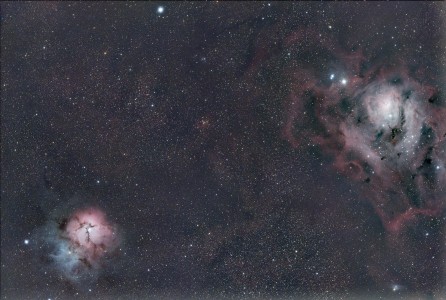
Image of the day

Captured by
Michael Scherman

Lagoon and Triffid Celestron C6 Hyperstar4

My Account

New to Astromart?

Register an account...

Need Help?

Aperture, power and 'image breakdown'

Started by Ron777, 08/20/2006 07:56PM
Posted 08/20/2006 07:56PM Opening Post
Here's a thought....

A statement we always see, "I was able to view at X power with no image breakdown"

Will using a shorter focal eyepiece actually damage the image formed by the main optics, that is floating at the focal plane? Naaaa!

All were doing is 'seeing' the raw image on a larger scale. The fixed optics of the scope are projecting the image at the focal plane. Changing eyepieces will not affect the raw image, it only let's us get closer to it. If you look at a picture in the newspaper with a magnifying glass, the picture doesn't 'break down', you just see the dots it's made from. It's less pleasing, but still the same image. If Saturn looks good at 150 but not at 300, all that means is you can now see the defects at the larger image scale.

So... why can we use higher power with larger scopes? I have never seen the 'dots' that make up the image no matter how high in power I went? Somehow, larger aperture must be (generally), putting up a cleaner raw image.
I can print off a picture at 50 DPI, and another at 600 DPI. If both are clean crisp images, I can blow up the final picture as large as I want. The 50 DPI will have less detail but will never 'mush out' or look 'out of focus'.....



Posted 08/20/2006 09:44PM #1
Hello:
First, I'll disagree with the previous post regaring the optical perfornance of our eyes with very small exit pupils. I agree that our eyes are not that good (optically speaking), I have quite a bit of astigmatism, so it's particularly bad for me. But with a very small exit pupil, we are only using a small part of the cornea/lens, so that little patch is much closer to being optically perfect than the whole thing. It's the same idea as using an aperture mask to improve image sharpness.

As far as why the image "breaks down", I agree that the eyepiece doesn't affect the image made by the telescope. All the eyepiece does is magnify the image that is there. Given a perfect telescope, the image would start to break down when you magnify so much that the resolution is limited by diffraction. In most cases, the resolution is limited by seeing. I also think that the eye can see more detail with more light (part of the eye-brain image processing miracle mentioned in the previous post). I remember looking at Saturn once on a night with very good (0.3") seeing. At 400x it looked great. At 800x, no so wonderful. It was dimmer, and didn't look as sharp. So, I thought the image was "better" at 400x. But was it? It looked sharper since the magnification was lower, and brighter for the same reason, but the two images presumably had the same detail. I think that at 800x the image resolution was limited by seeing, making the image more blurry, and dim enough that the eye/brain was having a harder time pulling out detail.

Cheers
Mike Connelley
Posted 08/21/2006 12:43AM | Edited 08/21/2006 12:45AM #2
>>>A statement we always see, "I was able to view at X power with no image breakdown"

..... If Saturn looks good at 150 but not at 300, all that means is you can now see the defects at the larger image scale.
------

Some times the reason that image looks good at 150X and not 300x is the telescope, sometimes it is the seeing...

If the seeing is good and the telescope allows one to take advantage of that seeing then one might say "I was able to able to view at X power with no image break down."

>>>So... why can we use higher power with larger scopes? I have never seen the 'dots' that make up the image no matter how high in power I went? Somehow, larger aperture must be (generally), putting up a cleaner raw image.
I can print off a picture at 50 DPI, and another at 600 DPI. If both are clean crisp images, I can blow up the final picture as large as I want. The 50 DPI will have less detail but will never 'mush out' or look 'out of focus'.....
------------

There are no "dots..." But there is limited amount of information available because the airy disks are larger with smaller scopes. These amount to the image scale.

So imagine that what happens is that the dots your are printing with get larger with a smaller scope. These dots are not printed on the eyepiece but on the mirror.

And further imagine that the dots are not nice, round sharp dots with a sharp edge but instead a disks that are brightest in the center and drops off towards the edge and has some rings around them.

Now, you are trying to print a image that has infinite resolution, but you can only do it with these fuzzy dots that say 0.020 inches in diameter. (50 dpi) Sure you can print 500 of these dots per inch but 10 of these somewhat fuzzy dots will be lying on top of each other....

The smaller the dots, the better, the more detailed the image and the more it can be magnified before the image becomes dimmer but no more detailed.

If you want to see the dots over lap, trying splitting a double star beyond the Dawes limit of your scope when the seeing is good. Double stars are the best way IMHO to see that larger aperture results in greater resolution.

Jon

Posted 08/21/2006 05:13AM #3
Not my words but good ones none the less concerning this thread 8)

DETAIL IN EXTENDED OBJECTS. When you look at any extended object, the telescope image is made up of an arrangement many diffraction disks of a size and spacing determined by the diameter of the objective. The smaller the disks, the more detail you can see, just as more detail is visible in a fine-screen magazine halftone than in a course newspaper halftone. When the telescope image is magnified 13x per inch of objective diameter, the diffraction pattern becomes equal to the resolving power of the eye. This is the equivalent to a 150-line halftone screen. Such a pattern or screen readily allows about 2.5x magnification in order to produce a larger picture and yet not, make the screen pattern too prominent. The pattern or screen is then 60-line, the same as used in newspaper halftones. This is the approximate effect you get at 32x per inch magnification. This is the ideal high power. Definition remains good to about 50x per inch and deteriorates sharply: at 60x per inch, the diffraction pattern has a structure of about 25 lines per inch. Being a picture painted with light disks, you can't view a telescope image and actually count off the lines-per-inch structure. However, the effect of a too-course screen is readily apparent, the picture becoming soft and woolly like a photograph with too much enlargement. REMEMBER: You can use all the power you like when looking at single stars or double stars or open clusters, because what you are looking at is a single diffraction disk, or a pair of disks, or an open cluster of disks. However, when you look at an extended object, you want to see the picture as a whole without making the disks of light which comprise it too prominent.

Keith
PS: Aperture rules but the seeing seldom allows it wink

Scopejunkie


40 year old restored C14 with recirculating cooling w/Skywatcher DOB GOTO Conversion (CPC14)

Synscan DOB mounted Sky-Watcher Evostar 150mm/1200mm ED Refractor

"Rescued" Craig's List Orion 120mm/1000mm Refractor


USAF Vet