Hey all,
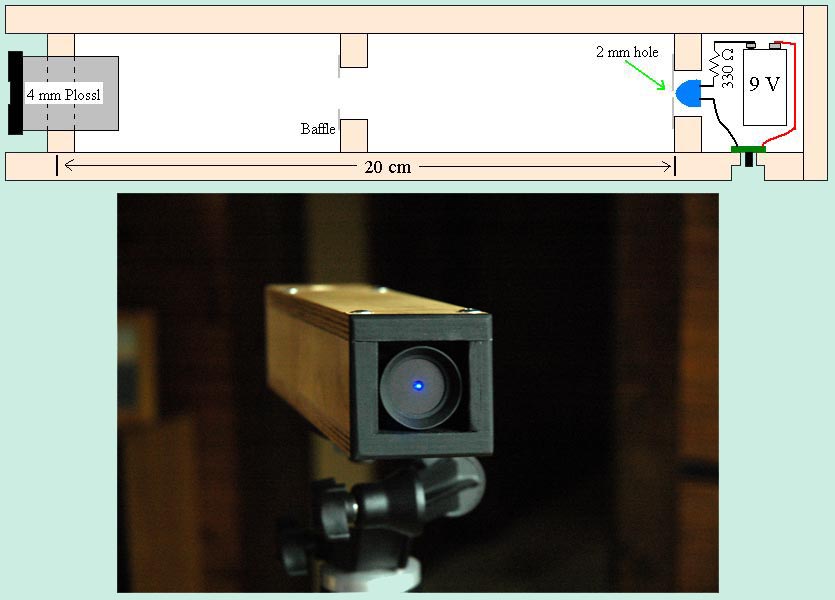
I decided I needed an artificial star to try to collimate my (pretty worthless) C130 Mak, and found plans on CN to build one. The one I made is a modified version of the one from the plans. I used an ultra-bright blue LED from Radio Shack, a 330 ohm resistor, a switch, and 9 V. battery for the source, and a 4 mm Plossl eyepiece for the optical component. The body of the device is made from 1/2" plywood. The idea is that the eyepiece is used to form a tiny real image of a small aperture located near the LED. In the same way that the image of the Moon in a scope is much smaller than the actual Moon, the image of the illuminated aperture is much smaller than the actual aperture. Using my dimensions, the image, which constitutes the "artificial star" is about 0.04 mm across. With the setup placed about 60 m from my scope, the size of the "star" is well below the resolving power of the scope.
The light from the LED has a very narrow bandwidth (not monochromatic, but almost!) so the diffraction pattern formed by the scope is very sharp. Bottom line, it works like a charm. (I was able to get the C130 Mak collimated to the best degree so far, but the process reveals some other issues with the optics.)
Anyway, it cost about $6 to make. I've attached a photo of the working end of the finished product, and a rough diagram of the construction.
Comments and questions are welcome!
Steve
I decided I needed an artificial star to try to collimate my (pretty worthless) C130 Mak, and found plans on CN to build one. The one I made is a modified version of the one from the plans. I used an ultra-bright blue LED from Radio Shack, a 330 ohm resistor, a switch, and 9 V. battery for the source, and a 4 mm Plossl eyepiece for the optical component. The body of the device is made from 1/2" plywood. The idea is that the eyepiece is used to form a tiny real image of a small aperture located near the LED. In the same way that the image of the Moon in a scope is much smaller than the actual Moon, the image of the illuminated aperture is much smaller than the actual aperture. Using my dimensions, the image, which constitutes the "artificial star" is about 0.04 mm across. With the setup placed about 60 m from my scope, the size of the "star" is well below the resolving power of the scope.
The light from the LED has a very narrow bandwidth (not monochromatic, but almost!) so the diffraction pattern formed by the scope is very sharp. Bottom line, it works like a charm. (I was able to get the C130 Mak collimated to the best degree so far, but the process reveals some other issues with the optics.)
Anyway, it cost about $6 to make. I've attached a photo of the working end of the finished product, and a rough diagram of the construction.
Comments and questions are welcome!
Steve
Attached Image:


