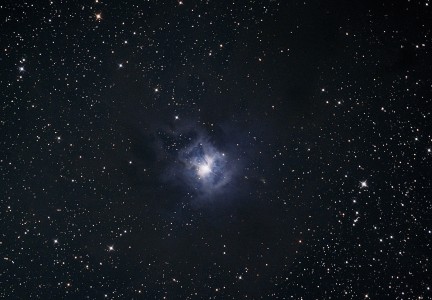
Image of the day

Captured by
Erwin Forbragd

Iris Nebula

My Account

New to Astromart?

Register an account...

Need Help?

Bigger reflector VS smaller MAK - Planetary Views

Started by Ron777, 07/19/2004 04:07PM
Posted 07/19/2004 04:07PM Opening Post
Anyone ever compared, either side by side or just from past experience, the difference in detail and sharpness between a 5-6 inch MAK and a 8-12 inch reflector?
I know optical quality is a huge factor, but just wondering with the average samples out there, how they compare.

What I'm wondering is this. I know more aperture = better resolution and personally my 10 dob has shown me the most on planets, BUT, thinking in arc seconds, are we really using a large scopes resolution or is it merely the added brightness causing small dim features to show up that might be there in the smaller scope but go unnoticed?
(example, anyone ever calculated the size in arc seconds of a certain loop or festoon on Jupiter to know just what theoretical aperture would be needed to detect it?)

How much CAN you see in a GOOD 5-6 inch MAK?

Just curious!
Thanks!
Ron
Posted 07/19/2004 08:44PM #1
The rule of thumb that I remember was that a good MAK will hold up well against a refractor that is 80% of it's diameter. (probably some formula like aperture minus central obstruction) So the 5" MAK will perform like your 4" refractor. My experience is that neither of those will get close to my (or your) 10" reflector.

As for the "more light" issue, I think there really is a lot to that. The one thing I recall from a view of Jupiter through a 30" scope was the color. I don't think the resolution was all that much better than my 10", but the image had LOTS of color - just like some photographs. That made it much more interesting to look at, and I'm sure I could have gotten lots more detail because of the more light. Would have been fun to do a side by side.

Charlie

Fort Lewis Observatory: (37.238, -108.052) ~2360m (7744 ft.) elevation.
Darkness - typically 6.5+
Scope - Meade 16" LX200; f6.3 focal reducer
Focus - JMI Smart focus
Camera - SBIG ST-10XE; (~.5"/pixel)
Guiding - AO-8 and/or Meade 5"/DSI/PHD
http://www.fortlewis.edu/observatory
Posted 07/19/2004 10:10PM #2
Ron,

I used to own a 7" F/10 Intes-Micro Mak-Cass. I now own a 10" f4.8 dob in its place as my main planetary instrument.

The short story is that the 10" dob completely beat the 7" Mak on planetary targets, especially Saturn. At over twice the brightness, it is the most significant factor, in my experience. Contrast is better but not as much improvement as the brightness. Subtle hues are so much more noticeable in the dob than the MC. Quality, aperture rules.

I don't want to start a flame war, but I really expected more out of my Mak, judging from the generally positive reviews they garner. I don't have the Mak anymore.

Simon
Posted 07/19/2004 11:46PM #3
A Newtonian of the exact same aperture as a mak CAN perform as-well-as or better-than the mak provided it is collimated, tube currents are not a problem, and the planet is kept in the coma-free field of view (which may not be the case with a dob).

There is a weird mystique about Maks and Mak Newts that leads to an expectation that they can outperform larger Newtonian. The main advantages to the Mak are the lack of diffraction spikes, larger, flatter, coma-free field and possibly a sealed tube which may have an advantage in terms of tube currents once the scope is cooled. The non-optical advantage is that the tube is much shorter than the same-aperture newt.

I think when people look through a Mak and see those clean planetary disks without diffraction spikes, it creates a first impression that slants their overall opinion of the scope even if a newt shoes more detail in the disk.

That being said, the only comparison I have done side-by-side was with my 8" F6 Newt and a 4" Mak which isn't such a good comparison because of the aperture difference -- also, the Newt had better optics. What was sort of interesting was that the Mak was more sensitive to the seeing even though the aperture was smaller. I later found an explanation of this on the Internet somewhere -- due to the large central obstruction in the Mak more light is placed in the first ring of the diffraction pattern -- the seeing can cause the first ring to merge with the airy disk.

The 8" F6 and it can give planetary views that will knock your socks off and have spoiled me from using anything smaller. I also am so satisfied with the planetary views at this aperture that I don't really feel the need for anything larger.

-- Ian
Posted 07/21/2004 08:41AM #4
Well, the summit craterlet on Mons Gruithuisen Gamma is usually obvious in my 10" f/5 Teleport, and it was always invisible in my old MK-66 DX. Also, I don't recall seeing the two side-by-side craterlets in Plato as bowls in the MK-66 DX, whereas they appear that way under suitable illumination in both my 10" f/5 and 7" f/6.7 Newts. With Jupiter's type of detail, the contest sometimes seemed closer, however.
--
Mike
