What I have done is use a cheap 8-bit camera for
recording, and then use software to obtain the needed format.
I use a ToUcam ($90). If you stack say 1000 raw frames in
Registax, the 8 bit limitation of the raw images is
effectively overcome by the averaging process. Registax
outputs in 16 bit FITS, although some final tweaking of the
image format is still needed. Essentially Registax is
treating the de-focused star image as a planet, and it
is happy to register and stack the frames, and output
16 bit FITS in each color.
You do need to make sure the images have a linear
brightness scale. This is critical. For example by
setting "gamma = 0" in K3CCD while recording the images.
And no image "enhancements" should be applied in
Registax; you just want the raw stacked image. You
can pick the color channel; I usually just use green.
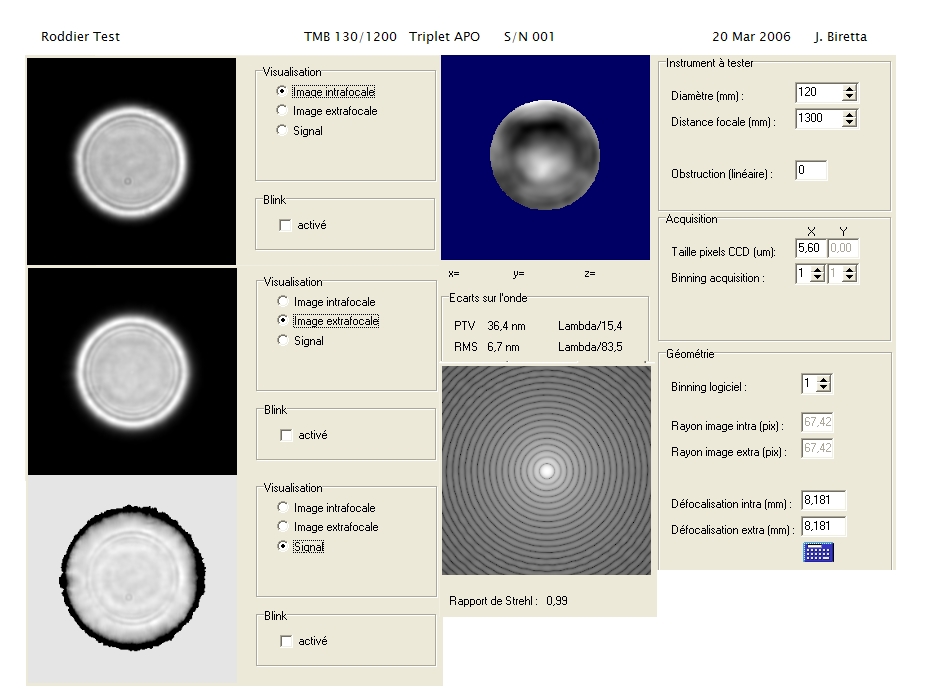
I'll attach an example. Here the two defocused star
images are at the top right. The wavefront map is in
the top middle. The bottom middle image is the programs
estimation of what the in-focus star test would appear
like (log scale). The result agrees well with interferometric
tests both in terms of Strehl ratio and general shape
of the wavefront map.
I do not think Roddier is numerically as accurate as
interferometery, but it may be better in other respects.
For example, with Roddier you can test with the scope
in its "as used" environment -- pointing upwards and
at observing temperature. Also there is no auto-collimation
flat mirror or extra optics that might introduce some
extra errors unrelated to the telescope.
Attached Image: