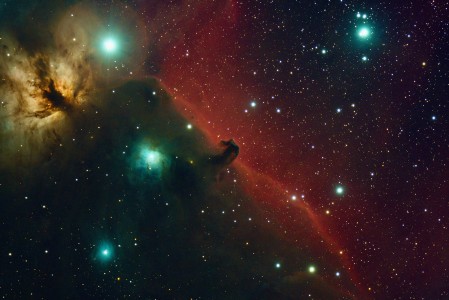
Image of the day

Captured by
Erwin Forbragd

Horsehead Nebula

My Account

New to Astromart?

Register an account...

Need Help?

Colliminating a Newtonian

Started by colhbh, 06/13/2003 01:45PM
Posted 06/13/2003 01:45PM Opening Post
I am the owner of a refractor and I am looking at Newtonians in a search for aperture. One of the topics that come up again and again is the issue of collimation.

1) How often does one need to colliminate a Newtonian?
2) How long does the process take?
3) How well do these scopes hold collimination? or what are the "triggers" that make you want to colliminate it?

Please answer with specific numbers. For example, rather than answer "not often" to question 1, answer "every 2 or 3 times I take it out".

Thank you and clear skies!
Posted 06/13/2003 02:00PM #1
I check collimation every time I take either of my newts (dobs) out. If you opt for a truss tube dob, you will have to collimate every single time you set up. It is the nature of the beast, since you are disassmbling the entire scope, i.e. taking off the upper cage which contains the secondary, possibly removing the primary for transport, etc. I have managed to set my truss dob up to find that it was pretty well collimated without doing anything to it maybe twice out of hundreds of times that I have set up.

With a solid tube dob, it really depends on the scope. I have owned solid tube dobs that maintained collimation for what seemed like forever, though I still checked it every time I set up, as it is always possible for the secondary to turn, the primary to shift, etc. The 8" tube dob that I have now seems to need collimation a bit more often, probably 3 out of 4 times that I have set it up, but I have only owned it for about a month.

As to how long it takes, if you have never collimated a newtonian before, it may take you a few times until you get it down, but once you do it becomes second nature. I can collimate my truss dob in less than two minutes now, including a final autocollimation check. I use a combination of sight tube, Cheshire and autocollimator, but I also use a laser on many occasions as I tend to set up after dark a lot. Always testing with a star test at the end of collimation. It is not nearly as hard as some make it out to be though.

While searching for you Newt, check out these collimation sites:
http://zebu.uoregon.edu/~mbartels/kolli/kolli.html
http://www.efn.org/~mbartels/tm/collimat.html
http://w1.411.telia.com/~u41105032/myths/myths.htm

Just to keep you busy!

Doug
Midway, FL
Posted 06/13/2003 02:11PM #2
Cam,

Boy, maybe this thread will turn into another "which is better, an SCT or Newtonian or APO" or maybe the hallowed "how seeing effects collimation in larger reflectors more than smaller ones".

Here is what I do:

1. How often do you NEED to check collimation: Once a night before you start observing. Unless you have pulled one of the triggers mentioned later. THen check it again, or not.

2. How long does it take? Takes me < 1 minute. Took me 2 days the first time. As you get better, it gets quicker. I use the barlowed laser method to align the primary and that is very quick and extremely accurate. Always check collimation with a star test (nice round, concentric diffraction rings) because this is the only real way to tell if you are collimated. I have never had to make a tweak after using the barlowed laser collimation.

3. How well do they hold collimation? My XT10 holds very well. The secondary never needs tweaking (but I tweak it anyway. I fix alot of things that aren't broken) and the primary will need 1/16 turn after a long car ride. Triggers are bumping, moving the telescope or you just feel like it (that's just me. I'll sometimes check collimation in the middle of a tracking run on Jupiter just to make sure I'm getting the best I possibly can. Not normal, but makes me feel good).

That's it. Easy peasy. Once you figure it out and it clicks in your brain housing group what exactly it is you are trying to accomplish, newtonian collimation is very simple and quick. Certainly nothing to be intimidated by.

Clear skies,

TOm
Posted 06/13/2003 02:15PM #3
1) depends on focal ratio and how stiff the mirror mount is. Faster scopes are more sensitive to collimation errors. If you've got an f/4.5 dob with the mirror resting in a loose sling (like the old coulters) you need to collimate every time. I once had a 14.5" f/4.5 dob with a good mirror cell that I only had to collimate once every 4-5 uses. I currently have a 10" f/8 dob that only needs collimation about once every 10-12 uses.

2) Once you've done it a few times, about a minute.

3) Whether you 'check' your collimation or not, the need to re-collimate will make itself known through the out-of-focus star images while you're focusing -- central obstruction shadow will be off-center in the blur circle if you're out of collimation.
Posted 06/13/2003 10:33PM #4
My dad and I built a 10" f6 dob in 1982. I used it numerous times in washington state, including driving up onto Mount Raineer on icy roads, and to a desert mountain top in eastern washington over very bumpy washboard roads. I finally moved it over to Idaho in 2002 and began using it. My dad and I 'collimated it' if you can call it that, at some point when we finished building it in 82. It worked great the whole time. I rebuilt the scope in 2002 and again I just eye-balled it into place when I remounted the optics. Just a couple of weeks ago my buddy helped me collimate it with his laser collimator, but honestly I can't tell a difference in the image after the fact. If you're doing visual observations only, my experience has been it really hasn't been that big a deal or that important. But my mirror cell is solid aluminium and very stable. And I get very nice views. Even though I've had this telescope a long time I've only begun to get back into astronomy after a long hiatus and so you'll have to take my opions and comments with that expereince level in mind.

so from my limited experience:
1. every few years or so
2. by eye, about an hour, usually less; with my buddies laser unit, about 5 minutes
3. Mine holds for years, I recollimate when I take the cell out of the tube and put it back in.
Posted 06/14/2003 08:10PM #5
Just a little extra note here, last night I observed Jupiter again, I collimated the scope, then brought it out to cool, I looked at Jupiter and it was pretty good at 136, then I moved up to 272 and it was all smeared and mushed out. I re-checked the collimation and it was off a tad, I got it spot on, and then looked again at 272 and it was about 300% better. So it's definately true that with a fast F ratio, exact collimation (or as close as possible) really does make a big difference smile

Take care!
Ron S

BTW the new scope was shipped yesterday and I just ordered Suiters book :-)
