
Image of the day

Captured by
Philip Imbrogno

Jupiter

My Account

New to Astromart?

Register an account...

Need Help?

Coulter Odyssey 10.1" modifications

Started by atrumincendia, 01/28/2017 09:23PM
Posted 01/28/2017 09:23PM Opening Post
I have had this Coulter telescope now for a short time, and have used it only 4 times. I have read that the optics are only subpar on these, but I have compared it to my friend's Orion 8" and I feel the Coulter has good optics, as I get clearer views of deep space objects on it then on his, but yes, his has much better views of the planets.

What I want to do is change the eye piece on this! And yes, I have heard it before on other groups about just enjoying this scope and upgrading in the future to a much better scope. That does not help with what I want though. So I would like to hear serious suggestions of a good non expensive way of changing the Focuser? The draw tube on this can be very hard to get just right, and I really want to use this scope more often once the snow melts here in Utah, and we can get a clear sky.

So if anyone has some good suggestions on this, I would love to hear from you. Also any other recommendations on upgrades that would make this scope last for a good long while before making a decision on spending a lot of money for a newer scope. I am just beginning, and I know it will take me a while to decide on whether or not to buy something else.

For a good reference, I am late to the amateur astronomy party, I am in my early 30's
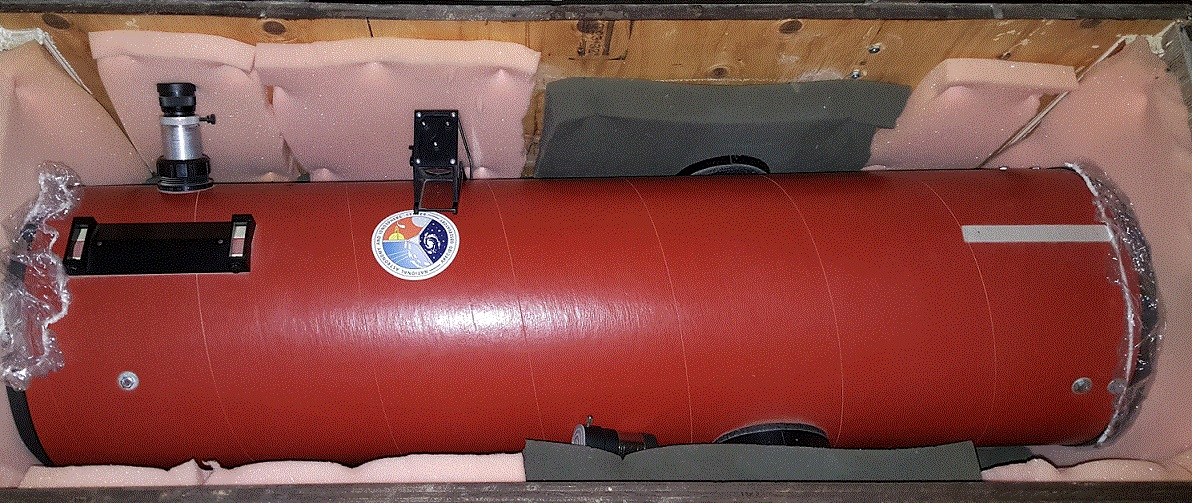
Attached Image:

atrumincendia's attachment for post 60749
Posted 01/30/2017 04:38AM | Edited 01/30/2017 04:53AM #1
Hi, I have what started out as a 10" f/4.5 Meade Starfinder from the 1990's. About the only thing left of the original scope today is the tube and mirror mounts, but the original mirror (now re-figured) beat the planetary views of a perfect-optics 8" f/7 Cave Astrola side-by-side on more than one night despite suffering from astigmatism originally (so my mirror was not great, either). The greater Aperture trumped the better yet smaller Cave, so you can get more out of your scope with the mirror it has. A Barlow or Tele-negative lens (different words for the same thing) should be used with a good eyepiece if the best planetary or lunar high-power views are desired, because using a Barlow with a fast focal-ratio Newtonian-design mirror like yours and mine flattens the field and narrows the light cone, similar to a Cassegrain design (which are fabled as planetary-purposed scopes). Since a Barlow doubles (or triples) the magnification of any eyepiece used alone, a useful medium-power eyepiece can then also provide higher power when used with the Barlow. Accurate focus at the fast focal-ratio or your or my scope is critical with no real lee-way outside of that, so a good focuser is vital for glimpsing fine planetary or lunar detail, and such ability also improves deep-sky views especially when higher power is used on objects like globular clusters or planetary nebulae. I use a vintage Sky-micro 2" helical/rack & pinion which allows coarse and fine adjustments. Any modern unit that provides for fine adjustment will do what you want; an ordinary rack & pinion focuser can prove frustrating attempting to fine-adjust such unit via their relatively coarse gearing. A helical or rotating thread focuser allows such fine movement and so helical 2" to 1.25" adapters used with a coarse 2" focuser are also excellent for your need. You will want a 2" barrel 32mm focal length eyepiece for the widest-field views of the stars & Milky Way fields and perhaps a 20mm or 16mm wide-field eyepiece for Deep-Sky too plus a 12mm or 10mm and a Barlow for higher power planetary and lunar scrutiny. If your local Seeing conditions permit greater magnification, then condider shorter focal length eyepieces. My own local Seeing rarely allows greater than 200X or so on the planets or Moon regardless of whether a 6" f/8, 8" f/7 or 10" f/4.5 s used. Changing the focuser involves drilling mounting holes for the new focuser and maybe enlarging the focuser hole in the tube to accommodate the new focuser; easy to do with the cardboard tube you (and I) have (BTW, that cardboard tube does not introduce air currents due to it's insulating ability, so is better than you might imagine). Also measure focuser height to ensure the new unit will reach focus; if necessary to accommodate a new focuser, the easiest method is to re-position the mirror up (or down)the tube to move the focal plane if necessary. Just drill new holes for the mirror mount in the appropriate place. Used focusers from the classifieds are the least cost.