Image of the day

Captured by
Erwin Forbragd

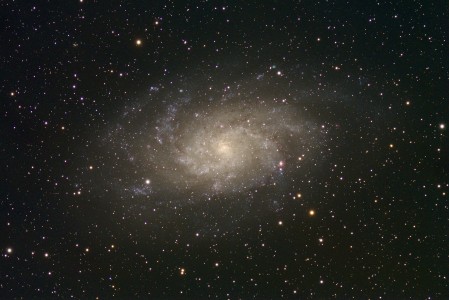
M33 in Triangulum

My Account

New to Astromart?

Register an account...

Need Help?

How much light is twice as much?

Started by splathrop, 03/28/2003 03:01PM
Posted 03/28/2003 03:01PM Opening Post
An accoustical engineer friend has told me that to get a perceived doubling of loudness, mechanically measured sound energy has to be multiplied by 10.

Anybody know if light perception works the same way? If so, then mathmatically it takes a 12.5-inch aperture to double the perceived brightness of a 4-inch. Does this square with experience?

Please note, I'm not asking about photons, I'm asking about perception. Obviously, it's subjective.

Steve

Posted 03/28/2003 06:02PM #1
hi,

i believe a 1st mag star is perceived twice a bright as a 2ed mag star and if so a 6" scope will just about double the percieved brightness of a 4" scope.

Larry Citro
Posted 03/28/2003 07:34PM #2
For me, this discussion will be more directly applicable to the questions I'm trying to answer if we express answers in terms of aperture, not magnitudes, and maybe more in terms of direct experience at the eyepiece, which is the standard I hope to apply, instead of in terms of mathematics.

Thanks

Steve
Posted 03/28/2003 08:13PM #3
In acoustics a just noticeable difference is double (or at least double the wattage).

For me, a 30% increase in area of primary, is clearly noticeable. That is about the difference between a 70 mm Ranger and an 80 mm Vixen. From 5 inces to 8 inches is a clear, well, an order of magnitude (probably a little over that).
Posted 03/29/2003 12:58AM #4
I don't think we ever answered your question ... how about this:
"For the human eye, the response to light obeys a power law, not a logarithmic one as was once thought. As a result, perceived stellar brightness is proportional to the 0.4 power of actual brightness. Thus an actual brightness increase of one-hundredfold is only perceived as an increase of 6.3 times, and an increase of a thousandfold is only perceived as an increase of 15.8 times." from http://www.geocities.com/michaelcapobianco/PhotometryStarlight.htm - a very interesting article btw re. the capabilities of the eye..

So "twice as bright" will require about six times the light, or 2.5 times the aperture. Instead of 4", you need 10".

But - does it matter? The fact is that the eye is very sensitive to relative changes in brightness, so that it takes a heck of a lot less to make a visible difference!