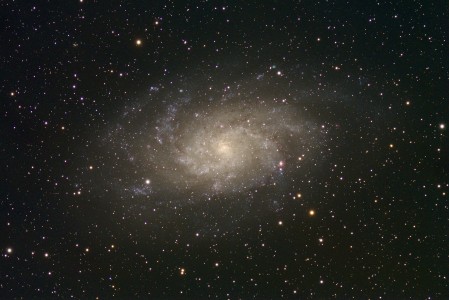

I want to know more about the use of radial guiders in the digital imaging era. First some background on my setup.
I have a few questions regarding my current prime focus astrophotography setup. I have a Celestron Nexstar 9.25 GPS, and a Canon Digital Rebel. My current configuration attaches is with a Celestron radial (off axis) guider attaching to the rear cell, followed by a barrel connector(a rather long one at that), a t-ring, and the camera body. Attempts made at maneuvering the camera by spinning the camera body to frame different frames are difficult because of the placements of the flash portion of the camera, and the eyepiece portion of the radial guider. With a little planning before I threaded the t-ring it wasnt a huge problem, but out of convenience I got a barrel connector. In this current setup with the radial guider at the rear cell, followed by the barrel connector, and the Digital Rebel it did present a clearance issue for me with the base of the scope. It was not that limiting because the scope is mounted on an equatorial wedge, and the part of the sky limited is not usually optimal.
The more I have started to practice, the more I am coming to the conclusion that I dont need the radial guider for my application. I guide my scope with DSLR Focus. I drift align the scope during alignment before my I start imaging with an illuminated eyepiece. Could I simplify my setup with just a straight t-adapter, t-ring, camera config? Am I loosing any real functionality by eliminating it since I dont do any film photography, and since I guide with my laptop? Thanks for the advise.
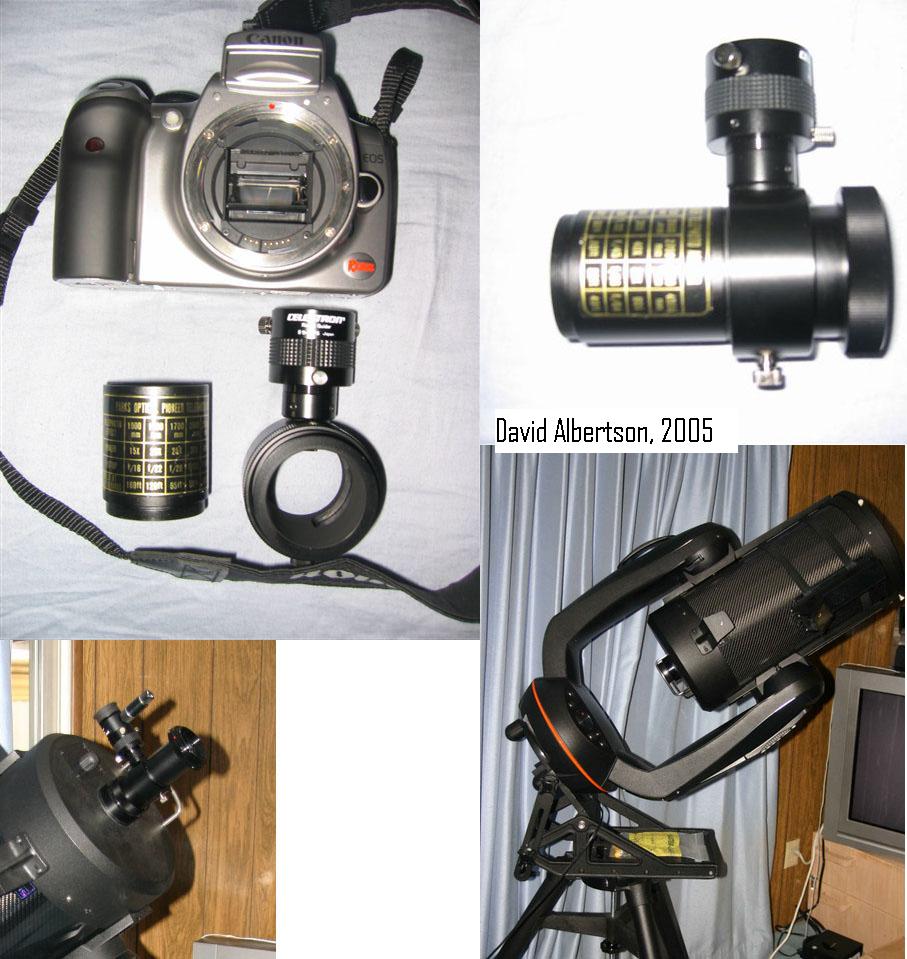
I have a few questions regarding my current prime focus astrophotography setup. I have a Celestron Nexstar 9.25 GPS, and a Canon Digital Rebel. My current configuration attaches is with a Celestron radial (off axis) guider attaching to the rear cell, followed by a barrel connector(a rather long one at that), a t-ring, and the camera body. Attempts made at maneuvering the camera by spinning the camera body to frame different frames are difficult because of the placements of the flash portion of the camera, and the eyepiece portion of the radial guider. With a little planning before I threaded the t-ring it wasnt a huge problem, but out of convenience I got a barrel connector. In this current setup with the radial guider at the rear cell, followed by the barrel connector, and the Digital Rebel it did present a clearance issue for me with the base of the scope. It was not that limiting because the scope is mounted on an equatorial wedge, and the part of the sky limited is not usually optimal.
The more I have started to practice, the more I am coming to the conclusion that I dont need the radial guider for my application. I guide my scope with DSLR Focus. I drift align the scope during alignment before my I start imaging with an illuminated eyepiece. Could I simplify my setup with just a straight t-adapter, t-ring, camera config? Am I loosing any real functionality by eliminating it since I dont do any film photography, and since I guide with my laptop? Thanks for the advise.
Attached Image:
David Albertson
