

In the 9 years I've lived in MA, I'd never been to Rietta Flea Market in Hubbardston. We headed over Sunday morning with the kids and had fun perusing the junk. I came across a pile of old cameras that sparked my interest.
There was a milk crate filled with discarded vintage cameras. I dug around without anything really looking too interesting. Then I noticed a lens on the guys table among rusty tools and other debris. Half of its case was missing and it was real dirty and looked like it had seen better days. When I took a closer look I noticed it was a reflector.
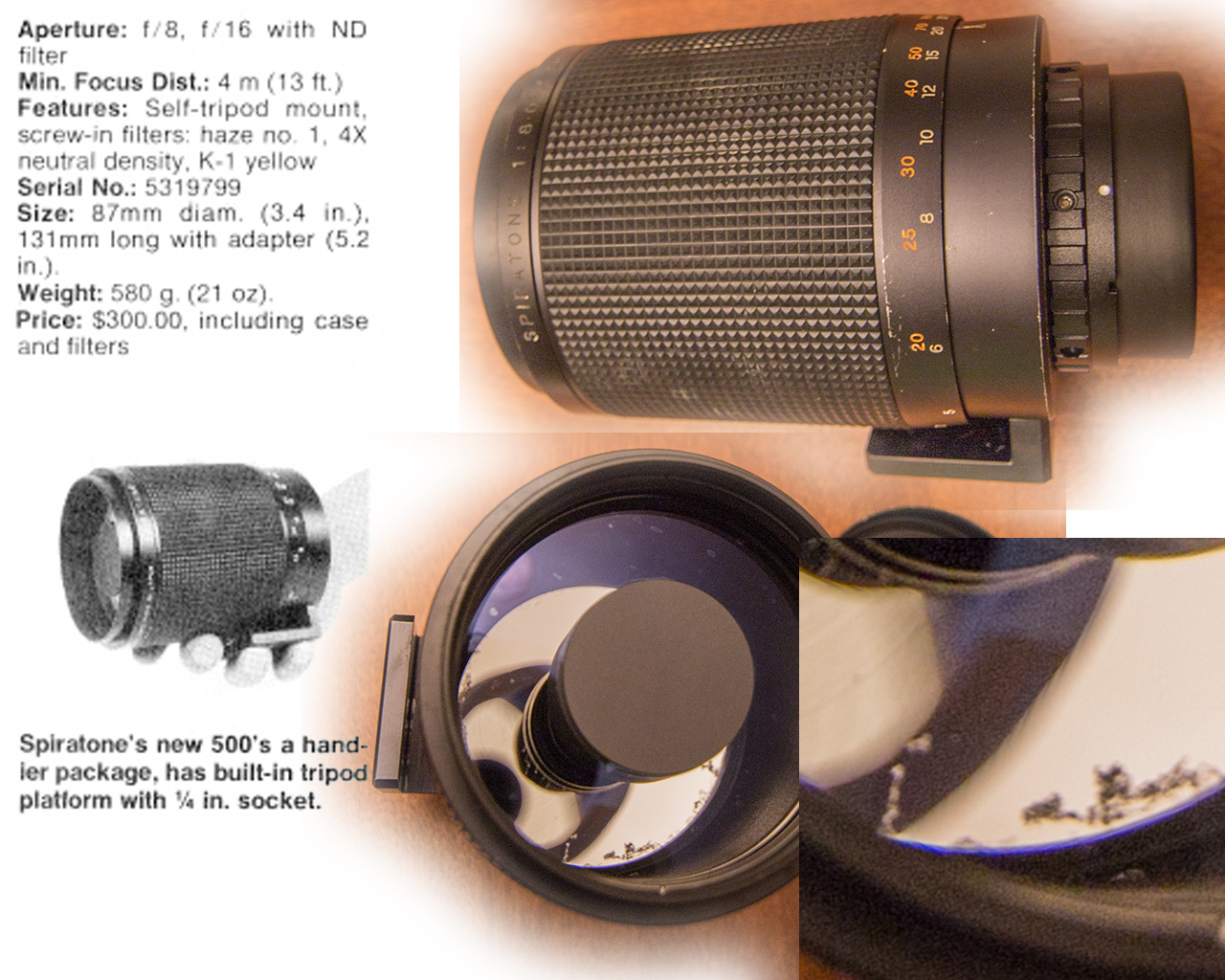
The primary mirror coating has been etched away by fungus (see photo) here and there due to neglect. Anyways, thinking of some conversations with our local mirror making guru I figured I'd pick it up and maybe it he could tell me how to fix it up.
I talked the seller down to $3.00. When I got home I managed to hook it up to my Canon EOS 6D by rigging my Baader Planetarium T-adapter. It actually takes nice photos! I took it mostly apart and cleaned the corrector plate. The corrector plate and secondary mirror are mint (there was a hard lens cap in place). The primary is the only thing that seems in rough shape. Is there any merit in re-coating the primary as a learning experience?
I read somewhere that coatings can get eaten away by fungus. I don't know if it's etched the primary glass too.
The lens is a compact Spiratone 500mm f/8 mirror lens (no. 5319802) made in Japan. It has a T-thread adapter and can focus 15 ft to a fair amount past infinity. Collimation seems perfect. I've actually grown pretty fond of it! :-)
An almost identical model of the lens is described here: http://pubpages.unh.edu/~eme39/MP_Minolta_500f8_mirror.pdf
See the black patterns all around the outer edge of the primary. Any thoughts? I heard cold cream could remove the fungus patterns.
There was a milk crate filled with discarded vintage cameras. I dug around without anything really looking too interesting. Then I noticed a lens on the guys table among rusty tools and other debris. Half of its case was missing and it was real dirty and looked like it had seen better days. When I took a closer look I noticed it was a reflector.
The primary mirror coating has been etched away by fungus (see photo) here and there due to neglect. Anyways, thinking of some conversations with our local mirror making guru I figured I'd pick it up and maybe it he could tell me how to fix it up.
I talked the seller down to $3.00. When I got home I managed to hook it up to my Canon EOS 6D by rigging my Baader Planetarium T-adapter. It actually takes nice photos! I took it mostly apart and cleaned the corrector plate. The corrector plate and secondary mirror are mint (there was a hard lens cap in place). The primary is the only thing that seems in rough shape. Is there any merit in re-coating the primary as a learning experience?
I read somewhere that coatings can get eaten away by fungus. I don't know if it's etched the primary glass too.
The lens is a compact Spiratone 500mm f/8 mirror lens (no. 5319802) made in Japan. It has a T-thread adapter and can focus 15 ft to a fair amount past infinity. Collimation seems perfect. I've actually grown pretty fond of it! :-)
An almost identical model of the lens is described here: http://pubpages.unh.edu/~eme39/MP_Minolta_500f8_mirror.pdf
See the black patterns all around the outer edge of the primary. Any thoughts? I heard cold cream could remove the fungus patterns.
Attached Image:
~ Charlie Stevenson
8" f/5.7 String Telescope - 1st Scope Build; 2nd Place Stellafane 2016 Optical Award for Newtonians 12.5" and Smaller
10" f/4.5 Newtonian (June 2015) mirror refigured by Optic Wave Labs P-V WaveFront 1/14.24, Strehl Ratio 0.993 (Aug '15)
Criterion RV-6 seems to be circa 1973 (June 2015) [For Sale]
Celestron C8-A XLT (January 2015) [For Sale]
Celestron PowerSeeker 70AZ (Christmas 2014)
Aldrich Astronomical Society member since 2015
http://astro.charleskelleystevenson.com/

