Image of the day

Captured by
Lawrence Parchman

Eastern Veil Nebula

My Account

New to Astromart?

Register an account...

Need Help?

The truth about a central obstruction

Started by jeyjey, 03/22/2007 11:40PM
Posted 03/22/2007 11:40PM Opening Post
I'm trying to determine the best way to upgrade my 16" Meade SCT OTA. I'm currently visual only -- if and when I get into imaging I would be amenable to purchasing a different scope for that, so let's assume the use will be 95% visual. Let's also assume 80% deep sky and 20% planetary (my seeing is usually Pickering 4 - 7, and very rarely 8 or 9).

I have an observatory and a mount (AP1200GTO), and I'm happy with sitting in a rolling pneumatic chair. So it has to be a Cassegrain of some type.

I've boiled it down to two choices: a 16" f/8.4 RC (optics likely by Star Instruments), or a 16" f/14 classical Cassegrain (Tak C-400). I already find the field of my 16" f/10 SCT somewhat limiting, so I'd probably use the classical Cassegrain with a focal reducer (yeilding f/10.4).

The RC would still have a considerably shorter focal length, which is enticing. But the classical Cassegrain has a smaller central obstruction (29% vs 40%). The RC optics makers have suggested to me that the CO size will not be an issue for my intended application, even visually. I've heard others say the CO size is very important. So where's the truth?

Thanks for any insight you can provide,
-- Jeff.
Posted 03/23/2007 04:49AM | Edited 03/23/2007 04:51AM #1
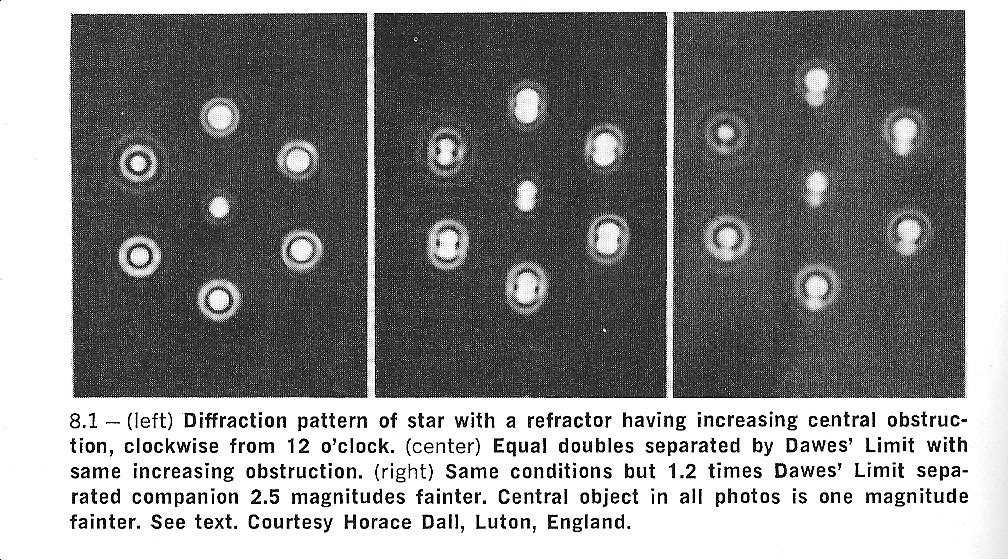
According to the text, "Telescopes for Skygazing": increasing the central obstruction above a tenth of the diameter (only 1% of the area) in a reflector noticeably changes the perfect stellar diffraction pattern, and image contrast of extended areas is reduced with startling rapidity with increased obstruction. A 1 1/2" diameter diagonal used with a six-inch mirror (1/4 the aperture) obstructs only 6% of the incoming light, yet there is considerable loss of image contrast. In the attached figure we see (left) the effect of increasing the central obstruction going from zero obstruction at the 12 o'clock position clockwise through 1/6, 1/4, 1/3, 1/2 up to 5/8 of the aperture obstructed at the 10 o'clock position. The central pattern is also from an unobstructed aperture, but from a star one magnitude fainter. If we refer to the light distribution pattern, more and more light is going to the outer defraction rings as the obstruction gets larger, thus reducing surface contrast of any object viewed. Also note that as obstruction increases the central disc actually gets smaller; this being the reason obstructed apertures can under favorable conditions separate closer stars, yet can fail on faint surface detail differences, as the second photo of the figure illustrates with equal magnitude double stars at Dawes' limit separation. Double having low-intensity companions falling on an enhanced diffraction ring may be missed entirely, as illustrated in the third photograph with unequal double stars at 1.2 times Dawes' limit separation--companion 2.5 magnitudes fainter.

Attached Image:

Rod Kaufman's attachment for post 112622
Posted 03/23/2007 05:03AM #2
Apperture rules. The "upgrade" will not be worth the trouble, especially if your observing is 80% deep sky, of the type that hardly requires Dawes' limit from a 16-inch scope. As for resolution, some of the best planetary images taken from earth are through scopes just like yours. Check the ALPO sites. Hooray for wanting better views, who doesn't, and for having money, but another 16" some-kind-of-Cassegrain is not likely to get you there.
Ron
Posted 03/23/2007 08:55AM #3
Hello:

From a certain point of view, they're both right. The central obstruction is important to get the highest constrast planetary images for diffraction limited scopes. However, for deep sky observing, the size of the central obstruction really doesn't matter since you're not interested in the details of the PSF. A 16" scope is VERY RARELY diffraction limited, which is the only time you can see the PSF structure. When the scope is seeing limited, which is most of the time, the telescope's PSF (and thus the central obstruction) are generally irrelevant. Frankly, the issue of central obstruction is over rated. Some of the best planetary images ever taken were done with HST, which has a central obstruction of about 33%. I have resolved a 0.4" binary with my classical cassegrain, which has a 32% central obstruction. In short, don't worry too much about the central obstruction.

Cheers
Mike Connelley
Posted 03/23/2007 01:33PM #4
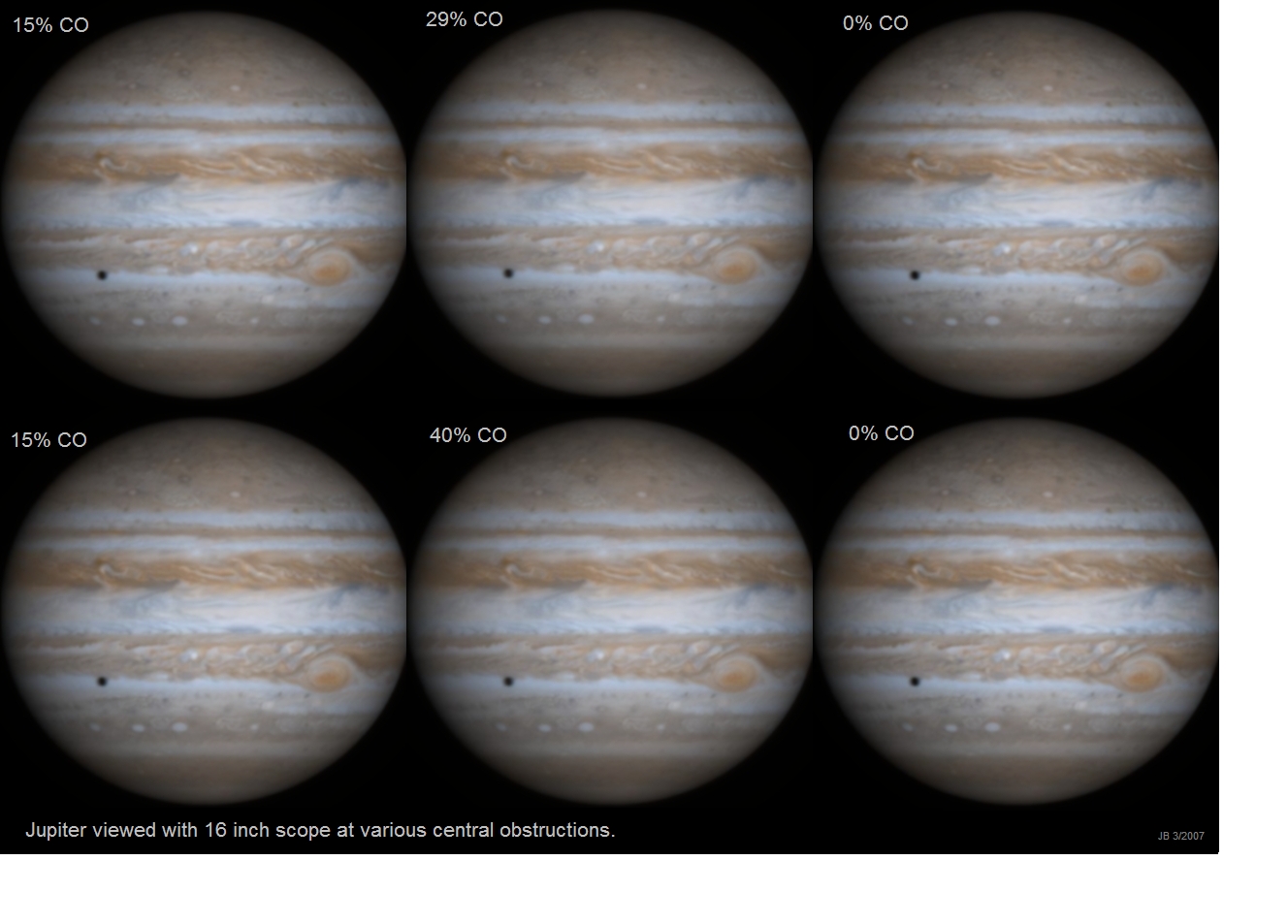
Here's a comparison of Jupiter views in 16 inch
scopes with various central obstructions (CO). I would
say the difference between 29% and 40% CO is
subtle but real. The finest details get slightly
more mushy as the CO increases.


Attached Image:

m87's attachment for post 112631
Posted 03/23/2007 04:47PM #5
The reason why 16" SCT is somewhat limiting is not the co size but the overall optical quality, you will be lucky to find a Meade 16" SCT that is as good as a 1/2 wave in figure.
RC's with over 40% co. are optimized for imaging, they are not intended for visual applications.
Tak 400 will be your best bet among your choices, although not perfect for all visual, they are clearly better in optical quality than the Meade and have smaller co than the RC.

Vahe
Posted 03/23/2007 06:20PM #6
Jeff Young said:

I'm trying to determine the best way to upgrade my 16" Meade SCT OTA. ..... Let's also assume 80% deep sky and 20% planetary.. .[/B]

-- Jeff.

Jeff,

Let me add a little practical experience: I regularly observe with an Obsession 20 (15% obstruction - Torus primary), OGS 20RC (35% - Star Instruments), C-14, and an A-P 6" F/12 APO -- all within feet of each other. On deep sky there is NO difference in what the Newt and RC show. On planets the Obsession 20 kills the others.

You really need to consider many issues here: like percent of illumination across the field, the coma-free performance of the RC, the light loss of the SCT's corrector plate, etc.

My advise would be to fix what ever is wrong with the SCT, but otherwise, for visual deep sky observing (while sitting) I'd advise a Classical Cass with premium optics and a secondary large enough give decent illumination across the field. It also should be a good planetary scope.

George N
Posted 03/23/2007 06:46PM #7
Scott --

Yes, that's my observatory under construction. There's a few threads on it starting here:

http://www.astromart.com/forums/viewpost.asp?forum_post_id=355146

Cheers,
-- Jeff.
Posted 03/25/2007 01:52AM | Edited 03/25/2007 02:32AM #8
It depends on your type of target and the mags you will be running. H.R. Suiter's book has charts that proves that at high mags, approximately 2X the diameter in mm and upward to diffraction limits, a centrally obstructed scope will exceed the contrast of the best refractors. In low mag deep sky viewing, the obstructed scope will suffer by comparison. I have found this to be true in my own experiences with both my high quality LOMO Maks, a 34% obstructed 6" Mak-Cass and a 40% obstructed 4" Mak-Newt. I use the 4" Mak-Newt at 2X+ aperture mags (over 200X) on lunar viewing, and the contrast is incredible, easily better than my 80mm Stellarvue refractor. At low mags in deep sky use, the reverse is true. This is exactly what the charts in H.R. Suiter's book says it should be. At high mags on bright extended objects, a high quality Mak will NOT suffer in comparison to a refractor AFTER IT COOLS DOWN. At 6" or less aperture, the cooling of a Mak is no problem whatsoever and has almost nothing to do with the big hunk of glass in the front corrector.

Mak-Cass scopes usually suffer a bit from SKY FLOODING at very low mags, and this sometimes causes a lot of blame to be shifted to the central obstruction for contrast loss. Jack up the mag, cool your scope, use the right kind of EP, and the contrast will return.

Buy a Baader Neodymium Moon & Skyglow filter for any Mak scope you get. It sucks up much less light than a UHC filter and allows good nebular viewing with a 6" Mak while giving a very noticeable contrast boost. It doubles as an excellent lunar/planetary filter and can be left in almost all the time for astro use. I use mine as a dust blocking filter at the front of my Mak diagonal or on the nosepiece of my Baader click-lock EP holder on my 8" Schmidt-Newtonian. It performs like a 12" Newtonian with a UHC filter for brightness.

Maks with 1/8 wave or better optics should NOT be confused with SCT's with 1/4 wave optics. CO aside, the SCT's just aren't going to cut the mustard no matter what you do, especially at HIGH MAGS where the Maks get a contrast boost relative to refractors. My Maks will easily exceed mags of 3X aperture before becoming diffraction limited. Try that with your average SCT. My Maks have never needed recollimation. The F/2 mirrors of SCT's need frequent collimation. Obstructed scopes need to be run pretty well flat out as far as mags go in order to achieve their theoretical contrast boost over a refractor, and that rules them out as the best high contrast widefield scope. Any quality achromat, even cheap ones, can make a better richfield scope. A high quality Mak of the right aperture will make a lunar scope like you never saw before. Large SCT's cannot run the high mags needed to get better contrast because they first become seeing limited before getting into the mag range where contrast gain takes over relative to a refractor. So....no matter how good their optics, and they are usually quite poor, they lose contrast relative to a big refractor.

So centrally obstructed scopes are 1) Better, 2) Worse, or 3) About equal, depending on how you use the scope and the type and quality of the scope. For visual use, I would stick with an MCT or MNT over an R-C or classic Cassegrain. The scopes you are interested in are too big to run high enough mags to get into a range where they give a contrast boost relative to a refractor. Since you are mostly deep sky oriented, the biggest Mak-Newt you could afford should do you more good than an R-C or classic Cassegrain. That's because the very low central obstruction is not objectionable at low mags and will cause very little contrast loss. Dust on optics also causes contrast loss, for another vote for the sealed tube scope. I think Mark Rieck is now selling the type of scopes you should be considering if you want an obstructed scope for deep sky that is an upgrade over your SCT. It will probably be a Russian scope or a TEC with Russian glass that would do you the most good. Certainly it will cost no more than a Tak Cassegrain.