Dan Ritts said:
Back when I made my dob in around '93, guided mostly by the book by Tom Clark of Tectron Telescopes, one paradigm of good truss OTA design was 8 LARGE diameter poles in the typical criss cross arrangement in order to reduce flex to a negligible amount, helping ensure good collimation at both zenith and horizon. The angled trusses force the stress into tube tension/compression, with aluminum tube being extremely resistant to either deflection. But now I see designs such as the well-reviewed Teleport and similar parallel-pole mass-produced models which seem to ignore this tenet of engineering. The Teleport in particular interests me since not only are there only four parallel poles, but they even have tripod style fittings allowing the tubes to collapse. So is the value of 8 angled pole rigidity overstated? Any insight into this change in style would be appreciated. If I could find a good source of tripod style telescoping tubing fittings I would like to rebuild my dob and take advantage of this sort of design.
Thanks,
Dan
Dan: I am not a big expert on this but here goes...
- A true truss design with all members in either tension or compression, no bending, is ideal but likely to be heavier than a "strut design." One has to pay attention to the tube diameter to make comparisons... Strut scopes need more robust tubing...
- I put together a 16 inch Dobstuff, Dennis uses the Albert Higbe Strut tube. As a mechanical engineer, I knew I wanted stiff poles so I went with 2 inchers. The stiffness of a tube in bending is a function of the 4th power of the diameter so a small increase in diameter, say, 1.75inch upto 2 inch adds about 70% in stiffness. I doubt you will see a 16 inch Truss Dob made with 2 inch tubing, probably 1.25 inch.
- With the 16 inch, I tested the rigidity by placing my Howie Glatter collimator in the focuser and then moved the scope from horizontal to vertical and measured the amount the spot moved on the primary. It was more than I liked, something on the order of 5 or 6 mm. This is within tolerance for the secondary tilt but not for the primary tilt. By trial and error I was able to reduce this down to less than 1mm. There were a variety of sources but one was the bending of the poles.
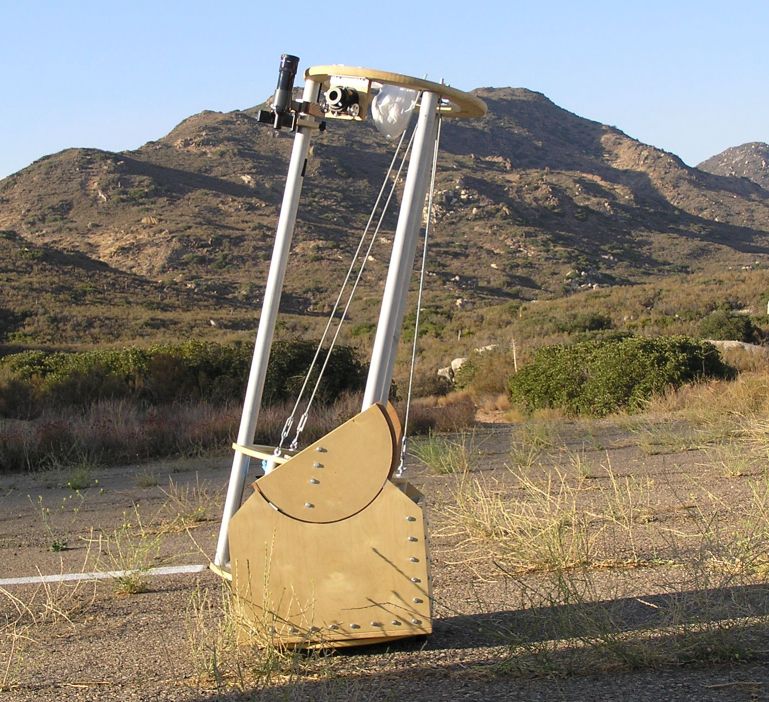
So, in order to reduce the bending, I added some 1/4-20 tensioning rods, these provided triangulation and so the poles are in compression and not in bending. This means this Strut/Pole design is transformed into essentially a truss design.
The bottom line is that there are a variety of designs that are quite reasonable, each has it's advantages and disadvantages. A good design maximizes the advantages minimizes the disadvantages, partly by careful design and partly by understanding the particular application and which design is most applicable.
Jon
(Tensioning Rods)

Attached Image: