Image of the day

Captured by
John Greenlee

Before and after

My Account

New to Astromart?

Register an account...

Need Help?

Unable to see image

Started by BartC, 12/17/2006 08:17PM
Posted 12/17/2006 08:17PM Opening Post
I recently inherited a Holmar Astronomical telescope. I am unable to see images when looking through the main tube. I can see through each lens individually, but not when everything is put back together. I can find objects with the finder scope just fine.

Any suggestions as to what I should be doing?
Attached Image:

BartC's attachment for post 34929
Posted 12/17/2006 08:31PM #1
Bart Condax said:

I recently inherited a Holmar Astronomical telescope. I am unable to see images when looking through the main tube. I can see through each lens individually, but not when everything is put back together. I can find objects with the finder scope just fine.

Any suggestions as to what I should be doing?


This may sound silly Bart but your post isn't 100% clear (no pun intended).
Are you looking through the 'main tube' using an eyepiece or just looking up through the telescope tube?
You indicate, "when everything is put back together". Did you receive the objective as seperate pieces or disassemble it yourself and put it back together?
I'm not that familiar with the Holmar refractors, is the objective a doublet, triplet, or ?? and are there any other lenses in the refractor such as near the front of the drawtube?
Clear Skies, Bill
Posted 12/17/2006 08:57PM | Edited 12/17/2006 09:00PM #2
I have no idea how familiar you are with telescopes, so I'll just assume they are new to you.

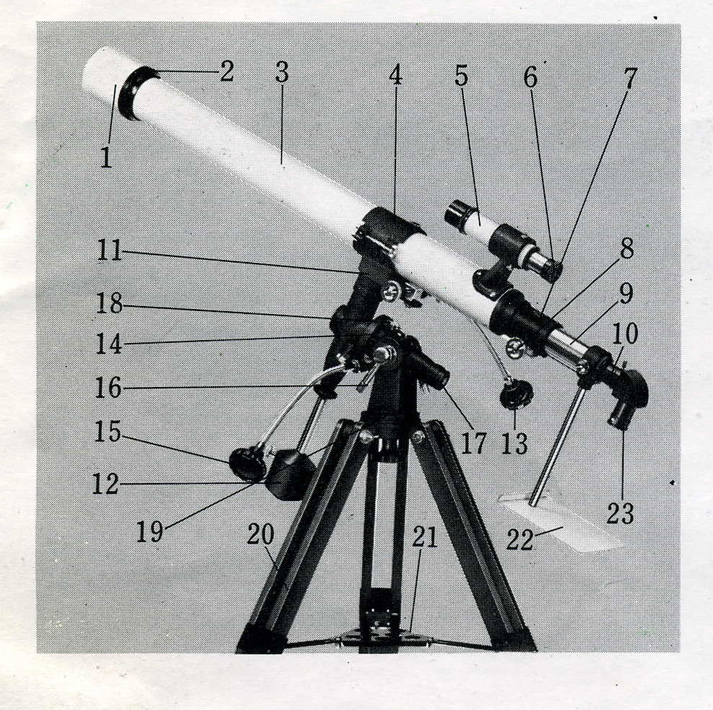
The diagram shows the scope set up for solar projecting - that is, for using the telescope to project the image of the Sun onto the white screen. For visual use, the eyepiece holder (#23) should be angled upward and an eyepiece placed in it. You may have several eyepieces. The one with the highest number on it (possibly 25) should be the one to start with.

The number on the eyepiece is the eyepiece's focal length. Somewhere on the tube of the telescope, perhaps near the focuser, it should have the telescope's focal length. My guess is around 900mm.

The magnification is the telescope focal length divided by the eyepiece focal length. So for my example, 900/25 = 36, so it would be 36 power or a mafnification of 36. Low powers provide the widest view and often appear sharper than higher powers.

As Herbert suggested, try the telescope on a distant object during the day. Some telescopes like this have a draw tube which slides inside the focuser. If that is pushed all the way in you may not be able to move the eyepiece far enough outward to focus on a distant object (or a celestial one). If you remove or don't have the diagonal (#23), you may need to slide the draw tube out even farther.

Good luck!

Clear skies, Alan
Posted 12/17/2006 11:05PM #3
Bart:

Your telescope appears to be a 60mm or 76m long focal length refractor, probably from the 60's. These can be quite fun.

Others have address some issue but let me give it my own angle.

When assembling the telescope, first you should place the diagonal in the focuser tube. Then look at your eyepieces. The longest/biggest one probably has something like K-22 on it. This means it is a 22mm Keller eyepiece. This is the one you should use, the largest number means the lowest magnification which will give the brightest sharpest views.

Place that in the diagonal and then aim it at a distant tree. Then see if you can get it to focus.

One thing to be aware of is that many of these scope hand a sliding focuser draw tube. It is a nicely chromed piece that needed to be pulled out and adjusted so that you can focus the scope. It is really like a course focus.

Jon
Posted 12/18/2006 12:44AM #4
Thanks to all who responded. I appreciate your input.
