Vernonscope $445 2" Diagonal

Started by DarthVader, 08/03/2004 02:02AM
Posted 08/03/2004 02:02AM | Edited 08/03/2004 05:17PM Opening Post
Has anyone else seen this? New product showcase in the August S&T magazine has profiled a new Vernonscope 2" 1/20th wave (or better) VERNONscope Quartz Star Diagonal Mirror. Each diagonal mirror comes with an indivdual Zygo interferometer printout for proof of flatness. This bad boy cost $445 dollars!!! That is going to make the cost of the Maxbright and Everbrite seem like a bargain. Ok...

1. What does this translate to at the EP in a SCT? A excellent refractor? Others?

2. Is the supposed 1/20th wave cost justifiable over say the AP/Maxbright or Everbrite?

Paul Atkinson
Posted 08/03/2004 02:27AM #1
This seems to come up again and again. It is an example of a slick marketeer taking advantage of the general ignorance of geometric optics by the amateur public.

For a star diagonal where the mirror is near to focus, each star occupies a tiny fraction of the overall surface of the mirror. To see how small that area is, place a 4mm eyepiece into the eyepiece end of the diagonal, then look into the other end and ballpark measure the size of the mirror that actually gets used. It will be around .1 to .2 inches. Let's assume that the diagonal is only 1/4 wave across the entire surface. That central .1" will be 1/40 wave flat. And that is a fact. How much flatter do you want this device to be?

Any deviation from flatness in a star diagonal of this type will not change the final figure - it will not add spaherical aberration. Instead it shows up as an increase in astigmatism (stars will be little ovals instead of little round marbles at high power). At what point does this occur and would be visible in the eyepiece? It will begin to show up if the surface of the star diagonal is approximately 1 wave.

Note, this does NOT apply to a Newtonian diagonal, reason being that because of its location far from focus, it really does need to be 1/10 wave or better across the entire surface.

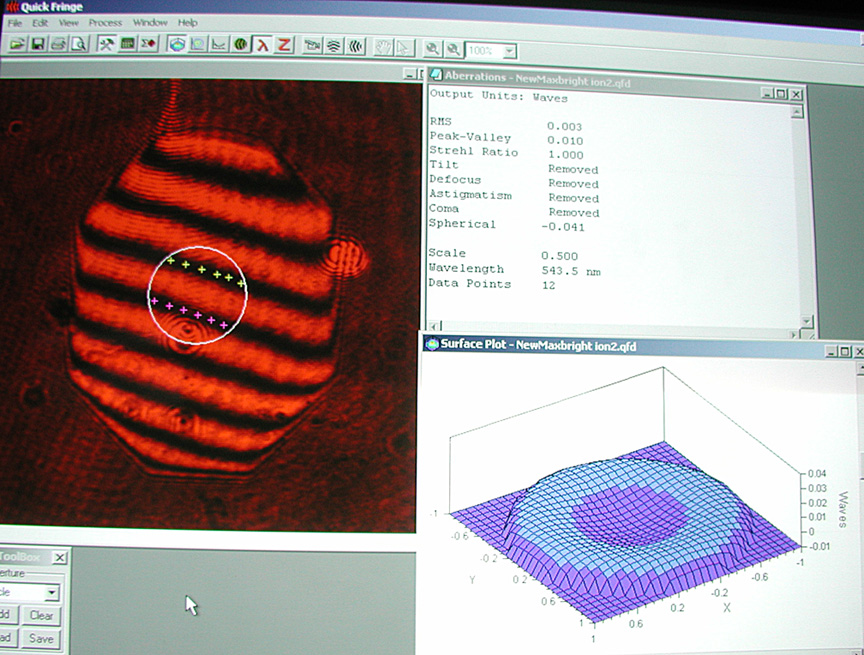
In the attachment the image shows an interferogram of a 2.3" x 3.1" coated quartz flat used in the Maxbright diagonal. The full aperture of a 2" star diagonal is only 1.8" (you cannot have zero wall thickness on the 2" adapter). The actual area used by any given star is shown in the highlighted test area and the actual wavefront numbers can be read on the right.

Roland Christen

Attached Image:

RolandC's attachment for post 81877
