Image of the day

Captured by
Gary Taylor

M27 - Dumbell Nebula

My Account

New to Astromart?

Register an account...

Need Help?

What cooling strategy for a big Mak-Cass?

Started by jeyjey, 04/01/2007 12:10PM
Posted 04/01/2007 12:10PM Opening Post
I'm likely upgrading my SCT to a 16" f/10 Mak-Cass. I've got some questions about cooling such a beast.

It will be observatory mounted. The temp inside my observatory in the evening is typically 2 - 4°C warmer than the outside temp. Not a lot, but enough to see tube currents in my current SCT.

While the Mak has a considerably thicker corrector, my SCT will dew up in an hour or so (even with dew heaters) if I leave the dew shield off. So I think the corrector will probably lose heat to the sky plenty fast enough. I imagine the primary is the main concert. (But if you disagree, please speak up.)

For the primary, do I want to promote a laminar airflow all the way up the tube from the back (the tube is 20-1/2" in dia, and has pierced baffles, so I've plenty of room outside the light path), or would it be better to scrub the front of the mirror (fans from the side), and let the warmer air rise out of the tube on its own?

Thanks for any comments,
-- Jeff.
Posted 04/01/2007 05:35PM #1
"I imagine the primary is the main concert. (But if you disagree, please speak up.)"

I am hoping to do a serious cooling related modification to my TEC250/20 one of these days. I did my studies using a beat up C8 and what I have found is the basis for these mods.

First, I tried to understand what exactly happens when a Cat is exposed to cooler ambient air, we all know what happens when the primary starts to shed its stored heat resulting in a boundary layer at its surface which is considered to be the major source of image degradation, but to me the puzzle is where and how does the primary sense the cooling which triggers its own cooling, after all it sits deep inside the tube and has no contact with the outside world.

Based on my studies the metal tube is where the initial cooling takes place, the metal tube will cool well below the ambient by radiating its heat to the outer space. Once that happens a boundary layer is formed on the inner surface of the tube, this is the cooler and denser air, which will start to flow downward inside the tube by gravity and as it hits the primary surface the primary reacts by releasing its heat.

You have two things happening when your Cat is exposed to the cooler ambient air, inside the tube you have downward flowing cooler air mass formed at the metal tube and the upward flowing warmer air currents started at the primary, these two act as an irregular shaped refracting element in the light path that is constantly changing its shape and screws up the wavefront as it passes through it.

To get an upper hand on the cooling problems of your Maksutov you must take care of both problems and not just the primary mirror.

I will give the details of my modifications when it is done and tested.

Vahe

Posted 04/01/2007 10:42PM #2
Jeff,
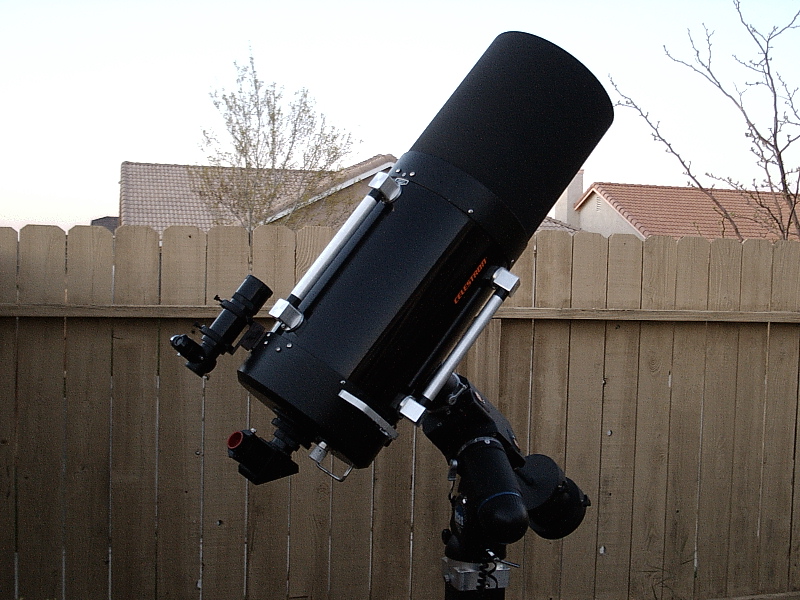
Here is my solution to the "CAT" cooling problem. It's a closed loop cooling system. There is a cooling fan in each "nacelle". There is no need for filters beacuse the inside air is re-circulated to keep it at a consistent temperature which eliminates any and all temperature currents. It makes a huge difference in high performance observing.

The scope in the photo is a C-11. I have performed this mod on a C-9.25 and a C-8. In all, I have never had a problem with temperature currents either from the tube, primary or secondary. Other than collimation and a good set of optics, IMO this is the biggest killer of "CAT" performance. I'm about to perform this surgery on a another C-9 that has a great set of optics. If anyone is interested I can post the progress of this "operation" when I start.

Keith

Attached Image:

klawson's attachment for post 112901

Scopejunkie


40 year old restored C14 with recirculating cooling w/Skywatcher DOB GOTO Conversion (CPC14)

Synscan DOB mounted Sky-Watcher Evostar 150mm/1200mm ED Refractor

"Rescued" Craig's List Orion 120mm/1000mm Refractor


USAF Vet


Posted 04/02/2007 09:58PM #3
So here's a hybrid thought:

6 sets of vent holes in the back, 3 with fans. Vent holes around the corrector, with some way to close them.

Corrector holes open produces a laminar flow up the tube; closed cools the back of the mirror. Not quite scrubbing, but it gives run-time options.

I just can't figure out a neat and tidy way to close the vent holes around the corrector. Perhaps a simple cover ring with a couple of magnets in it?

-- Jeff.
