Image of the day

Captured by
John Roach

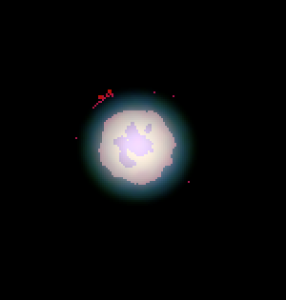
Enhanced Uranus showing Polar Cap and possible Aurora

My Account

New to Astromart?

Register an account...

Need Help?

What is the Problem???

Started by david101, 06/06/2004 04:23AM
Posted 06/06/2004 04:23AM Opening Post
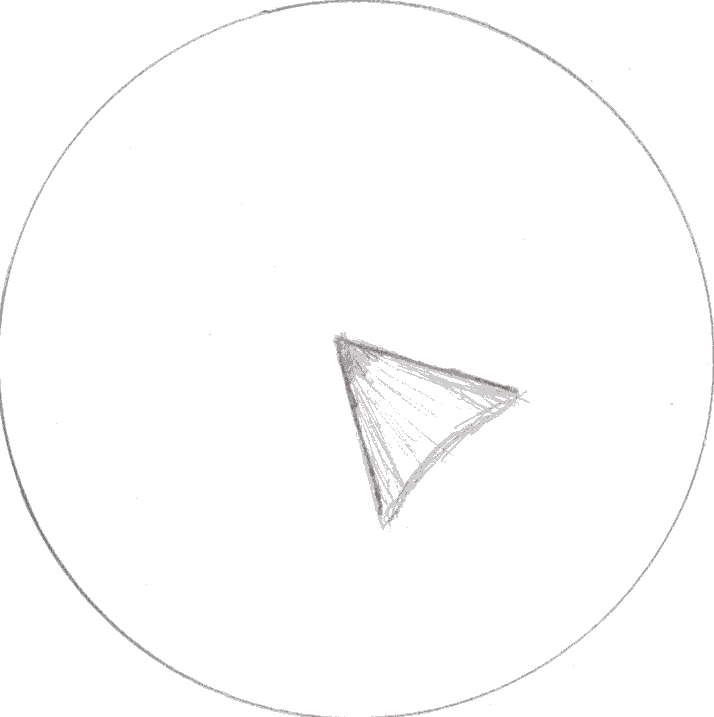
I've attached a quick sketch I made of a slightly defocused star looking through my f4.5 reflector with a Meade 14mm swa ep. A focused star looks like a fuzzy dot, a blob actually. If I use a 2X barlow, I can see the defraction rings and the scope looks pretty well collimated, (the obstruction is pretty much dead center)however the image is jumpy and spikey due to poor seeing.

I reglued the mirror to the cell recently and this is the first attempt to collimate it.

I've been working on my collimation, but may be having a problem with the secondary alignment. I took the secondary off while working with the primary. It all looks pretty well collimated according to my laser and cheshire. Even the star test didn't look to bad. I don't think I can get it so much closer that would make a significant difference. I could be wrong though.

The seeing tonite was not very good, but I don't think I can blame this solely on the seeing. I probably have tube currents also as I don't have fans installed. I believe the scope was cooled down but it may have needed more time. The clouds rolled in pretty quick after I rolled the scope out of the garage to collimate it.

I believe I'm doing something wrong in my collimation attempt. The view has never looked quite this bad. But I've done a pretty good job a collimation before.

What's the problem - poor seeing, misalignment of secondary or primary, poor optics, a combination of things.

If one of the more knowledgable could give me some advice, I'd appreciate it.

Thanks for helping,

David Roberts
Attached Image:

david101's attachment for post 16488
Posted 06/06/2004 05:29AM #1
I'm not a hugely experienced person, but I'm going to suggest two possibilities:

1) Your collimation is off that is making coma worse and you're seeing the coma. At f4.5, you are normally subject to coma which produces an arrow head or comet shaped blur at the edge of the field with the point aimed toward the axis of the primary mirror. So your sketch suggests that coma could be the main problem by the shape of the blur.

You can't get rid of coma, it's a natural effect of a paraboloid mirror. (A Paracorr is a way to get rid of it optically). But bad collimation can make the coma worse, Because the centerline of the primary (where coma is zero) is not lined up with the center of the eyepiece. The fact that you are getting coma (if this really is coma) near the center of the field of view, as in your sketch, suggests that your collimation is off. With good collimation, the coma would be negligle in the center and then gradually increase as you get to the edge of the field of view.

A sight tube would be good to check the secondary alignment with respect to the focuser tube. Tectron tools sells one. The sight tube is about 4-5 inches long with crosshairs. The sight tube plus your cheshire is a good combination.

2) Another possibility is that there are some pinched optics somewhere that gives a triangular shaped blur. If so, that could mean that there is some stress of the primary or secondary mirror. Possibly you introduced some stresses when you reglued your primary. There is a procedure for reglueing to avoid stresses using silicone, by placing some nails between the mirror and the cell and letting the mirror gradually settle on the nails and the silicone blobs. Then you pull out the nails when the silicone is set. Silicone is better than epoxy because it hardens more slowly allowing time for the mirror to settle on the nails stress free.

Turbulence certainly makes things harder to figure out.

Hope this helps.

Mike
Posted 06/06/2004 05:57AM #2
To me, this looks like coma. What is the focal ratio of your scope? I would suggest reading Rick Shaffer's article "Wild Card 001.1
Posted 06/06/2004 12:24PM #3
I'm with Mike above - looks like pinched optics to me. I did some mirror work on a Coulter 13.1" mirror and ended up with the same thing. You say you re-glued your mirror - did you put a nail or something similar in the glue to make sure the mirror wasn't resting directly on the pads? If not, I'd say do it again. Do you have side clamps? If so, loosen them. Good luck!

Pat
Posted 06/06/2004 08:43PM #4
Thanks for all the responses. There were several questions regarding the method of cementation, collimation tools used, etc. I'll try to answer each.

The coma image is in the middle of the ep. The mirror clips are not used. I don't believe the secondary is pinched.

I used GE brand silicon bought at the local hardware store. I started to use spacers made of wood but thought the spacers were to thick (about 1/4 inch) so at the last minute I pulled them out, with no Plan B. The mirror rests on the mirror cell with minimal air space (less than 1/8 inch). I probably used to much silicon as well. It will be difficult to cut through all the silicon. I read here that dental floss works well for sawing through the silicon. Is this the method of choice?

I use a laser to align the secondary, making the laser point hit the donut by adjusting the secondary. Then I use a cheshire to align the primary. It works just like the Mel Bartel's page and some other collimation pages. This is the reason I think I'm pretty dead nuts on for collimation, except for the offset thing which I really don't understand well.

Someone mentioned pinched optics, which is an option since the mirror sits directly on the mirror cell with only an 1/8 or less silicon/air inbetween. The mirror may be touching the screwheads used for collimation.

I'll try collimation one more time when weather permits and if that doesn't work I'll take the mirror off again. Man I don't want to do that but the star image is just unbearable. I have no real ability to split stars.

Any other clues would be appreciated.

Sincerely

David Roberts
Posted 06/07/2004 12:51AM #5
Would you tell us the thickness of your primary mirror and is it pyrex or other glass?

Did you get the same results with a different eyepiece?

Russ Schnitzer
