
I live in a house where a lot of mold grows, particularly in the summer. Lately I've noticed some mold on the primary mirror of my telescope, and inside of my binoculars, on the objectives and prisms. I've tried gently cleaning, using dish soap, water, and denatured alcohol, but wasn't able to get it all off. Does anyone have any recommendations for removing mold from my optical surfaces, or for deterring this sort of thing in the future?
what to do about mold?
Started by vaughn_j, 12/15/2005 06:45AM
Posted 12/15/2005 06:45AM
Opening Post
Posted 12/15/2005 07:19AM
#1

Vaughn.
The mold grows and as it grows it produces acids that eat away at coatings on lenses and mirrors. Once it is on a lens and etches it, the damage is permanent. You must keep your optics in a dry place, even if that requires a de-humidifier or light bulb in an enclosed closet.
What ever is one the optics whould be removed as soon as possible to avoid any more damage.
[SIZE="Large"][/SIZE][COLOR="Blue"][/COLOR] Floyd Blue

Amateur Imager
Posted 12/15/2005 11:24PM
| Edited 12/16/2005 03:05AM
#2
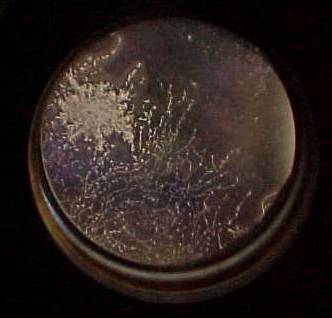
There is actually a fungus which grows on optical surfaces. In large amounts it sometimes has the appearance of "spider-webbing". If it remains long enough, it can eat the coatings and eventually even etch the glass itself.
Flooding your optical-train surfaces periodically with the light of the nearest star will prohibit/inhibit it's formation, as it requires a specific "window" of darkness, temperature and moisture to grow.
It is quite easily killed and removed with a solution of 50% regular ammonia (non-sudsy) and 50% hydrogen peroxide. It is best to also clean the adjacent mounting surfaces where the fungus can linger. If caught soon enough, this will save the surface/s; unfortunately, any damage and/or etching that may have already taken place will remain.
Clean optical surfaces normally after use.
Hope this helps.
Flooding your optical-train surfaces periodically with the light of the nearest star will prohibit/inhibit it's formation, as it requires a specific "window" of darkness, temperature and moisture to grow.
It is quite easily killed and removed with a solution of 50% regular ammonia (non-sudsy) and 50% hydrogen peroxide. It is best to also clean the adjacent mounting surfaces where the fungus can linger. If caught soon enough, this will save the surface/s; unfortunately, any damage and/or etching that may have already taken place will remain.
Clean optical surfaces normally after use.
Hope this helps.
Attached Image:
Posted 12/16/2005 07:55PM
#3
I had to move to europe on short notice and left my 12.5 mead dob in my mothers house. I was gone longer than I thought, 8 years, and returned to find that mold and fungus has covered my primary and secondary mirrors. I am thinking the time as let the mold eat down to the glass. Would it be worth the cost to have the mirrors recoated or should I just buy new mirrors?
Dwight :C
Dwight :C
Posted 12/18/2005 09:22AM
#4
Vaughn Jett said:
...Does anyone have any recommendations for removing mold from my optical surfaces, or for deterring this sort of thing in the future?
I lived in the wet & humid tropical region where the potential mould on optical glass surface is an on-going threat.
For my previous C8 & current C5+, I have to regularly open up the corrector plate & carefully clean off the fungus with lens-cleaning solution & lens paper. It works well so far

For me, the best deterrence is to keep all optical equipment in a electrical-operated dry cabinet with hygrometer control. And I always get binoculars which are water-proofed & nitrogen-filled, this prevents the internal optical glass surfaces from getting mouldy.
Hope this helps...
Funding Member
