
Image of the day

Captured by
Michael Scherman

Dual Clusters near Antares

My Account

New to Astromart?

Register an account...

Need Help?

why does Gaia have rectangular mirrors?

Started by gnowell, 02/02/2008 06:02PM
Posted 02/02/2008 06:02PM Opening Post
Read the S&T article about GAIA satellite mapping project but they didn't give any details about WHY this scope has rectangular mirrors (they did explain why it has two matched scopes with rectangular mirrors).

Anyone know the optical story here?

thanks
Greg N

"Scope will get you through times of no money better than money will get you through times of no scope." --Freewheelin' Franklin
Posted 02/03/2008 02:48AM #1
Clearly, in order to get rectangular pictures.

James Adams
Posted 02/06/2008 02:37PM #2
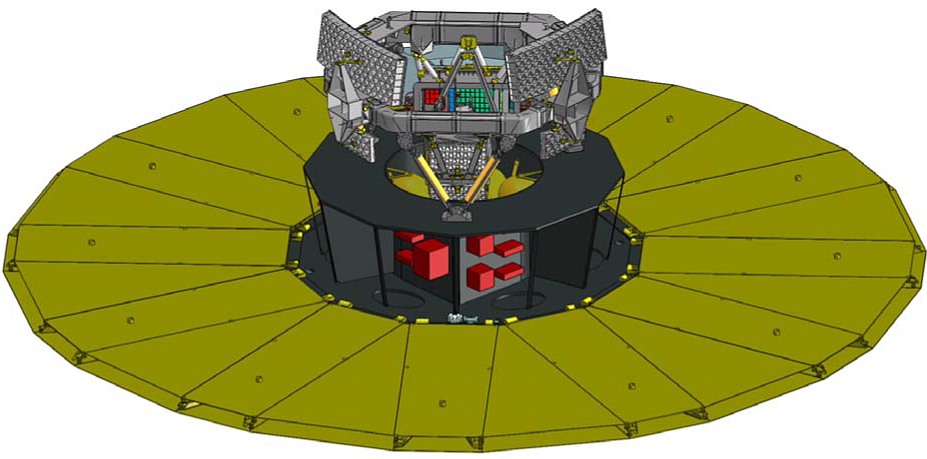
Optimum aperture shape is dictated by many factors, such as image quality requirements, constraints on volume and mass, support structure design, and integration issues. For the Gaia instrument, small star images are only required in one direction, the scan direction, as star positions are only measured along the scan direction. The rectangular primary mirror is long in the scan direction, thus producing diffraction-limited star images that are small in the scan direction. Use of a rectangular primary mirror thus meets image quality requiremenmts while reducing the overall instrument height, which benefits the overall observatory design. The attached drawing shows the anti-Sun side of the Gaia observatory with the instrument thermal covering removed to show the instrument optics. Reducing the height of the instrument allows a reduction in structure mass and in the size and mass of the circular sunshield. The sunshield, which must be deployed after launch, shields the instrument from solar heating, allowing it to passively cool to its -110 C operating temperature.

Chuck Perrygo

Attached Image:

cperrygo's attachment for post 120090
Posted 02/07/2008 05:18AM #3
Could might also be to fit the payload section of the launcher . . . and in another even stranger thread:

I worked a small bit on James Webb and that mission has a 9 section gold surfaced barium primary mirror with each section being on the average 2mm thick. All 9 section are suppoed to a. unfurl and interlock together and b. small motors on the back of each section will stress the individual mirror segments as well as mirror segments aligned to the main spacecraft body to get the whole telescope into the final figure needed (think "adaptive optice with an attitude". . .).

I really, really hope it unfurls and aligns correctly as it being sent to the L2 point about 1 million mile towards the sun where any "rescue mission" would pretty much be out of the question (this ain't a Hubbell in a LEO anymore, Ma!).

Tom Mengel (Moderator Equipment Forum)

Tom Mengel
Moderator Equipment Talk

“Insanity: Trying the same thing over and over and expecting different results”.
Albert Einstein
