Image of the day

Captured by
Jay Messeroff

Lunar & Solar Transits

My Account

New to Astromart?

Register an account...

Need Help?

Burgess/TMB 4mm Planetary -- superb in refractors

Started by m87, 11/02/2006 10:53PM
Posted 11/02/2006 10:53PM | Edited 11/02/2006 10:56PM Opening Post
I just wanted to register an interesting impression
of the BO/TMB 4mm Planetary. In particular, the
performance at the field edge. It is remarkably good in
refractors. I tried it in a TMB 100mm F8 and an Orion
ED80 (80mm F7.5). Both displayed nice Airy disks all the
way to the field stop -- very, very impressive. Even at the
field edge there was no astigmatism and lateral color was
almost non-existent. Swapping with some others --
Nagler 3.5mm T6, Nagler 3-6 Zoom @4mm, Tak LE 5mm,
UO 4mm Ortho, UO 5mm Ortho, and Orion 5.2mm Lanthanum
showed the BO/TMB to have the best edge performance of the
bunch. (From memory I expect it would also be
superior to Radians, where I did not like the edge
performance due to lateral color.) It seems perhaps the
BO/TMB has been optimized for F8-ish refractors. Perhaps
not surprising after all, considering the designer and
manufacturer.

An interesting test would be in the TeleVue NP-101 (F5.4)
but I have not tried it. Can anyone comment?

However, in fast Newts, the situation is quite the opposite.
Field edge performance was fairly dismal. Both F4.4 and F5
Newtonians showed huge coma at the field edge -- much more
coma than from the Newt optics alone. This is rather
consistent with some of Floyd's comments using a Newt. some weeks back
http://www.astromart.com/forums/viewpost.asp?forum_post_id=460761
(But I think the true value of this eyepiece may have been entirely
missed by that review.)

Apparently the eyepiece has significant Newtonian-like
coma at the field edge, which compounds and worsens the
normal fast Newtonian coma. (I could clearly see this by
placing the field edge of the eyepiece at the optical
axis of the F4.4 Newt. using some side-ways shifting
magic.) But in refractors, which tend
to be slower and have opposite-signed coma, the eyepiece
tends to cancel the OTA coma, leading to really superb
performance.

In other respects the performance was also excellent --
contrast, sharpness, field curvature, eye relief, etc.
all very nice. It seems this eyepiece may be a bit of
a "gift" to refractor owners.

I will try to make a more detailed review when I can.
But this was just so remarkable I wanted to give a
quick comment.
Posted 11/02/2006 11:10PM #1
Hi Jon,
I will try that in my 127ED f/9 and see. So far I have not used the BO/TMP in it. I have the whole set, so I will look at it compared to the 9mm Orthos that I have to test. These are all top of the line Orthos, so it will make a good test.
I will also test the 4mm BO against the 4mm Radian and see how they compare.
Very possible that the BO are really optimized for refractors.

[SIZE="Large"][/SIZE][COLOR="Blue"][/COLOR] Floyd Blue grin
Amateur Imager
Posted 11/03/2006 10:40PM #2
John,
Very interesting. Maybe it's something peculiar to the 4mm? I have the 5mm and 7mm and both of these perform excellently to the edge. Actually impressively so in my 10" f/4.7. Stars did not even bloat right to edge - no ca, coma, or astigmatism - but I rarely get that at these short FLs. So I'm getting some different performace than you in my fast newt.
-Bill
Posted 11/03/2006 11:19PM #3
I've used the 4mm BO/TMB Planetary eyepiece in my f/5.4 Tele Vue refractor and have been pleasantly surprised with its performance.

It is my understanding that coma is not a major optical aberration in eyepieces.

Dave Mitsky

Chance favors the prepared mind.

De gustibus non est disputandum.
Posted 11/04/2006 03:56AM #4
Three more showed up today -- the 2.5, 5, 7 are here.
The mystery deepens. Both the 2.5mm and 4mm have
enormous off-axis coma (Newtonian-like coma)
at F/4.4. The 5 and 7mm have virtually none.
Perhaps different they are designs? Or perhaps
there is some problem?

Shining a fiber-optic probe around the bottom
element and looking at the reflection patterns
revealed the first surface is strongly
concave in the 2.5 and 4, but not in the
5 and 7. I thought about the design a little,
and decided that a steeply concave first
surface could make off-axis coma.

The upper lens groups had nearly identical
reflection patterns in all four.

I also took one of my beat-up old Lanthanums,
which perform roughly like the 5 and 7, and
did a little experment. I took the bottom section
off the eyepiece, flipped it over backwards, and
tested again -- and there was now enormous
off-axis coma much like the 2.5 and 4 BO/TMB.

This leads me to wonder if the first element in my
2.5 and 4 might be installed backwards. It seems
that might explain the big off-axis coma in the F/4.4 scope.
I will try to discuss with Thomas and get his comments.
Fortunately, only fast scopes off-axis would be affected.
Posted 11/04/2006 12:31PM | Edited 11/04/2006 12:42PM #5
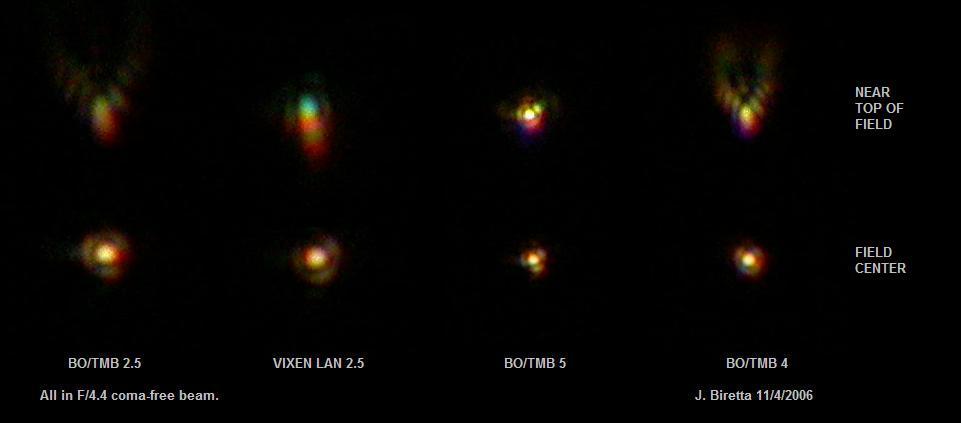
Heres a couple pics off the optical bench to illustrate
what I am seeing. All use an F/4.4 Newtonian on the OTA optical
axis. For the field edge images the eyepiece is moved side ways
in the scope (the telescope is not moved), so there is no
coma from the scope. All use the same artificial star.

The BO/TMB 5mm is remarkable. Almost perfect images at the
field edge -- nice Airy disk and ring. Just a trace of lateral
color -- a bit of red tail pointing to the field center.

The BO/TMB 2.5 and 4 show huge coma near the field edge. Still a
very small lateral color. The difference from the near perfect
5mm to the 4mm is very surprising. It must almost be certain
there is some problem like a reversal of the first lens group,
or some very different design.

For comparison I also show a Vixen Lanthanum 2.5mm. No coma,
but a big lateral color. This is more what I am used to
seeing in eyepieces like this. In this sense the BO/TMB are
remarkable for having low lateral color.

There are also some small artifacts from the camera -- the
field center images are not text-book perfect. So do not
be concerned with every last detail of the images. But the
issues I am trying to illustrate are well represented.

Attached Image:

m87's attachment for post 108772