
I've been looking forwards to new moon weekend so I can test my CLS filter under dark sky conditions but, as fate would have it, I've got to take my annual re-licensing seminar on the same day. IT ALWAYS HAPPENS THAT WAY! >
Still, I salvaged some eyepiece time in front of my home last night(1-25). The clear sky clock was spot-on with a forecast of very good seeing and fair transparency. Seeing was 4/5 and transparency, although reasonable, could have been a notch or two better.
IMO, the number one mistake amateurs make in using filters is that they tend to try them on only one or two objects or with only one or two focal length eyepieces and conclude they do or (as is more often the case) don't work. Big mistake!
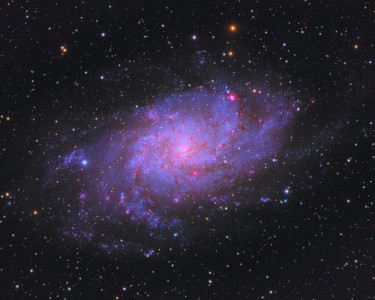
For instance, many galaxies have regions that do emit wavelengths that can appear enhanced by a broadband or a narrow band filter. As an example, a bright, large face-on galaxy which is a member of the M81-M82 local group and is now prominently riding high in the winter sky is NGC 2403. This huge galaxy is in a constellation that nobody seems to know much about but contains many fine galaxies as well as planetary nebula. It's a fine source of galaxies that beckon the arrival of the realm of the galaxies in the spring. The constellation is Camelopardalis. It's currently well-placed for observation. A link to NGC 2403can be found here:
http://www.noao.edu/outreach/aop/observers/n2403.html
My CLS filter allowed a "deep-sky" view of this galaxy and it quickly fills the AFOV of a 14MM ES100 eyepiece. This filter functions as a mild broadband unit with just enough blocking to reduce light pollution under mild to moderate skyglow but preserves most of the desired wavelengths. I'm itching to try it out under dark skies to block the ever-present natural skyglow and I have high hopes of its success.
Whatever filter you try, remember to try it on multiple objects and in multiple focal length eyepieces.
Finally, it's a bit amusing to see some of my ideas and advice appearing in CN forums a few days after I post here. Either a few of the guys happen to think like I do and have similar experiences or they read this forum and post elsewhere...
 )

