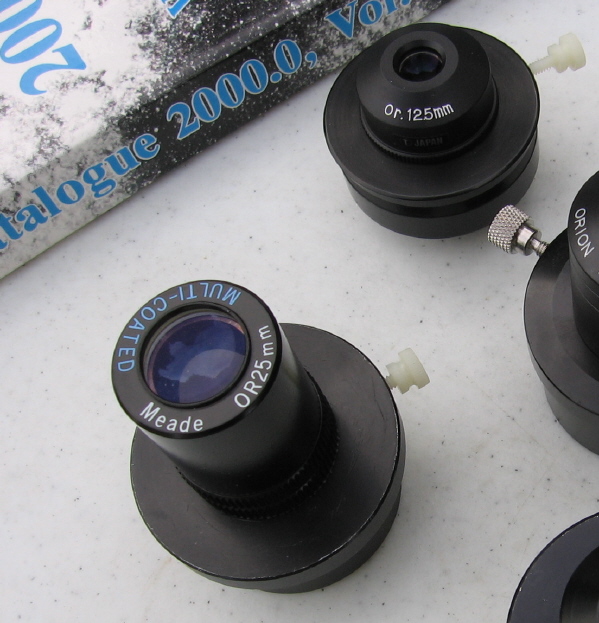

Okay, well, maybe not a cage match, and not in Texas, but a gentlemanly duel between respected Orthoscopics to settle the score on who's sharper, flatter and more contrasty.
Over the last two nights I've been comparing the University Orthoscopics Abbe Orthoscopic (aka the UO "Volcano Tops") line to other respected or even highly respected Orthoscopics.
The UO 25mm, 18mm, 12.5mm and 7mm were matched up against 0.965" Takahashi Orthoscopic contenders in like focal lengths (25mm, 18mm, 12.5mm, 7mm) as well as matching a Zeiss Jena Abbe Orthoscopic of 10mm focal length against the UO 9mm.
Some of the results were surprising to me, and others reassuring. Reassuring in the sense that when one buys Zeiss one is not wasting one's money, but more on that in a bit.
I focused (bad pun) on comparing these oculars with reference to the hallmark virtues of the Orthoscopic design; sharpness, flatness and contrast. Test subjects included open clusters M35, M44, M67 and M37, and the planet Saturn. The test bed was an excellent Orion 100ED refractor on a driven Celestron AS-GT equatorial mount. I chose this set up over other refractor OTAs and equatorial mounts for a couple of reasons. First, I am astounded by how far the Chinese and Taiwanese optics makers have come in the last few years and feel that increasingly their products represent the best deals in astronomy. Second, the advances in such optics are not going unnoticed. There are ever-growing numbers of amateurs purchasing similar scopes from Orion, William Optics, Stellarvue and other designer/importers. Using optics that are more accessible may make an evaluation more relevant and personal to a larger number of hobbyists.
Without further ado, here are the results:
At each focal length (25mm, 18mm, 12.5mm and 7mm) the UO Volcano Tops and Takahashi Orthos were virtually identical in the categories of sharpness, contrast and flatness. I honestly could not detect one iota of difference between them 99.9% of the time. Each eyepiece showed the same number of stars in the open clusters, and on Saturn, the same surface detail, ring system detail and moons. In fact at 18mm in particular the UO was consistently a teensy bit sharper than its Takahashi peer, and displayed a slight amount less scatter on Saturn.
That surprised me. I had read several other reviews comparing the UO, Takahashi, Zeiss and Pentax SMC Orthos, and uniformly those reviews concluded that the UOs were good, but not a match for the Zeiss and Pentax SMCs, and that the Takahashis were equal (or very nearly the equal) of the Zeiss and Pentax SMCs.
But then entered the "Z" factor. The 10mm Zeiss Jena Ortho trounced its 9mm UO opponent in sharpness and contrast. More cluster stars were visible in the Zeiss than in the UO, despite its lower power (90x vs. 100x for the UO), and more ring (Cassini sharper and blacker) and planetary surface detail (2-3 bands consistently versus 1 consistently) was visible in the Zeiss. The Zeiss "homerun" was in the scatter department. Both the Takahashis and UOs showed extended diffuse glow around Saturn; perhaps extending a planet's width in radius around Saturn. The Zeiss showed only the slightest amount of scatter on Saturn; the diffuse glow extending perhaps only a quarter ring's width radius around the planet. Wow. Heck, make that should be WOW!
I plan on repeating this comparison on the moon to validate these results and concentrate a little more on resolving power, but for now I am becoming convinced that the UO Orthos are a GREAT DEAL! I am now looking for a complete set of Pentax SMCs and a set of UO HDs to do an Orthoscopic Battle Royale.