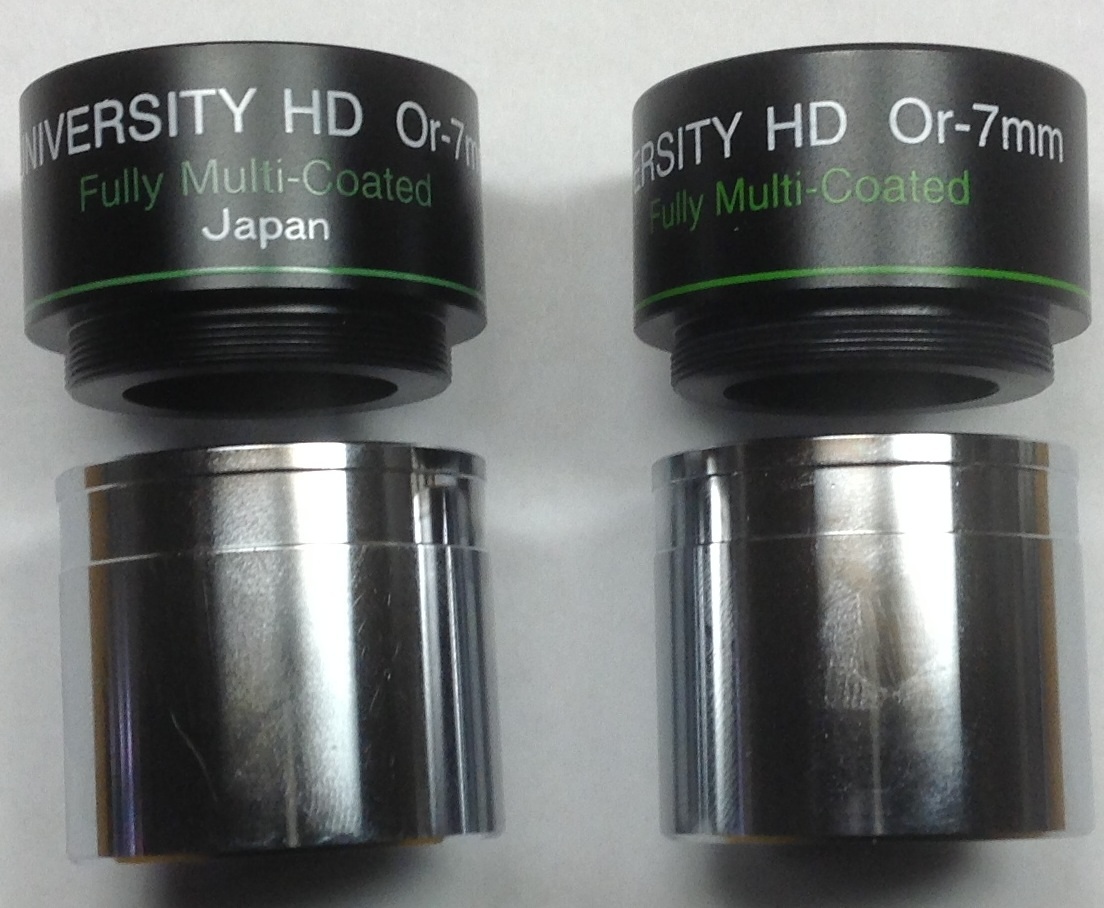

I was testing a recent modification to my Baader Herschel Wedge to allow me to use Denkmeier Binoviewers. I spent a good deal of time testing out a number of different eyepiece pairs to determine which gave the most impressive views. While using pair of 7mm UO Ortho HDs I focused on Sol's limb and then panned over to AR2251 and tweaked focus. In the middle of the field of view was a large bright, circular spot. Close inspection revealed it to be a reflection from one of the two HD Orthos. These eyepieces were acquired from the used market in separate transactions from different sellers, and I am almost certain they are first generation HDs.
When I acquired the second 7mm HD I immediately noticed subtle differences. One of them was marked Japan, and the other not marked with the Country of Origin. The "unmarked" one came with a shorter barrel lacking an undercut which is now a "feature" of second generation HD Orthos. This UO HD Ortho has been in circulation awhile which makes me think it is a first generation. The previous owner may have swapped barrels with another eyepiece or maybe UO used smooth barrels on some early HDs. (For parfocal use in the Binoviewer I swapped it with a 6mm HD so they matched.) The retaining rings securing the lens elements are of a different diameter.
To confirm my suspicions I removed both HD Orthos and inserted my 19mm Pans. I verified the absence of the bright spot. It was gone. I then re-inserted the 7mm Orthos one at a time in the right SCD of the Binoviewer. The unmarked Ortho with the large retaining ring showed no spot. Moving on to the one marked "Japan" with the smaller retainer, there it was again - a bright circular spot in the center of the FOV! Close inspection reveals it to be a specular reflection off the thread locker on the smaller diameter optical retaining ring.
Now the question is: Why are they so very different mechanical designs? Was this a design change due to similar experiences from other users? I suppose I'll have to reach out to UO to see if they can explain....Does anyone here have one of these 7mm HDs that you can compare and comment on?
Regards,
Gary
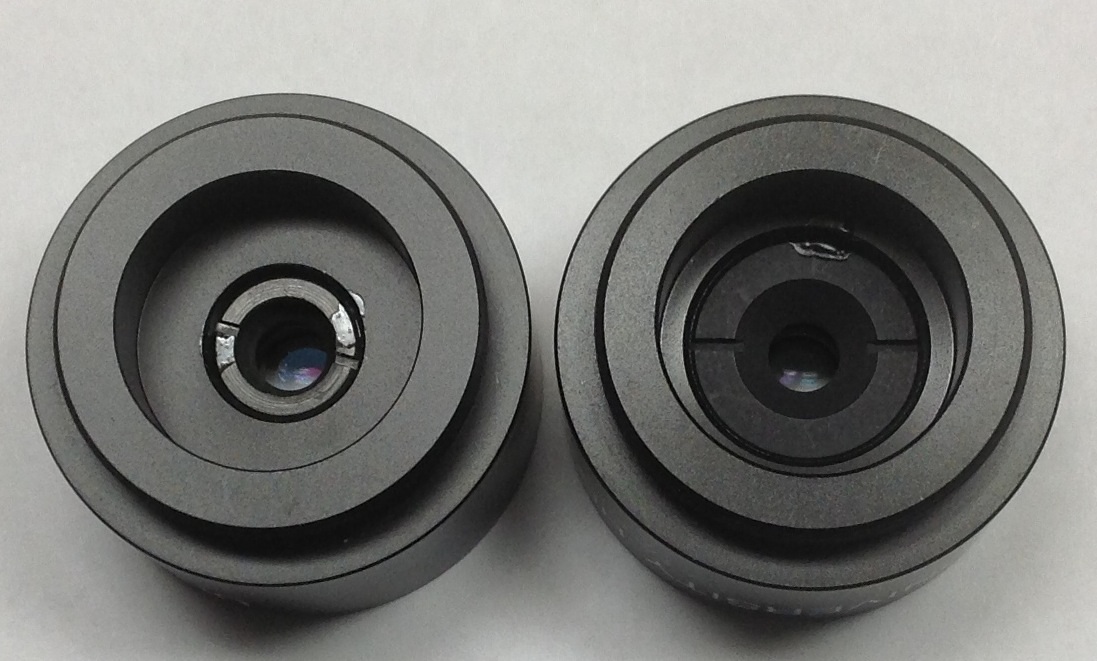
When I acquired the second 7mm HD I immediately noticed subtle differences. One of them was marked Japan, and the other not marked with the Country of Origin. The "unmarked" one came with a shorter barrel lacking an undercut which is now a "feature" of second generation HD Orthos. This UO HD Ortho has been in circulation awhile which makes me think it is a first generation. The previous owner may have swapped barrels with another eyepiece or maybe UO used smooth barrels on some early HDs. (For parfocal use in the Binoviewer I swapped it with a 6mm HD so they matched.) The retaining rings securing the lens elements are of a different diameter.
To confirm my suspicions I removed both HD Orthos and inserted my 19mm Pans. I verified the absence of the bright spot. It was gone. I then re-inserted the 7mm Orthos one at a time in the right SCD of the Binoviewer. The unmarked Ortho with the large retaining ring showed no spot. Moving on to the one marked "Japan" with the smaller retainer, there it was again - a bright circular spot in the center of the FOV! Close inspection reveals it to be a specular reflection off the thread locker on the smaller diameter optical retaining ring.
Now the question is: Why are they so very different mechanical designs? Was this a design change due to similar experiences from other users? I suppose I'll have to reach out to UO to see if they can explain....Does anyone here have one of these 7mm HDs that you can compare and comment on?
Regards,
Gary
Attached Image:
-Gary
There is only one constant in our infinite universe; it is change.
D&G 8” f/15, AP178 f/9, C11, C8, ED80, TV-85, TV101&102, SW120ED, 6"Cave f/8, Solarmax 40, ES127MC,
DM-6, Losmandy Titan 50 GEQ, G11, AP800, ES Twilight-1, UA Unistar Deluxe, WO EZ-Touch,
Denk BVs, 7x50 Fujinons, 10x50 Nikons, 15x70 Astrophysics, 16x70 Fujinons, 22x100 Oberwerks,
Sim Picheloup CPT, Canon 40D, 60Da, Vixen Polarie, SXV-H9, DMK 41AU02, DBK 21AU618,
Shelyak Lhires Lite Spectroscope, Rainbow Optics Spectroscope, Field Tested Systems RSPEC,
Chairman, Southwest Region of the Astronomical League (SWRAL)
President Emeritus, Historian, AL Awards Coordinator, Texas Astronomical Society of Dallas (TAS)
Member/Volunteer, 3RR Comanche Springs Astronomy Campus (CSAC)
ALCOR, Advisor to the Board, Texas Star Party (TSP)
NASA-JPL Solar System Ambassador Volunteer (SSA)