Image of the day

Captured by
Erwin Forbragd

Iris Nebula

My Account

New to Astromart?

Register an account...

Need Help?

Ronchi Test of an unknown mirror

Started by David Simons, 03/16/2009 07:00AM
Posted 03/16/2009 07:00AM Opening Post
Hi Folks,

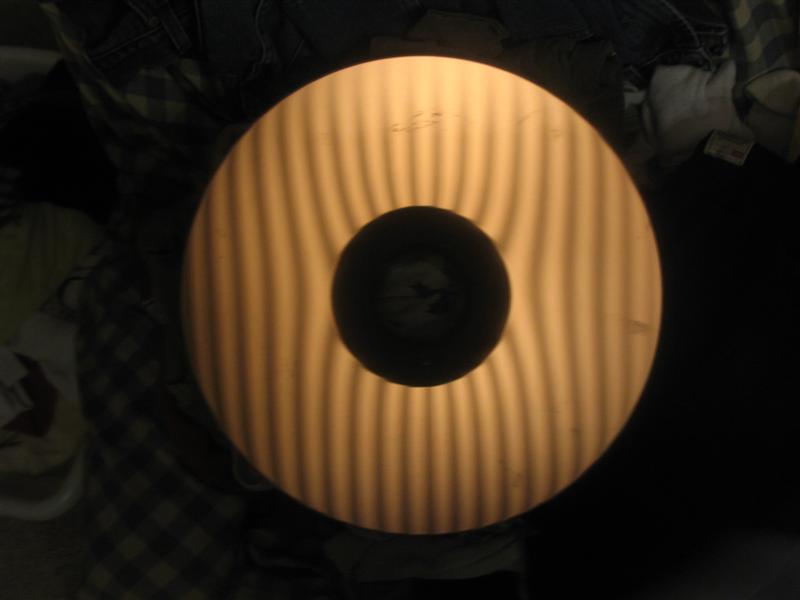
I just received a 16" f1.2 mirror that I think is supposed to be spherical. It has a large central hole with an epoxied on aluminum mounting flange.

I recall a spherical mirror would have straight lines in a Ronchi-gram ?

Any thoughts on what is going on with this mirror ?

Thanks !
Attached Image:

David Simons's attachment for post 46084

David Simons
Posted 03/16/2009 03:51PM #1
You have something other than a sphere.

Rolando
Posted 03/16/2009 11:04PM #2
I'm not a Ronchi expert, but I'll try to interpret the surface based on test's basic principles. Take it for what it's worth.

Widening of Ronchi lines on both sides of the central hole indicates that those
areas focus closer to the test grid than the
outer ~1/3 of the radius. At the same time, the lines above and bellow the central hole are slightly narrowing, indicating that light from those (much smaller) areas focuses farther away than most of the outer mirror area. If so, the surface around central opening is wavy, with fairly symmetrical cross-like pattern.

The error is largest, both in magnitude and the area, on either side of the central hole. With a typical 100 lines per inch Ronchi grating, some 20 intercepted lines would indicate that the illuminated grating area is about 5mm in diameter, which with an f/1.2 16" mirror (pressumably) at the r.o.c. indicates some 12mm focus-to-grating distance for the outer zone. If the line width next to the side of the opening is roughly 50% greater, this portion of the surface to a first approximation belongs to a surface of the sphere (or other conic) focusing about 3mm closer to the grating. Assuming it does belong to such a sphere, a quick calc gives that surface error at its max (at the side of the opening) could be as large as 0.016mm, or 30 waves in units of 550nm wavelength.

The actual error may and may not be close to this value, but it definitely has to be very large to show that clearly on such fast mirror, with that many intercepted lines. It would also vary with grating density, being only half as large with 200 lpi grating and so on.

The good part is that the deformation area is relatively small. If the rest of mirror surface is decent, it could still be useable. It's hard to tell though, with so many intercepted lines. Another shot with no more than 3 or 4 lines would probably give some more information.

Vla
