The following was borrowed from Roger Ceragioli's refractor web site; would anyone care to comment (e.g Roland, etc.)
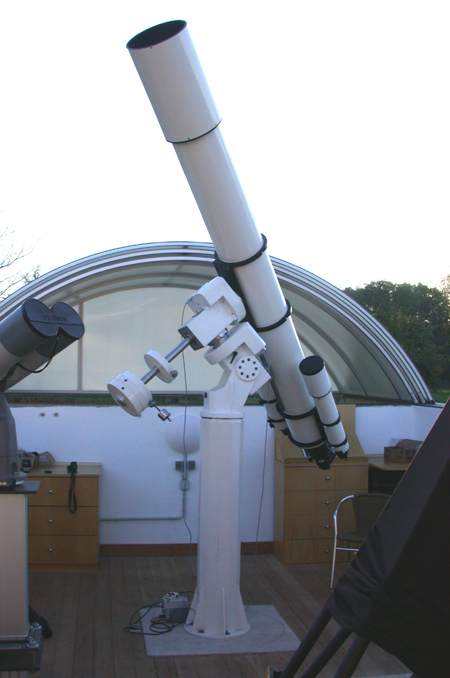
"I have seen one 10" f/9 triplet from a commercial maker and it showed no visible color error. That is not to say, however, that the telescope gave a stellar performance. On the contrary, by introducing airgaps back into apochromatic lenses--which inevitably show strong internal curves--we bring back the old problems of the Zeiss B and Taylor triplets, namely their great sensitivity to temperature and to internal alignment. I was rather aghast to see the severe spherical aberration in the 10" lens, due to the falling temperature that night. Because of the great thickness and mass of the lens, as well as the fluor-crown's very high coefficient of thermal expansion and its insulted position in the middle of the lens, this $40,000US extravagent objective never performed as well that night as a decent 10" Newtonian would. My impression is that the owner found this true on other nights as well and lamented that the lens could not keep up with the falling temperature. Other examples of this type of instrument also show the same problem I am told by my optical acquaintances. So while the smaller lenses of this type in the 160mm range may be fine, it would appear to me that the makers of the larger lenses have overreached the limits of what triplet apos are capable of--at least the air-spaced variety. It is a shame that oiling, the revolutionary technical advance introduced by Wolfgang Busch and Roland Christen almost 30 years ago, has been abandoned. Oiled lenses even of rather large thickness show much more moderate variation of spherical aberration during cool-down in my experience. Perhaps the large air-spaced beasts will work well on tropical islands where the diurnal temperature variation is minimal. But people who live in temperate climates may wish to be careful of large air-spaced ED lenses."
"I have seen one 10" f/9 triplet from a commercial maker and it showed no visible color error. That is not to say, however, that the telescope gave a stellar performance. On the contrary, by introducing airgaps back into apochromatic lenses--which inevitably show strong internal curves--we bring back the old problems of the Zeiss B and Taylor triplets, namely their great sensitivity to temperature and to internal alignment. I was rather aghast to see the severe spherical aberration in the 10" lens, due to the falling temperature that night. Because of the great thickness and mass of the lens, as well as the fluor-crown's very high coefficient of thermal expansion and its insulted position in the middle of the lens, this $40,000US extravagent objective never performed as well that night as a decent 10" Newtonian would. My impression is that the owner found this true on other nights as well and lamented that the lens could not keep up with the falling temperature. Other examples of this type of instrument also show the same problem I am told by my optical acquaintances. So while the smaller lenses of this type in the 160mm range may be fine, it would appear to me that the makers of the larger lenses have overreached the limits of what triplet apos are capable of--at least the air-spaced variety. It is a shame that oiling, the revolutionary technical advance introduced by Wolfgang Busch and Roland Christen almost 30 years ago, has been abandoned. Oiled lenses even of rather large thickness show much more moderate variation of spherical aberration during cool-down in my experience. Perhaps the large air-spaced beasts will work well on tropical islands where the diurnal temperature variation is minimal. But people who live in temperate climates may wish to be careful of large air-spaced ED lenses."