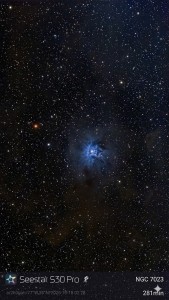
Does the Petzval design of this scope eliminate the blue halo around stars that is typical of an achromat combined with digital SLR?? :S
Vixen NA140 Neo Achromat
Started by globular-man, 03/18/2008 04:38PM
Posted 03/18/2008 04:38PM
Opening Post
Posted 03/18/2008 05:10PM
#1
The blue halo is reduced compared to a achromatic doublet
of the same focal ratio, but the blue halo is still
visible (to visual
observers) on bright objects like Jupiter and 1st mag stars.
The blue will likely be even more apparent in DSLR imaging.
See the review section of the website for the report of
a visual observer, also google 'vxreview' for the report
on the Orion VX-120 (aka Vixen NA120), which is the
120mm version of the NA140. The reviewer there complained
about photographing "bloated stars" on the 120, and the
140 version will be worse. It's not an APO by any means.
The Petzval element does flatten the field so that you get
sharp images across the whole field. Probably a mild minus
violet filter like the Lumicon MV will take care of most of the blue halo.
Posted 03/25/2008 03:32AM
| Edited 03/25/2008 03:33AM
#2
I've always wondered how these NA scopes were designed. My understanding is that they have large main doublet lenses in the front that are actually f/12 to f/15. Then, the smaller rear doublet somehow "reduces" the focal length while retaining the lower false color of the higher focal ratio. Also, the rear doublet flattens the field as well. Going with this, theoretically, one should be able to remove the main doublet and put it in a loooong tube as a traditional long focus doublet?
Posted 03/25/2008 02:33PM
#4
A Petzval is a simple achromat doublet which has been shortened by the addition of a telecompressor element placed half way down the tube. It does not eliminate chromatic aberration (blue and red color error). It does reduce sphero-chromatism which is inherent in short focus doublets, and also can flatten the field. Longitudinal chromatic aberration is still present, same as a normal achromat. It is a way to obtain short focal ratios in a long tube (essentially the opposite of a Cassegrain configuration where you obtain long focal ratios in a short tube - another example of optical magic that is now well understood but was the source of much head scratching in times past).
Rolando
Rolando
Posted 03/31/2008 03:57PM
| Edited 03/31/2008 03:59PM
#5
I have this scope.
It doesn't use any exotic glasses. It's more like an achromat with correcting lens.
False color does exist on stars at 1st mag. or brighter.
But the field is very flat and stars are pinpoint at the edge. To me this is more important since I only intend to use this scope as low power, wide field "DSO" scope.
Want color free Petzval-style scopes? You will have to go Televue.....
Funding Member
