Image of the day

Captured by
Arthur Hogan

Wizard Nebula

My Account

New to Astromart?

Register an account...

Need Help?

Baffling Newts unnecessary?

Started by djscobel, 01/14/2004 07:34PM
Posted 01/14/2004 07:34PM Opening Post
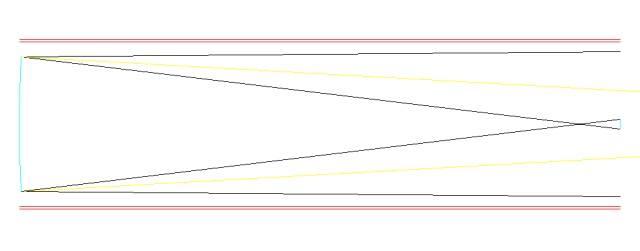
A lot has been written about baffling Newtonian reflectors, but I’m wondering if it is overkill in most cases. The attached picture is a scale CAD drawing I made of my 13.1-inch f/4.5. The tube has an ID of 16”. The blue arc at the left represents the front surface of the primary mirror, radius of curvature 117 inches. The short blue line at the right is the focal disk 58.5 inches from the primary, which I arbitrarily set to 1 inch diameter. The black lines represent light rays that just hit the outer edge of the focal disk. The yellow lines are normals to the mirror’s surface, about which these focal plane edge-grazing rays are reflected.

As you can see from the diagram, there are no light rays that can reflect off the inside of the tube (red lines), strike the primary mirror, and end up in the focal disk. If they do reflect off the inside of the tube, then they’ll miss the focal disk. In other words, no part of the inside of the tube is visible from the focal plane. All such rays would have to reflect twice off the inside of the tube, which is no biggie. Simple flat black paint would be fine – even at 5% reflectance, two reflections would result in only .0025% of the light reaching the focal disk.

Am I looking at this correctly? If I am, then putting annular baffles inside the tube do nothing. But, I think it would be advantageous to add a baffle at the open end of the tube to prevent seeing the sky itself.

FWIW, I did the same analysis of my 8-inch f/8 with 10 inch ID tube with the same results.

Any thoughts?

Doug Scobel

Attached Image:

djscobel's attachment for post 12276
Posted 01/14/2004 09:18PM #1
hi Doug,
The light rays that enter the tube parallel to the optical axis, like the ones in your drawing, aren't the problem. The light rays that come in at various other angles, and bounce all over the place and finally hit the primary and secondary mirrors , and reduce image contrast, is where the problem lies. Baffling will definitely improve the situation, without doubt. If it didn't, then the inside of the tube might just as well have a mirrored (or painted white) surface. As an experiment, you might try lining the inner surface of your ota with sheets of newspaper around and opposite of your focuser (held in temporarily with masking tape) if you still have doubts.
good wishes,
andy z
Posted 01/14/2004 10:39PM #2
Are you sure about 5% reflectance with low-angle specular reflections off a smooth flat black painted surface?

Biggest bang for the buck, though is opposite the focuser. Light reflected off the tube opposite the focuser can have straight shot into the eyepiece, and beyond the tube (if it is too short, as they usually are if the focuser is low-profile) light can come in without even a reflection and get inside the eyepiece. It usually doesn't have a straight shot to the focal plane inside the field stop of the eyepiece, but it can show up outside the exit pupil and cause a glare problem.

As for baffling the rest of the tube, many choose not to, but there is scatter to think of as well. Some of the light striking the tube wall will reflect in specular fashion, but some of it will be scattered. When this happens all over the tube I think the results can add up to something noticeable at the eyepiece, but as I said before, baffling opposite the focuser is priority 1.

BTW, check out the reflection of the tube near the fan in the mirror box from this angle in the photo below. It's painted textured black like the struts everywhere else. Of course this angle isn't relevant in this scope (and the shroud would normally be up), but notice how bright the reflection is off that short section of tubing.
--
Mike

Attached Image:

mhosea's attachment for post 75154
Posted 01/15/2004 04:03PM #3
Mel Bartels writes, in his article on Ultralight Dobs ( http://www.efn.org/~mbartels/tm/ul-dobs.html ):

"Proper baffling ensures that no unwanted light enters the focuser. There is a baffle just below the focuser and a baffle opposite the diagonal. The focuser baffle is particularly important. Both are covered with Edmund Scientific black felt. The primary is also baffled, just in front of the glass, and totally enclosed in ultra flat black. It is an impressive demonstration to shine a powerful flashlight on any part of the scope, and discover that your observing buddy looking through the eyepiece with his eye cupped cannot tell you when you have the light on or off. The goal in baffling a minimalist ultra light is to block every ray of light not coming from the primary mirror. Extra baffling to absorb secondary reflections from the baffles is used in high performance refractors, but this is a luxury we can forego since the flashlight test is quite convincing when using light trapping felt or velvet."

Later, he continues:

"Some traditionalists are upset by the absence of a shroud. With a heated diagonal, and proper baffling, the shroud is superfluous. Some claim that a shroud cuts out stray light. Stray light does not mysteriously diffuse through the air to reach the focal plane. It must reflect off of some surface. Proper baffling will stop all of these reflections. Under bright light situations, if you see glaring then the scope needs to be better baffled. Adding a shroud will be a hit and miss affair, depending if the shroud blocks the unwanted light from the focal plane. Beware of the placebo effect which can cause a shrouded scope to perform 'better' in a bright light situation thanks to more care given at blocking out stray light from the eye at the eyepiece."

Chuck Dethloff added this clarification of a question about Mel's "flashlight" experiment:
http://astro.umsystem.edu/atm/ARCHIVES/JUN98/msg01154.html

I hope this furthers understanding of the points Doug Scobel raised.

Darren
Posted 01/16/2004 02:39AM #4
The scatter effect is the main problem.

The big problem is light from local background pollution. It enters from all angles. It sets up a little symphony in there.

Baffles eat it up.

This is an argument for slightly wider tubes, too. More room for baffles. Same entry diameter with a top baffle, but more chance to get darker later.