My favorite new astronomy program is only $9.99 - Galaxy Explorer. It is by Space.com Software, same people that make Starry Nights.
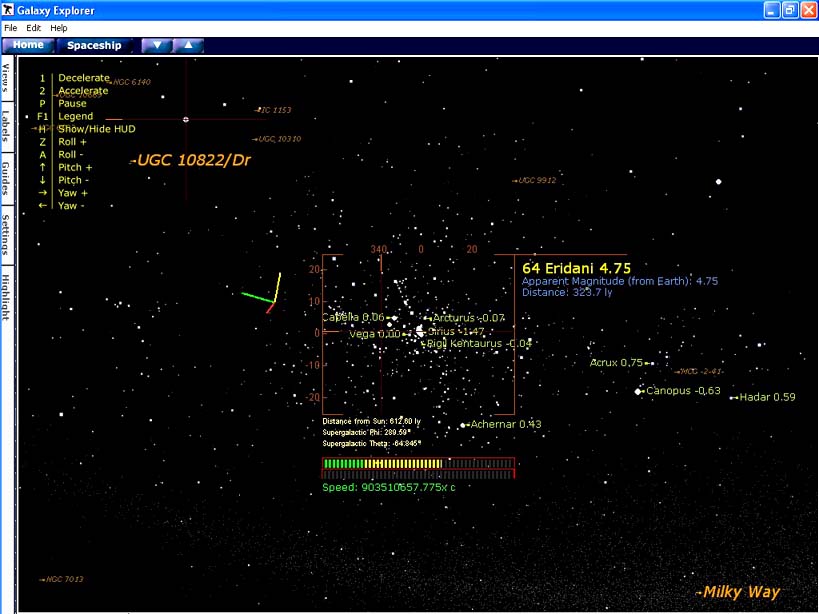
The program maps 28,000 of the nearest galaxies by position, orientation, and type. In spaceship mode, you can fly (in variable multiples x the speed of light) to visit all of them.
Even more amazing is starting at the edge of the mapped universe, or even the known universe, and trying to hunt down the Milky Way, then our own sun, and finally the earth or another planet or moon. Objects are beautifully rendered.
No astro program I've ever used gives such an incredible sense how vast our universe is and how fortunate our tiny patch of planetary surface is. It is absolutely worth the $10 price of admission. My kids use it almost every day, and probably not more than a couple days go by before I hear it calling my name.
From what I can tell, Galaxy Explorer is Space.com's $19.99 Deep Space Explorer, stripped of its multimedia content and Find functions.
http://www.buytelescopes.com/product_list.asp?m=73
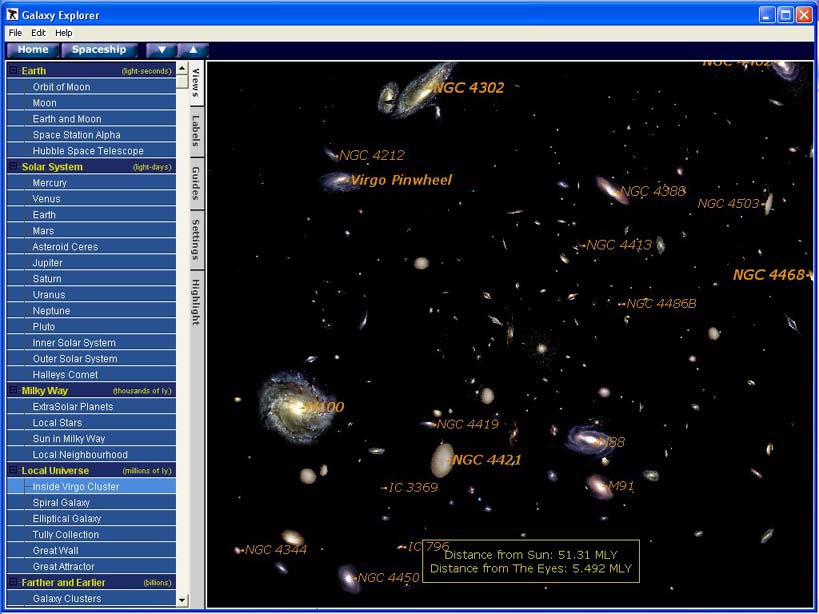
Here are some screenshots for you. First off, the Virgo Cluster in non-spaceship mode. Dragging your mouse around, the cluster pans to show you the various galaxies. If you click "spaceship", you find yourself flying toward one of the galaxies at this zoom level.
The program maps 28,000 of the nearest galaxies by position, orientation, and type. In spaceship mode, you can fly (in variable multiples x the speed of light) to visit all of them.
Even more amazing is starting at the edge of the mapped universe, or even the known universe, and trying to hunt down the Milky Way, then our own sun, and finally the earth or another planet or moon. Objects are beautifully rendered.
No astro program I've ever used gives such an incredible sense how vast our universe is and how fortunate our tiny patch of planetary surface is. It is absolutely worth the $10 price of admission. My kids use it almost every day, and probably not more than a couple days go by before I hear it calling my name.
From what I can tell, Galaxy Explorer is Space.com's $19.99 Deep Space Explorer, stripped of its multimedia content and Find functions.
http://www.buytelescopes.com/product_list.asp?m=73
Here are some screenshots for you. First off, the Virgo Cluster in non-spaceship mode. Dragging your mouse around, the cluster pans to show you the various galaxies. If you click "spaceship", you find yourself flying toward one of the galaxies at this zoom level.
Attached Image: