Greetings to everyone. I just had to unveil the “Humble Space Telescope” to someone who would understand. I have lurked here for a while, enjoying the discussions and stealing a few ideas. I have loved telescopes since childhood, 40-some years ago, and built quite a few. But never one this large, and never one that used modern Dobsonian techniques. Also, I invested in a few nice eyepieces: a 22mm Panoptic and a 30mm 1RPD.
The design is conventional K&B, with design assisted by NEWT and PLOP. The optics (12.5” F5.25) were bought second-hand - more about this later. The rest I built over the last six months. In the process, I learned to weld, and use a milling machine, router, and lathe from indulgent co-workers. Not a bad way to pick up some new skills!
First a few observations:
WOW! This is a whole different experience from what I am used to. The wide views and bright images are astonishing. The Pleiades looked like bright blue diamonds sprinkled across velvet. The Great Orion Nebula filled the Panoptic with festoons and streamers out the edge of the field. The combination of large aperture and excellent eyepieces makes a real difference. (I had hoped it would.) It’s hard to go back to standard Plossl performance after this; like looking down a hole rather than a window.
Now the questions:
1) Should I invest in refiguring the primary? The images are generally pleasing except for very bright stars and planets. There I see a large amount of haze around these objects, almost as if the eyepiece is dewing up. Definition is not as good as I am used to from my old 8” F8. I think the collimation is OK, but I haven’t yet made a Barlowed laser.
The 12.5 inch mirror is obviously amateur-made: it’s thin (about 1”) and has no commercial markings. There is a problem with incomplete polishing: a hazy annulus around the outer 2” of the mirror face – not really obvious unless the illumination is right. I think I know the answer, but is this the source of halos visible around bright objects? I would cheerfully pay someone like Swayze or Royce to fix it. (OK, I would grumble, but this scope is a keeper.) Would improving the polish be worth the cost?
2) The Dobsonian motions are wonderfully smooth, even “buttery”, but a bit too much force is required. I should note that the temperature is typical for Minnesota: COLD. What do people think of silicone or dry lube? Does this gum up the works or make the force undesirably low? (The scope has Ebony Star with Teflon bearings.)
3) I notice that aluminum truss tubes are frequently covered with foam. Is this merely to protect fingers from the cold, or does the cold metal create turbulence in the light path?
See you later, all. I need to help get Christmas ready.
Gary Hansen
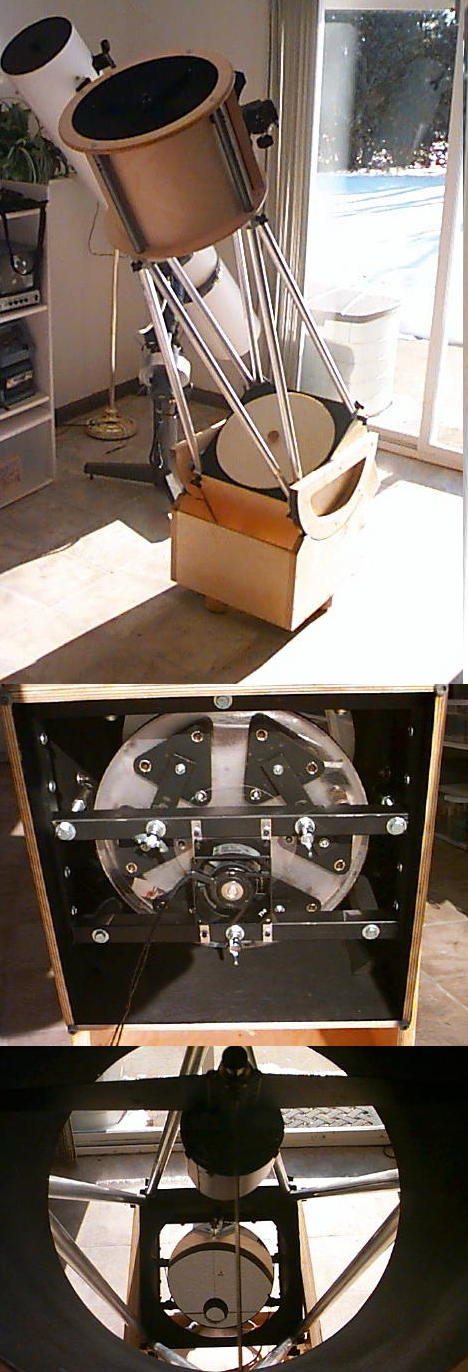
The design is conventional K&B, with design assisted by NEWT and PLOP. The optics (12.5” F5.25) were bought second-hand - more about this later. The rest I built over the last six months. In the process, I learned to weld, and use a milling machine, router, and lathe from indulgent co-workers. Not a bad way to pick up some new skills!
First a few observations:
WOW! This is a whole different experience from what I am used to. The wide views and bright images are astonishing. The Pleiades looked like bright blue diamonds sprinkled across velvet. The Great Orion Nebula filled the Panoptic with festoons and streamers out the edge of the field. The combination of large aperture and excellent eyepieces makes a real difference. (I had hoped it would.) It’s hard to go back to standard Plossl performance after this; like looking down a hole rather than a window.
Now the questions:
1) Should I invest in refiguring the primary? The images are generally pleasing except for very bright stars and planets. There I see a large amount of haze around these objects, almost as if the eyepiece is dewing up. Definition is not as good as I am used to from my old 8” F8. I think the collimation is OK, but I haven’t yet made a Barlowed laser.
The 12.5 inch mirror is obviously amateur-made: it’s thin (about 1”) and has no commercial markings. There is a problem with incomplete polishing: a hazy annulus around the outer 2” of the mirror face – not really obvious unless the illumination is right. I think I know the answer, but is this the source of halos visible around bright objects? I would cheerfully pay someone like Swayze or Royce to fix it. (OK, I would grumble, but this scope is a keeper.) Would improving the polish be worth the cost?
2) The Dobsonian motions are wonderfully smooth, even “buttery”, but a bit too much force is required. I should note that the temperature is typical for Minnesota: COLD. What do people think of silicone or dry lube? Does this gum up the works or make the force undesirably low? (The scope has Ebony Star with Teflon bearings.)
3) I notice that aluminum truss tubes are frequently covered with foam. Is this merely to protect fingers from the cold, or does the cold metal create turbulence in the light path?
See you later, all. I need to help get Christmas ready.
Gary Hansen
Attached Image:


