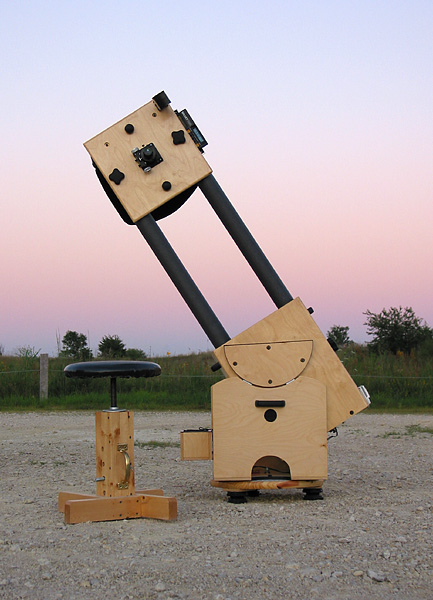

I use a Pocket PC at the telescope to provide real time Altitude and Azimuth coordinates which applied with an azimuth dial and altitude scale makes for a simple and affordable setting circle system.
Since implementing the system on my 13" I have worked to try and improve the accuracy of the system. I recently replaced my hand drawn azimuth dial with a computer generated dial and saw an improvement in accuracy. The altitude system still needed work. I have been using an inclinometer which I was able to make work pretty well, but the small size of the dial made making fine adjustments really difficult. I was often able get close with the dial, sometimes right in the one degree field, but often had to scan a little to pick up the target.
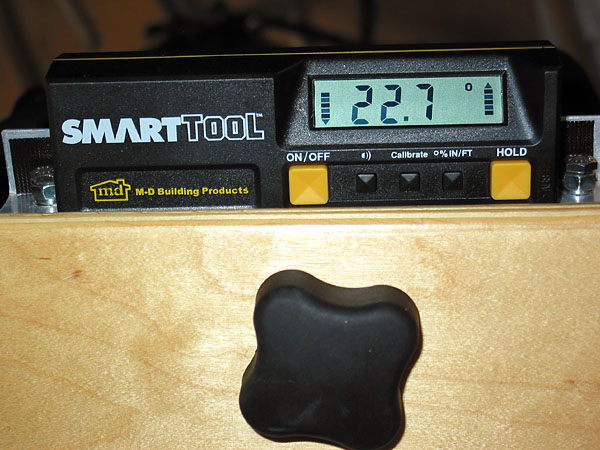
I was on the look out for a way to improve the accuracy of the altitude system when I came across an advertisement for an electronic level that was accurate to 1/10th of a degree. This might be just the ticket, that kind of accuracy would be excellent.
I ordered one of the units. I devised a simple mount using a short piece of aluminum angle. I attached the mount to one of my struts with 2 1/4 20 thumbscrews into threaded holes in the strut. I placed springs between the mount and the truss. The level attaches to the mount with velcro.
I have been out with the new system for 2 nights now.
The level is very accurate. As I worked my way through my observing plan, object after object was placed in the 1 degree field of view of my 32mm plossl. At one point, I had 15 consecutive objects in the field, and they were spread all over the sky.
In the event an object was not seen in the field, a half a degree scan in azimuth turned it up immediately, so altitude placement was accurate. After a "miss", I center on the object and simply reset the azimuth dial to the match the expected setting and things are back on track
This is a big improvement in this system. The resolution of a tenth of a degree offered by this device is all I had hoped for and makes using the system a real joy.
Since implementing the system on my 13" I have worked to try and improve the accuracy of the system. I recently replaced my hand drawn azimuth dial with a computer generated dial and saw an improvement in accuracy. The altitude system still needed work. I have been using an inclinometer which I was able to make work pretty well, but the small size of the dial made making fine adjustments really difficult. I was often able get close with the dial, sometimes right in the one degree field, but often had to scan a little to pick up the target.
I was on the look out for a way to improve the accuracy of the altitude system when I came across an advertisement for an electronic level that was accurate to 1/10th of a degree. This might be just the ticket, that kind of accuracy would be excellent.
I ordered one of the units. I devised a simple mount using a short piece of aluminum angle. I attached the mount to one of my struts with 2 1/4 20 thumbscrews into threaded holes in the strut. I placed springs between the mount and the truss. The level attaches to the mount with velcro.
I have been out with the new system for 2 nights now.
The level is very accurate. As I worked my way through my observing plan, object after object was placed in the 1 degree field of view of my 32mm plossl. At one point, I had 15 consecutive objects in the field, and they were spread all over the sky.
In the event an object was not seen in the field, a half a degree scan in azimuth turned it up immediately, so altitude placement was accurate. After a "miss", I center on the object and simply reset the azimuth dial to the match the expected setting and things are back on track
This is a big improvement in this system. The resolution of a tenth of a degree offered by this device is all I had hoped for and makes using the system a real joy.
Attached Image:
Rod Nabholz
Home Built Astronomy Projects
http://www.homebuiltastronomy.com/
Wild Bird Photography
http://www.wildsideiowa.com