Image of the day

Captured by
Byron Davies

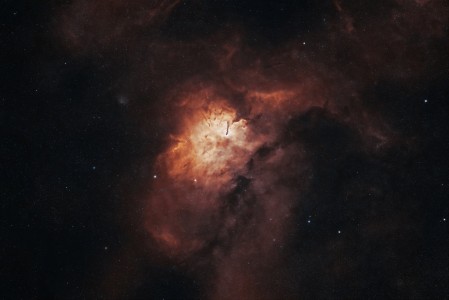
Sh2-86 (NGC-6820)

My Account

New to Astromart?

Register an account...

Need Help?

Mersenne-Gregorian?

Started by williamichang, 12/07/2004 05:00AM
Posted 12/07/2004 05:00AM | Edited 12/07/2004 05:15AM Opening Post
A la Clyde Bone's Mersenne telescope with "neutralizing" convex parabolic secondary (S&T 9/99) directing collimated rays to a refractor, what about the Gregorian configuration -- concave parabolic secondary with coincident focal point as the primary? How much aberration off-axis? Does anyone happen to have done a ray-trace or have good intuition how well it would work?

Thanks, -- William

Note added: Guess what -- just found Vlad's one-week-old (!) message in the ATM List: (my interpretation) the coma will be worse by 1/obstruction, astigmatism by 1/obs-squared. Ouch.

Posted 12/07/2004 05:38AM #1
Hello:
I have a friend who's been working on this for some time, and apparently it's as good as a regular mersenne (i.e. no coma or astigmatism if I recall correctly). The problem with both types is the field of view, which is very small. If you're using a refractor to focus the light coming off of the secondary, then you'd like the refractor objective at the pupil to get a wide field of view. For a regular mersenne, there is only an imaginary pupil behind the secondary so the field of view is very small. For a gregorian mersenne, there is a real pupil near the focus of the primary/secondary. I've thought about having a perforated lens so that the light from the primary can pass through, then focusing the collimated beam coming off the secondary. I suppose it'd work, but I've never done a ray trace. My friend's idea is to make an off-axis gregorian mersenne so that he can put a lens at the pupil, but making two off axis paraboloids ain't easy.

Cheers
Mike Connelley
Posted 12/07/2004 02:39PM #2
Hi William,

>just found Vlad's one-week-old (!) message in the >ATM List: (my interpretation) the coma will be >worse by 1/obstruction, astigmatism by 1/obs->squared.

It is even somewhat worse: it is not obstruction, but a minimum secondary size, determined by the width of the axial cone at secondary's location.
The reason is that any incident angle A at the primary becomes A/x after reflection from the secondary (either Gregorian or Cassegrain), "x" being the min secondary size in units of the aperture. So with x=0.25, all off-axis angles become four times larger after reflection from the secondary. That would make inherent coma of the imaging instrument four times worse, and its inherent astigmatism 16 times worse (which would
inevitably worsen field curvature too). The displaced aperture stop (which is for the imaging instrument approximately at the location of secondary mirror), would have some effect, but likely minor compared to that caused by the increase
in angles of incidence.

Vlad