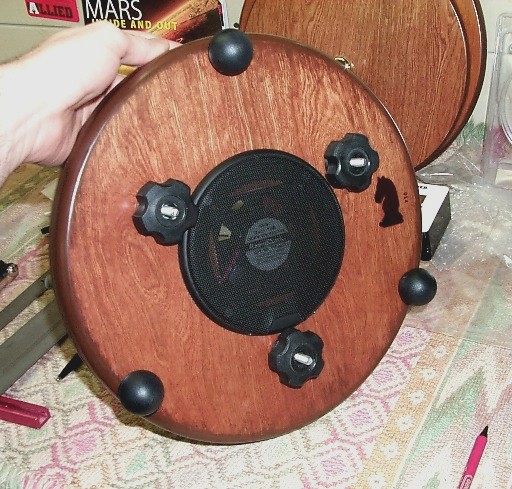
I'm getting ready to attach this 8-inch cell permanently onto the tube and thought I'd post a detailed view. Some features:
- CPU fans to break up the thermal boundary layer on the mirror face
- 3.5" PC case fan in a "down flow" configuration to pull air down the tube and out the back (including the boundary layer as it is blown across and off of the face of the mirror)
- 2" diameter felt support pads according to Bob Royce's recommendations for 8-inch mirrors (this one is a 1.5" thick Zambuto)
- Rubber stoppers instead of springs supporting the cell plate--prevents shifting/rocking of the cell plate as the scope is aimed from zenith to horizon
- Velcro retaining system rather than clips hanging over the mirror face consuming aperture and causing diffraction. It is really nice looking down the tube and seeing the entire mirror face without clips. The mating velcro on the side of the mirror is adhesive backed
- Routered channel in the end ring. It will be slid onto the end of tube and screwed to it. The back plate holding the cell (ala Richard Berry style) screws to the end ring and is quickly released by unscrewing three knobs around the perimeter of the ring
- Rear fan and boundary layer fans are on separate circuits with variable speed control for each, permitting you to dial in the airflow for rapid cooling vs. maintenance during observing (to eliminate the possibility of vibrations at the eyepiece)
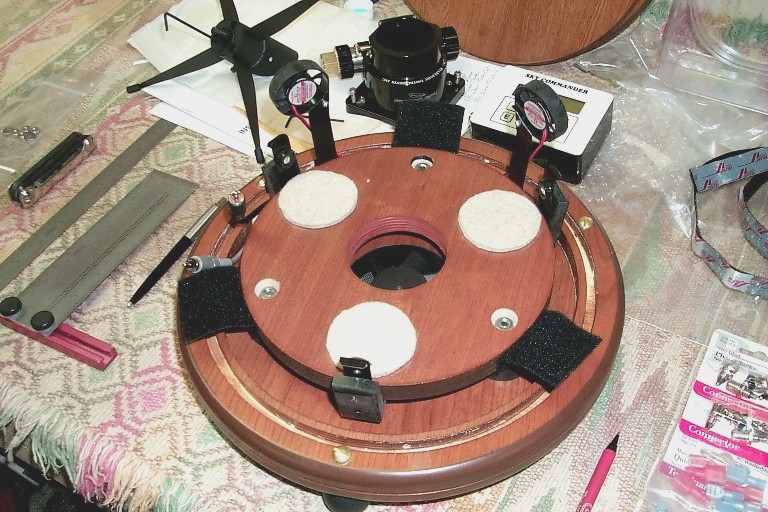
- CPU fans to break up the thermal boundary layer on the mirror face
- 3.5" PC case fan in a "down flow" configuration to pull air down the tube and out the back (including the boundary layer as it is blown across and off of the face of the mirror)
- 2" diameter felt support pads according to Bob Royce's recommendations for 8-inch mirrors (this one is a 1.5" thick Zambuto)
- Rubber stoppers instead of springs supporting the cell plate--prevents shifting/rocking of the cell plate as the scope is aimed from zenith to horizon
- Velcro retaining system rather than clips hanging over the mirror face consuming aperture and causing diffraction. It is really nice looking down the tube and seeing the entire mirror face without clips. The mating velcro on the side of the mirror is adhesive backed
- Routered channel in the end ring. It will be slid onto the end of tube and screwed to it. The back plate holding the cell (ala Richard Berry style) screws to the end ring and is quickly released by unscrewing three knobs around the perimeter of the ring
- Rear fan and boundary layer fans are on separate circuits with variable speed control for each, permitting you to dial in the airflow for rapid cooling vs. maintenance during observing (to eliminate the possibility of vibrations at the eyepiece)
Attached Image: