

How reasonable is it to expect to get every last bit of primary ripple out of a small, plate glass mirror?
I'm working on a 4" f/11 sphere, made of plate glass. I think it's an old mirror out of a Dynascope (I just have the mirror, not the scope) that exhibited a turned edge and some zones. I thought a refiguring was in order before making a grab-n-go planetary scope out of it. Getting a zoneless sphere has not been much of a problem, but getting rid of the last of the primary ripple has been difficult.
Using cerium oxide was a disaster - severe dog-biscuit - so now I'm using zirconium oxide. Much better, but still no cigar. I'm going about as slow as I can go, and as lightly as I can go, and maintaining good contact, but I just can't get rid of it all. My own guess is that the relatively fast speed of zirconium oxide combined with the high coefficient of expansion of plate glass just won't let me get it any smoother.
And how much primary ripple is too much? I know, a subjective question. It's quite noticeable under the Foucault test, using a moving-source slitless tester, which I would imagine to be quite sensitive. I'll try to get a picture of the mirror tonight and post it.
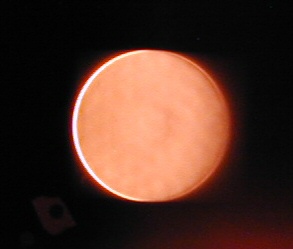
[edit] I've added an image. There are still some things to correct, such as a TDE of a couple millimeters, and a slight bump in the center (although it will be covered by the secondary). Those I know how to deal with, but the primary ripple is what I'm most concerned about.
Any thoughts?
Thanks,
Doug
I'm working on a 4" f/11 sphere, made of plate glass. I think it's an old mirror out of a Dynascope (I just have the mirror, not the scope) that exhibited a turned edge and some zones. I thought a refiguring was in order before making a grab-n-go planetary scope out of it. Getting a zoneless sphere has not been much of a problem, but getting rid of the last of the primary ripple has been difficult.
Using cerium oxide was a disaster - severe dog-biscuit - so now I'm using zirconium oxide. Much better, but still no cigar. I'm going about as slow as I can go, and as lightly as I can go, and maintaining good contact, but I just can't get rid of it all. My own guess is that the relatively fast speed of zirconium oxide combined with the high coefficient of expansion of plate glass just won't let me get it any smoother.
And how much primary ripple is too much? I know, a subjective question. It's quite noticeable under the Foucault test, using a moving-source slitless tester, which I would imagine to be quite sensitive. I'll try to get a picture of the mirror tonight and post it.
[edit] I've added an image. There are still some things to correct, such as a TDE of a couple millimeters, and a slight bump in the center (although it will be covered by the secondary). Those I know how to deal with, but the primary ripple is what I'm most concerned about.
Any thoughts?
Thanks,
Doug
Attached Image:
