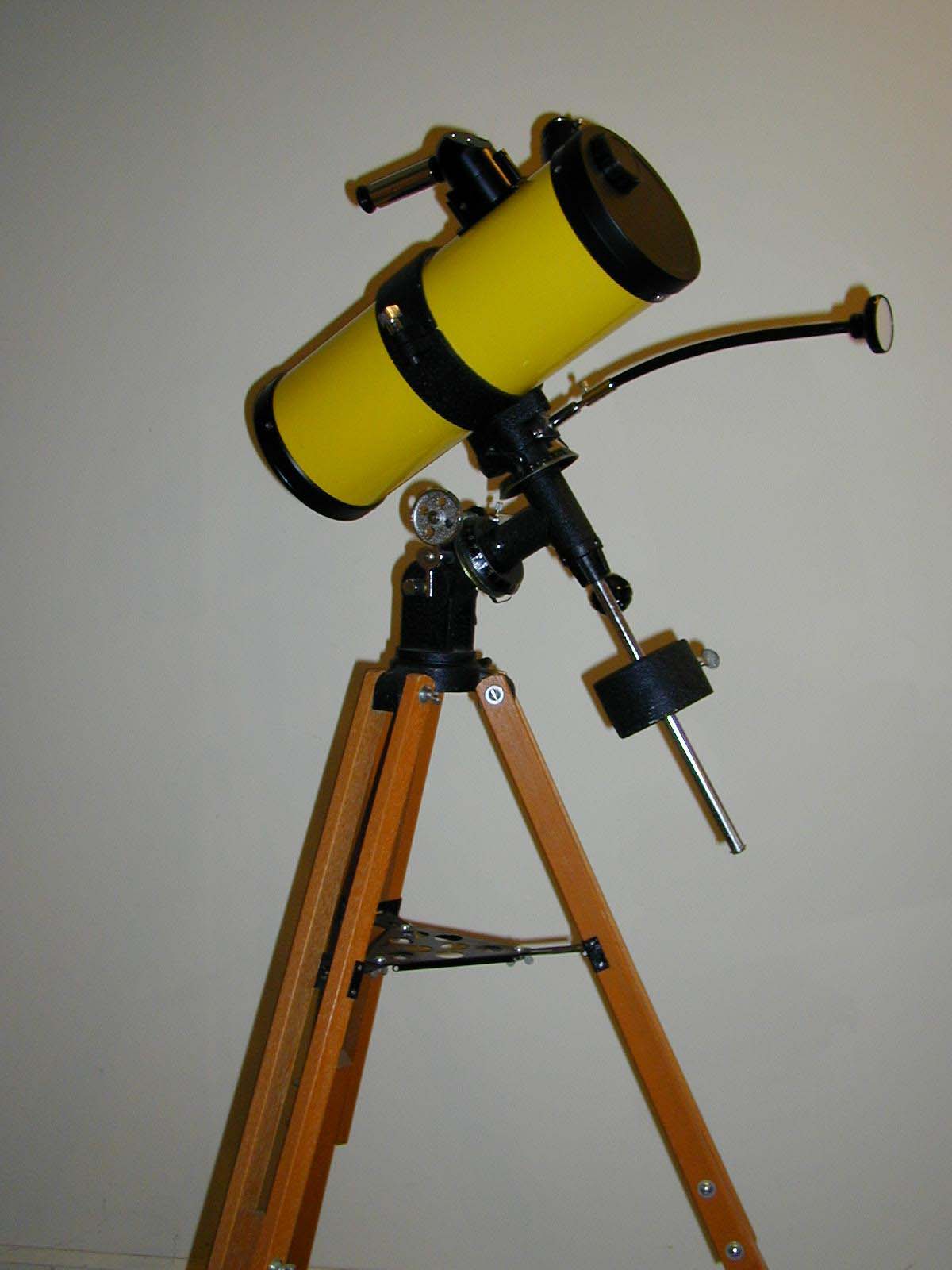
I have a short tube Schmidt-Newtonian (see picture below) that I am trying to sell through the Astromart classifieds. In writing up the ad, I noted that it would might a good scope for a tinkerer as it could be improved by replacing the .965" focuser for one that accepts 1.25" eyepieces. I'm going to continue to advertise this scope, but if there are no takers I might become the tinkerer. As someone with no experience in telescope construction I'd like to pose the following questions:
In addition to being able to use my 1.25" eyepieces, I'm assuming that using a larger focuser will increase the amount of light reaching the eyepiece and therefore will improve brightness and contrast. Is this an accurate assumption?
Due to its folded optics design, the OTA is only 15" yet it has a 1000mm focal length. In order to bring images to focus there is a 4" extender that attaches to the focuser. Obviously the FL will not change, but will changing the size of the focuser and using larger diameter eyepieces have any affect on where the images come to focus?
I haven't removed the focuser yet to see how large the opening in the tube is where the focuser is mounted. To take advantage of a larger focuser will I have to enlarge the opening?
Light from the primary mirror is reflected off of the secondary mounted on the correcting plate at the front of the tube to a mirror that is attached by an arm to the focuser assembly. When I change the focuser will I need to
change the mirror as well? Also, are there any issues related to collimating this third mirror; for example would I need special equipment to collimate it?
Finally, are there any manufacturers of simple rack and pinion focusers that you'd recommend? Obviously, this would be an experimental process for me and I don't want to invest a lot of money, especially if I can't get it to work properly.
Perhaps the biggest question is if fiddling with a compound telescope is something a novice should do.
Thanks for your feedback.
Dave Colton
In addition to being able to use my 1.25" eyepieces, I'm assuming that using a larger focuser will increase the amount of light reaching the eyepiece and therefore will improve brightness and contrast. Is this an accurate assumption?
Due to its folded optics design, the OTA is only 15" yet it has a 1000mm focal length. In order to bring images to focus there is a 4" extender that attaches to the focuser. Obviously the FL will not change, but will changing the size of the focuser and using larger diameter eyepieces have any affect on where the images come to focus?
I haven't removed the focuser yet to see how large the opening in the tube is where the focuser is mounted. To take advantage of a larger focuser will I have to enlarge the opening?
Light from the primary mirror is reflected off of the secondary mounted on the correcting plate at the front of the tube to a mirror that is attached by an arm to the focuser assembly. When I change the focuser will I need to
change the mirror as well? Also, are there any issues related to collimating this third mirror; for example would I need special equipment to collimate it?
Finally, are there any manufacturers of simple rack and pinion focusers that you'd recommend? Obviously, this would be an experimental process for me and I don't want to invest a lot of money, especially if I can't get it to work properly.
Perhaps the biggest question is if fiddling with a compound telescope is something a novice should do.
Thanks for your feedback.
Dave Colton
Attached Image:

