Image of the day

Captured by
RICHARD COFER

Lunar Occultation of Jupiter (Egress)

My Account

New to Astromart?

Register an account...

Need Help?

DSI imaging

Started by Skymainia, 02/25/2006 05:17AM
Posted 02/25/2006 05:17AM Opening Post

Hi all, Is any one using a Meade DSI imager that can share with me how to use the drizzle filter to reduce rotation ? I was trying to take a picture of NGC 2264 and even though I got a pretty nice picture for being a newbe one week useing a telescope and DSI experiance total. But I have trails and the large stars are stretched. I was using 9.6 exposure to get the nebulae to show up. Never quite shows up as brilliant as the live picture though but still fairly nice looking. I think my 2 problems are not having the telescope perfectly aligned because it never quite gets right on a star with the goto. I always have to adjust it. the other problem is I am not sure where to draw the boxes. I draw them on the brightest star but maybe I should make the boxes bigger? Or further apart?

What do you experienced guy's think?
Here is a picture to show the trails.

Attached Image:
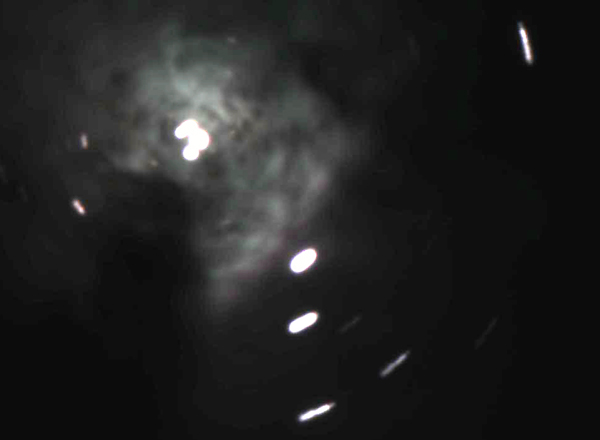
Skymainia's attachment for post 29966

8) [COLOR="Blue"]Dan, FR Observatory[/COLOR] [COLOR="Maroon"]www.featherriverwoodworks.com[/COLOR]
Posted 02/25/2006 10:56AM #1
Hi:

I am not familiar with the DSI and your setup but I have done some astrophotography.

It looks to me like what is happening is you are doing a long exposure with an ALT-AZ mounted telescope. To avoid the star trails, a wedge, GEM, a wedge or EQ mount of some sort is required. Otherwise the center of the image can remain fixed but the field rotates around it. This is what appears to have happened in your image.

It is my understanding that you can take a series of quite short exposures and stack them while the software adjusts for the field rotation but I have never done this.

The large stars could be caused by a variety of things, the mount not being sufficiently solid, the camera is "blooming" and there is some sort of "anti-blooming" control or quite possibly, focus. Stars are bright, in a long exposure image, they can appear much bigger because the camera captures light you normally don't see.

Focus is difficult, getting a sharp focus requires taking some time and adjusting it, checking it, adjusting it. I don't know what sort of focus options the DSI has, mine allows me to refresh quickly so that I can carefully adjust the focus.

You did not mention what sort of telescope you are using, if it is an Achromatic refractor like the AR-5 or AR-6 then the bloated stars could well be due to false color. WHile false color is a minor annoyance visually, when doing astrophotography it is a much bigger issue because both film and CCD's are capable of imaging from the ultra-violet down into the infrared. Astrophotography is the reason fast APO refractors were originally built...

Bottom line: It is fun to take images and capture things that are invisable to the eye but getting nice sharp photos, it is complicated, tedious and takes some solid equipment. Even then, stars will likely be bloated.

Best wishes and keep up the good work...

Jon Isaacs
