Dan Hereford said:
I'm struggling to decide what additional eyepieces I might need for use with an Orion X10 telescope. I've been using a Meade 2x shorty barlow lens along with either a 15mm or a 9mm Meade 4000 series plossl lens.
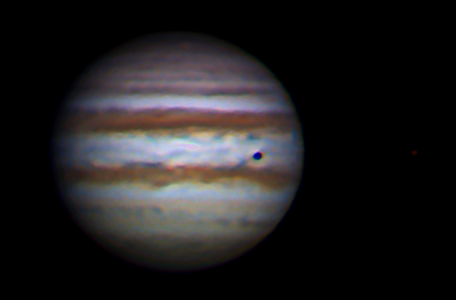
We've been looking at Jupiter and a few other objects but they seem to be extremely small even at the highest level of magnification. Should I be using higher power lenses or are these objects just more distant this time of year.
Dan: In general, I find that new astronomers tend to use magnifications that are too high. If the conditiosn are good, one can see a nice details on Jupiter and Saturn at 160x. Yes it is small but with practice, it's there to be seen. Part of this may come from advertisements touting 600x for 60mm telescopes. In reality, even with large telescopes like your XT-10 most observing will be done at less than 200x. Deciding upon the proper level of magnification is not so easy... There are many factors that determine the optimal magnification.
- Seeing... you are looking through a column of air that is at least 50 miles long, if that column is not stable, the light will be refracted and the image will suffer. When you see stars that are twinkling, that's a good sign that the seeing is not stable. The more air you are looking through, the closer to the horizon you are looking, these make the image less stable. Currently Jupiter is low on the horizon, even with stable seeing, you are looking through a lot of air, the views will be affected.
You can get a prediction for your local conditions from Attilla Danko's www.cleardarksky.com
Cold winter weather generally means poor seeing.
- You scope needs to be collimated and cooled down to the outside temperature. If the scope is not cooled down, the air inside the scope will not be stable, tube currents and thermal plumes make it look like you are viewing through a mirage.
A few things to know about increasing the magnification:
Increasing the magnification when viewing a planet makes the image larger but decreases the brightness. It also decreases the apparent sharpness as well as reducing apparent contrast. So, as you increase the magnification, objects become dimmer and less crisp.
A simple rule of thumb is to increase the magnification until the crispness, sharpness starts to degrade. On a great night in a 10 inch, this might be 350x or more. On a decent night, maybe 200x-250x.
The question to ask yourself is "I am seeing more detail or less detail when I increase the magnification." If you are seeing less, then that is a good sign that you are using too much. If you are not seeing a some detail at lower powers, say 133x, then increasing the magnification is unlikely to show you more.
Your current eyepieces offers you 80x, 133x, 160x and 266x.
Something between 160x and 266x would be good but 160x is plenty to see detail on Jupiter if the seeing is good. Right now, living where you live, I would be happy with seeing the moons and a hint of the cloud bands. Jupiter is probably a wavering mass... To get the good views it needs to be rock solid...
Hope this helps...
Jon