Image of the day

Captured by
Gary Taylor

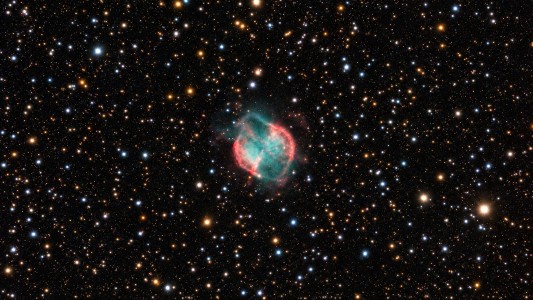
M27 - Dumbell Nebula

My Account

New to Astromart?

Register an account...

Need Help?

Measuring Degrees with a dobsonian?

Started by pern009, 08/05/2006 10:12PM
Posted 08/05/2006 10:12PM | Edited 08/05/2006 10:36PM Opening Post
Ok, so i'm starting to get into star charts. Looking to spot a few messier objects tonight, M103 (in Cassiopia) and M110 (and M32 since it's right next to M110, in Andromeda). I'm using starry night and the distance between M103 and it's closest star in cassiopia, Ruchbah which is a little over 1 degree away from it. How can I meassure the distance in degrees? Sounds like star hopping is favorable but is there a way? With my 7 degree finder scope and a good pair of 8x42 binocs maybe I won't having much trouble spotting it? And I should have no problem with my equipment right? (see below)

Wanna be Astronomer since August 3rd, 2006!
Skyquest xt12i
Celestron 1.25" plossl set

Posted 08/05/2006 10:58PM #1
Casey,
First off, the easiest thing to do in the long run is to simply star hop--just find patterns in the sky that show markers to your objects of interest. For instance, M4 is between Antares (which is easy to find) and another star nearer the pinchers (real obvious on the map. So, you put your telescope there, and plop it just a very slight plop to the south. And then you look with your finder scope and/or longest (widest field) eyepiece and look for something that isn't a pinpoint of light. Move your scope a bit (smoothly, slowly) till you find it--it has to be there.

But your question was-- how do you tell how far in degrees you are seeing with your dob. There are various ways to calculate (using formulae with the known focal length of telescopes and eyepieces). Or you can time how long a star takes to get across the field of view, and apply some formula. (I could look up either of these two methods, but I'm sure others will chime in.) The way I do it is to find something in my eyepiece that I can find easily on the charts. For instance, Antares and that star right next to it. Do they fit in your finder scope, edge to edge? How far apart are they on the map? How do they look in your finder scope? Can you see the two stars in Lyra next to M57? Can you get them both in the finder scope? at the edges, or how far in from the edges? How far away are they on your map? That is, to my mind the most useful way of figuring the "scale" of your scope and your map.

Alex
Posted 08/05/2006 11:23PM | Edited 08/05/2006 11:26PM #2
Hi Casey,

To get an estimate of your field of view you can look at the moon which is very nearly a half degree. You can then determine how far it is across the view in the eyepiece. You will need a bit of time for your eye to adjust back to normal after looking at the moon. If you can identifiy a pair of stars on a chart and get their distance you can use them to estimate your field of view.

Many of the objects discussed in recent threads will be easily seen in binos from dark skies including M51, 81, 82, 31, 13, 3, 4, and a whole bunch of others around the teapot. If you look with binos, you will see them even without a map. But...

The moon is big right now and until it is out of the sky, some of these targets are pretty tough even with a big scope. Last night we could see M51 in a 14" but it wasn't as good a view as a 4.5" will give under dark conditions.

M103 in Cass stands out in binos at dark skies but gets lost in the background stars when using a scope. I never found 103 to be very impressive and I never found it at all until I used binos at the cottage. Too many stars in the neighborhood. Use low power for the best view.

The companions to M31 can be seen in a low power view but dark skies are needed to see all three objects. I couldn't see them all until the moon went down last night and then it was easy. M31 from dark skies is a naked eye object for most folks.

Most messier objects can be seen in binos and I think many are easiest found this way. Some targets, like M57 are bright enough to be seen but just too dang small to be identified.

Being stuck in suburbia is like being stuck with a big moon. It doesn't lend itself to finding DSOs.

good luck and clear dark skies!
dan