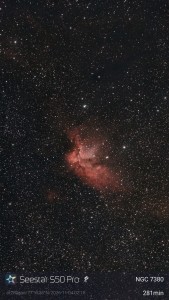
Image of the day

Captured by
Arthur Hogan

Wizard Nebula

My Account

New to Astromart?

Register an account...

Need Help?

What's the difference between long and short focal

Started by kevin7m, 01/24/2007 01:35PM
Posted 01/24/2007 01:35PM Opening Post
Hi,

I'm in the process of looking for a first scope and have a choice between a mak-cas or a mak-newt. Nothing too big, not too much maintenance, and something that has excellent quality. Both Intes scopes I've looked at offer great views but I've read a few articles about some people wanting longer focal lengths but they don't state why? What is the difference between a F6 mak-newt and an F10 mak-cas? Does the focal length affect what you see? I hope this isn't a obvious or stupid question but I get so caught up in trying to analyze every detail to make sure I pick the right scope.
Posted 01/24/2007 01:48PM #1
A long focal ratio gives more magnification, and a narrower field of view. You see less of a sky, but whatever you are focused on looks bigger. This is good for planets, double stars, or any time there is a small object.

A short focal ratio gives less magnification, but a wider field of view. This is more important on larger objects like large gas clouds (nebulae) and open star clusters.

Now, it is true that the amount of magnification you get is mostly dependent on the eyepiece you choose. So, you can change the field of view, and the magnification by changing the eyepiece. However, if you already have a long focal length, you would need an exceptionally long eyepiece to get a low power view. So, it is better to have a shorter focal length to start with if you mostly want wide-field views.

Now, there are other considerations, also. A long focal length minimizes false color, and can ease collimation problems. However, it can seriously lengthen the tube. But that is not always true (as, for instance, with a Mak, which is folded. Also, you have to consider the relative focal ratios, or F-ratios, which relate the aperture to the focal length.

Alex
Posted 01/24/2007 02:52PM #2
Hi Kevin,
If the two scopes you are considering are the same size aperture, they will both reach the same theoretical high magnification, you just need shorter focal length eyepieces to get you there with the Mak-Newt. Since the true field of view is a function of the focal length of the telescope and the field stop diameter of the eyepiece (literally, the size of the "hole" in the eyepiece), The F6 telescope will give you a wider field of view potential than the F10. This would make an F6 telescope more desirable for "large" targets like open clusters. Many people prefer the longer focal length telescopes if the primary purpose is expected to be lunar/planetary work, because longer focal length eyepieces are often more comfortable to work with. I am of this camp, however, with the introductions of lower cost, high quality, short focal length eyepieces such as the BO/TMB planetary's, telescopes with shorter focal lengths are becoming more popular for this use.

David E
Posted 01/24/2007 03:21PM #3
Kevin Morin said:

Hi,

I'm in the process of looking for a first scope and have a choice between a mak-cas or a mak-newt. Nothing too big, not too much maintenance, and something that has excellent quality. Both Intes scopes I've looked at offer great views but I've read a few articles about some people wanting longer focal lengths but they don't state why? What is the difference between a F6 mak-newt and an F10 mak-cas? Does the focal length affect what you see? I hope this isn't a obvious or stupid question but I get so caught up in trying to analyze every detail to make sure I pick the right scope.

Wider field of very is also good for finding objects (if you don't use go-to). It can be pretty frustrating for beginners to look for almost anything that isn't a planet or the moon.
Posted 01/24/2007 06:04PM #4
>>> I hope this isn't a obvious or stupid question but I get so caught up in trying to analyze every detail to make sure I pick the right scope.

----

Kevin: To put your mind at rest, there is no "right scope", there are just lots and lots of very nice scopes to choose from.

In the case of the Mak-Newt vs the Mak-Cas, the Mak-Newt has the shorter overall focal length but the primary mirror actually has a much longer focal length as it uses a flat diagonal rather than a convex/magnifying secondary. A F6 MAK-Newt is about as close as you can come to a APO refractor as is possible. They have much smaller obstructions than the Cassegrains so they are really optimal for planetary viewing. With their shorter focal length, they are capable of much wider fields of view.

The downside: They are heavy and like most MAKs, they take a while to reach thermal stability.

My personal thinking is that you might be better off choosing a simpler scope to get your feet wet. Yes a MAK Newt is a great scope but there are simpler, less expensive scopes that will give similar views and are affordable in larger apertures. A 6 inch MAK Newt and mount are going to run well over $1000. For half that you can buy a standard Newtonian with a 10 inch mirror that will do a good job on all targets and because of the light gathering ability will outperform a smaller Mak on the Deep sky objects.

After you have gotten in some eyepiece time, that is the real time to decide on what will best suit your needs.

Jon