Jan 29, 2009
A moderate 39F temp. near Santa Rosa, one hour north of San Francisco. At 10:30pm, seeing was about a Mag 4.8, with the Little Dipper stars directly visible, but with a slight haze, as the lights from jet airplanes would show a projection beam ahead of them. Targets were clusters, some nebulas and a few galaxies. I hadn't used my 8" f6 cardboard tube refractor since last fall, and had to dust off the mount, but the scope and lense were still in fine condition from their slumber in the garage these last few months. One of these days I will get around to painting the tube.
I tuned up the 30mm finder while observing M42. Can't go wrong starting a winter observing session with that. I then tried for the Rosette Nebula and would probably need the OIII filter. I was right, only the 6 bright stars of the inner cluster were obvious, but with the filter in, the giant hazy donut started to appear around the ladder of stars. This nebula is really big, I was viewing about 2 degrees FOV, and I still panned around a bit to catch it all. This would really be a treat at a truly dark sky site.
Jumping down to the Canis Major region I proceeded to cluster-hop starting from M50 in Monoceros down to NGC2335, 2343, 2345, left to 2374 and the truly awesome M46,47, and NGC2423 trio of clusters. All three were almost fitting into the FOV. The beautiful contrast of the carpet of fine small stars in M46 compared to the clumpiness of the bright stars in M47 always give me a smile. I then searched out the lone big cluster of dim stars M48, and further north to M67 and on to the giant Beehive cluster which just fits in the widest FOV of the 8" short tube refractor.
I swung over to Leo to bag a few of the bright galaxies. M105, 96, and 95 nestled in the dim "square" in the middle of Leo. These three required a bit more magnification to tease out from these not too dark skies, so they did not quite all fit the same FOV. But the ovel shapes were tantalizing glimpses of the Messier / Galaxy season yet to come. NGC 3384 came along for the ride as well. Moving to the Leo Trio M65,66, and NGC3628 in the back "Leg" of Leo always makes for a fine sight in the same field of view. Wrapping up, I swung over to the double cluster, and then ambled over to cluster M103 in Cass., which to me has a dual personality. It was just starting to show the cluster of fine stars stars behind the few bright stars. I continued a bit farther with the clusters NGC659, 663, and 654, again nearly fitting in the same field.
This was a fine night of clusters of clusters and groups of galaxies. Looking forward to Virgo and a proper Galaxy tour in the next few months !
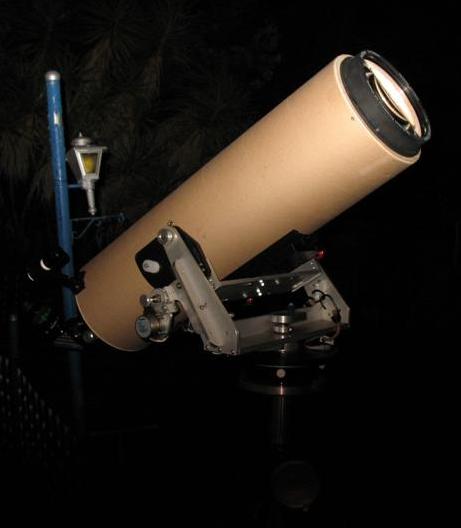
A moderate 39F temp. near Santa Rosa, one hour north of San Francisco. At 10:30pm, seeing was about a Mag 4.8, with the Little Dipper stars directly visible, but with a slight haze, as the lights from jet airplanes would show a projection beam ahead of them. Targets were clusters, some nebulas and a few galaxies. I hadn't used my 8" f6 cardboard tube refractor since last fall, and had to dust off the mount, but the scope and lense were still in fine condition from their slumber in the garage these last few months. One of these days I will get around to painting the tube.
I tuned up the 30mm finder while observing M42. Can't go wrong starting a winter observing session with that. I then tried for the Rosette Nebula and would probably need the OIII filter. I was right, only the 6 bright stars of the inner cluster were obvious, but with the filter in, the giant hazy donut started to appear around the ladder of stars. This nebula is really big, I was viewing about 2 degrees FOV, and I still panned around a bit to catch it all. This would really be a treat at a truly dark sky site.
Jumping down to the Canis Major region I proceeded to cluster-hop starting from M50 in Monoceros down to NGC2335, 2343, 2345, left to 2374 and the truly awesome M46,47, and NGC2423 trio of clusters. All three were almost fitting into the FOV. The beautiful contrast of the carpet of fine small stars in M46 compared to the clumpiness of the bright stars in M47 always give me a smile. I then searched out the lone big cluster of dim stars M48, and further north to M67 and on to the giant Beehive cluster which just fits in the widest FOV of the 8" short tube refractor.
I swung over to Leo to bag a few of the bright galaxies. M105, 96, and 95 nestled in the dim "square" in the middle of Leo. These three required a bit more magnification to tease out from these not too dark skies, so they did not quite all fit the same FOV. But the ovel shapes were tantalizing glimpses of the Messier / Galaxy season yet to come. NGC 3384 came along for the ride as well. Moving to the Leo Trio M65,66, and NGC3628 in the back "Leg" of Leo always makes for a fine sight in the same field of view. Wrapping up, I swung over to the double cluster, and then ambled over to cluster M103 in Cass., which to me has a dual personality. It was just starting to show the cluster of fine stars stars behind the few bright stars. I continued a bit farther with the clusters NGC659, 663, and 654, again nearly fitting in the same field.
This was a fine night of clusters of clusters and groups of galaxies. Looking forward to Virgo and a proper Galaxy tour in the next few months !
Attached Image:
David Simons


