Image of the day

Captured by
Erwin Forbragd

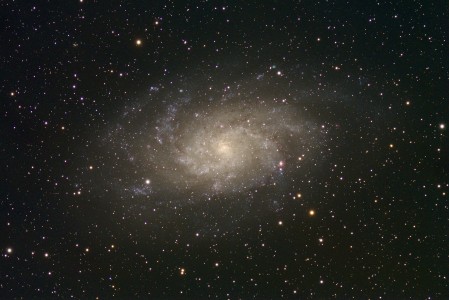
M33 in Triangulum

My Account

New to Astromart?

Register an account...

Need Help?

Daytime "star test" question

Started by Jim Goldring, 07/14/2002 06:15PM
Posted 07/14/2002 06:15PM Opening Post
I have read that one can use a small, stainless steel ball bearing at a distance as a point source to carry out a star test during the day. This seems advantageous as one does not have moving target to contend with. I've not been able to to find info on what distance and what size bearing to use. Input from anyone with experience with this technique would be appreciated.
Thanks in advance.

Jim
Posted 07/15/2002 02:44AM #1
Hi Jim.

What scope are you looking to test (focal length & aperture)?

I have Suiter, and I'd be glad to give you some rough (but conservative) guidelines.

I've star-tested using chrome bumbers and other bright solar reflections from distances beyond a mile. I've also star-tested using a precision pinhole at ~30 feet (small refractor). The idea is to image an intensely bright spot at a distance which yields parallel, effectively infinite-distanced light with zero (or minimal) spherical aberration -- an effective airy disc. The smaller the diameter of the reflecting spheroid (or quasi-spheroid), the shorter the minimum working distance needed to do so. Unfortunately, the smaller the image spot, the dimmer the reflection will be. Another unfortunate aspect: the greater the working distance, the greater chance of poor seeing over the intervening distance (hence, no real advantage over true star-testing, other than the artificial star's being stationary). Still, it's do-able.

If nothing else, I can give you a rough idea as to what you'd need to replicate a good-enough artificial star image.

Best wishes.
-Dan
Posted 07/28/2002 04:46PM #2
Hey, heres another way, I heard about it years ago and it worked pretty decent. Set up a lamp as far as you can from your scope, preferably have grass between your scope and the lamp to cut down on heat waves. Make a panel out of heavy aluminum foil and place it in front of the lamp. Poke the smallest hole possible with the tip of a tiny sewing needle in the foil. If you make the hole small enough and your far enough away, AND you actually make the hole round it makes a decent false star, and you can even do this on a cloudy day since you don't need sunlight to reflect off anything. In fact a cool cloudy day has better seeing conditions. The worst part is actually making the hole round and getting it in the right spot. I ended up with about 11 or 12 odd shaped holes before I got a decent one. And becareful if you have the foil too close to the bulb, it'll start smoking haha. Hope that helped, Take care! Ron
