During yesterday's observing session I split observing time about fifty-fifty between doubles and DSO's. I reviewed several favourite objects, and I also found some new ones.
Dmitri Kuglinov recommended the open star cluster NGC6940 in Vulpecula. I observed it for the first time yesterday, and found it to be a good object. I used a 24mm Panoptic giving a magnification of 63x. Possibly the cluster is better at lower magnification. Many of the stars are bright and cover an area of nearly half a degree. Near the centre of the cluster was a delicate pattern of very faint stars. Good object!
I just had to get a view of galaxy NGC6946 (The one with the present supernova). I find this galaxy bright in the 12.5-inch with several faint stars in front of it. Hard to tell which one was the supernova. Nearby cluster NGC6939 could be seen at the same time in the 24mm Panoptic. This is one of my favourite open clusters.
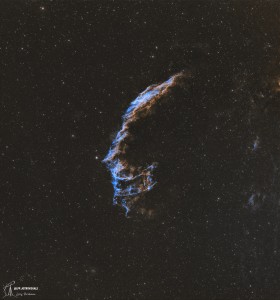
I observed both the Veil nebula and NGC6888 using an O-III filter. Superb!
M33 is a show object in the 12.5-inch. The spiral pattern is easily discernable. I found the emission region, NGC604, to be very conspicuous. It responded well to the O-III filter, revealing its true nature.
The great Andromeda Galaxy was near zenith. The star cloud, NGC206 eas obvious, as well as the dust lanes. M32 appeared very bright and NGC205 very large. If placed anywhere else NGC205 would have been a very popular target.
Also observed NGC404 and NGC891. In 891 the equatorial dust lane could be percieved with averted vision.
The galaxy pair NGC672/IC1727 in Triangulum was a good target. I found it slightly north of a C-shaped asterism containing a wide double star. IC1727 wasn't easy to see, but required averted vision.
M74 appeared large and pretty bright. But I couldn't make out the spiral pattern.
Galaxy NGC7331 in Pegasus often has disapionted me a bit. It is bright, but quite small. Maybe previous disappointment made it a positive surprise yesterday night. It appeared larger than I've seen it before, quite sharply defined towards a dust lane on one side, and with the small neighbour, NGC7553 as a faint smudge nearby. I also positively viewed Stephans quintet. The largest galaxy in the group, NGC7320 wasn't really difficult to see. The quintet, however, is no show object in the 12.5-inch.
I observed the globular cluster, M15 for the first time with 12.5 inches of aperture. To me it appears more concentrated in the centre than many of the other globulars. However, outlying members cover a large area.
I also observed a few planetary nebulae. NGC1501 in Camelopardalis appears round, bluish and well-defined. NGC7027 in Cygnus is much smaller. I suppose it is bright enough even for the smallest scopes, but it may be difficult to see that it is a nebula and not a star. The most interesting of yesterday's planetaries was IC2149 in Auriga. It looks like a star at 63x magnification, but its colour reveals that this is a planetary. An O-III filter reveals its nature beyond doubt.
Inge S
Haavik, Norway
