I have raised this issue previously, but since it is of considerable interest for the visual observer, and since new users probably now follow the discussion, I find it relevant to start a new thread about this.
Old DSO lists and tables used to list the integrated magnitude (sometimes together with the size of the object), and I used to believe that the visibility of the objects was closely related to the magnitude. Practical observation, however, showed me that it wasn't that simple.
More recently (like in the Night Sky Observer's Guide) surface brightness is also listed for galaxies and some other nebulae. This helps identifying large objects with low surface brightness, and is definitely a good supplement to the integrated magnitude.
However, even the surface brightness doesn't represent the whole truth. One reason is that the surface brightness is usually calculated from the integrated magnitude and the "visual extent" of the object. This is a rather rough simplification, since the surface brightness is normally not homogeneous across the object. An object with a very bright core surrounded by a large halo (e.g. M94), may get a relatively low value for the surface brightness, even though the central region is unusually bright.
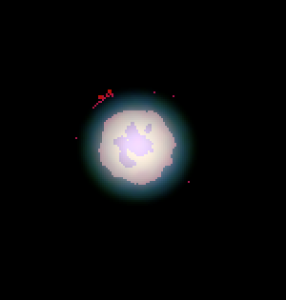
I'm convinced that for low surface brightness objects the brightness gradient (how quickly it changes with position) plays a key role. A large face-on galaxy with a faint core where the brightness slowly drops towards the edge may be very difficult to detect. A similar galaxy which is nearly edge-on will be much easier to detect, since the distance from the core to the nearest edge becomes much smaller (higher gradient). The perfect sky map in my opinion should use isophotes (lines of equal light intensity) for the nebulae. Where the distance between the isophotes is large, the object will be difficult to detect, but where the isophotes are close to each other, the object will be easy to detect.
To some extent this is connected with the question of magnification on nebulae and galaxies. A lower magnification will bring the isophotes closer together in the image of the eyepiece than a higher magnification. The drawback of low magnification, however, is that the sky background becomes bright. And small, intricate detail may require more magnification. For extended objects with small brightness gradients, however, it seems that the optimum magnification is considerably lower than for objects like, e.g. M82, where the amount of detail is large, and the magnitude of the brightness gradients are larger.
Inge S


