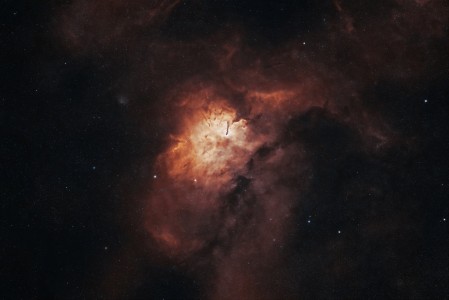

Earlier this week I did some star-gazing at the Cottonwood Springs area of Joshua Tree National Park, where I spent an evening methodically seeking out galactic clusters in the Monoceros-Puppis region. The sky was reasonably dark and the seeing was generally fair, neither the best nor the worst I have encountered in several years of winter-time observing at that location. I will not burden you with a detailed report, but I will mention one open cluster that I had not seen before and that immediately became one of my favorites. It's NGC 2477 in Puppis, which has probably not made it into the Herschel 400 only because of its southerly location at declination -38º, although Patrick Moore included it as item #71 of his "Caldwell" objects. This brilliant cluster immediately reminded me of two long-time favorites of mine, NGC 7789 in Cassiopeia and M37 in Auriga. These three are all enormous swarms of hundreds of suns which are near and extensive enough to be individually resolved in reasonably dark skies, but the great majority of which appear to lie within a narrow range of rather faint visual magnitudes, avoiding the appearance of a scattered handfull of sparklers in a sea of nebulosity. NGC 2477 filled about half of my 20 mm eyepiece's 30-arcminute field of view. Archinal & Hynes says this cluster includes 1,911 stars within a diameter of 20 arcminutes and with a total visual magnitude of 5.8. The equivalent ratings for NGC 7789 are 583 stars, 25 arcminutes and magnitude 6.7; and for M37 they are 1,842 stars, 15 arcminutes and magnitude 5.6. I recommend NGC 2477 to any observer of galactic clusters for whom it is within reach, and for those of you located too far north for this cluster I suggest that you put it on the agenda for your next trip to the south.
NexStar 8i SCT, Orion 80ED APO refractor, Orion 120 mm EQ refractor, 3.5-inch Questar

