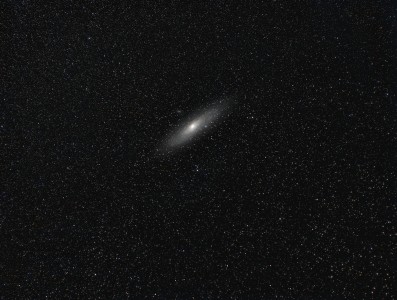
Do you see colour in any non-stellar object?

Started by Inge_S, 02/23/2012 10:27AM
Posted 02/23/2012 10:27AM Opening Post
Looking through magazines and internet sites it is easy to get an impression that galaxtic nebulae and even galaxies are very colourful objects. Looking through the telescope the universe appears differently. Certainly some stars (and star clusters) are coloured, but most nebulae appear pale greenish or neutral.

What is your experience? Do you seen any colour in deep-sky objects? Does large aperture help?

Inge S
Posted 02/23/2012 12:30PM #1
Some of the planetary nebulae have strong blue or green color. IC 418 is pale pink. Other than that, no.

John
Posted 02/23/2012 02:03PM #2
Except for a faint bluish or greenish tint in a few bright planetary nebulae, I don't see any color in nebulous objects with my 14" and 20" scopes.
Posted 02/23/2012 05:23PM #3
Yes- in objects like those listed. Comets offer color, also.
Hyakutake was electric teal (naked eye and scope), Holmes pale yellow.

Customized Zhumell Z12 on Dedicated Atomic EQ Platform
Customized Hybrid Z12/Lightbridge on Baltic Birch Planisphere Mount

(I'm holding famous Martian meteorite ALH84001 in the picture.)
Posted 02/25/2012 04:14PM #4
I find many planetary nebulae greenish of bluish. The "blue snowball" is definitely blue. NGC6543 is clearly green and contrasts beautifully with the central star which appears orange to me - possibly due to contrast.

Most other diffuse nebulae appear neutral to me. The Orion nebula is an exception. Much of this nebula looks distinclty green and under the best conditions I have a clear impression that the outer parts are pinkish. I doubt, however, that this is anything but an illusion. These parts of the nebula are probably less green than the rest, fooling my eyes to see pink colour.

Have anybody seen Campbells hydrogen star in Cygnus? It is claimed to be clearly red in colour when viewed with very large aperture.

Inge S
Posted 03/05/2012 01:47PM #5
Hi Inge. There are very few deep sky objects that show their colors in my 5" achromat refractor. Last year I observed the Eskimo nebula for the first time and it showed up as a nice pale cobalt blue object. M31 appears as a greenish yellow oval. Other than that, as best as I recall, most deep space objects appear with pale smoky gray or green hues in my 5" refractor.

Aperture will help by collecting enough light to the point that you can see the colors in the object. From my experience, I'll list M42 as an example. In my 5" refractor and a 4" refractor, it appears as a grayish T-Bone (or clamshell on really good nights with prolonged observations) with just a bit of mossy green in the fantail area around the Trapezium. Many years ago, I observed it with an 8" dob and recall seeing a lot more green with the Trapezium area showing up quite bright (whiter).

Since I choose to work with a smaller scope (I'm a refracto-fanatic), I just acknowledge this limitation of a 5" objective and try to get the shapes and filamentation in objects especially like nebulosities and galaxies.

Best Regards,

Mark Costello
Matthews, NC, USA

"I hear you're mechanically inclined. Did you ever do anything with perpetual motion?"

"Yeah, I nearly had it a couple of times."
Posted 03/05/2012 03:27PM #6
Hi Inge,

The easiest deep-dky object that I have seen a reddish colour to is M20. I have seen the red colour with as small as 10". With a 17.5" I can see red in the outer parts of M42 and in NGC 3372. I have not seen any red in NGC 2070.

My theory why M20 shows so easily is the blue region next to the red. Although the blue colour does not show, I think the contrast between the 2 regions makes the red show more easily.

Regards,

Maurice

* Teach a man to fish and you feed him for a day.
* Teach a man to use the internet and he won't bother you for weeks.
Posted 03/05/2012 10:52PM #7
I actually studied physiological optics (vision) at the Boynton Center (U of Rochester) as an Igor and then did lighting and astro design all my life. Bright planetaries can be distinctly bluish or green. And M42 ever since I was a kid looks greenish. Beyond that gray, gray, gray...to my dark-adapted eyes. Never red. Aperture helps only to a point. Contrast (very clear, dark sky, superb scope baffling) and "surface brightness" matter more. And that strictly depends on exit pupil equal or greater than eye pupil. So sometimes reducing the mag actually helps color perception because the surface brightness of admittedly a "smaller" object is maximized. Only distinctly red object to me is our sun in H-alpha - alas, stellar! Tom Dey

29-inch Dob in a dome
36-inch upgrade soon
LUNT 80/80 solar scope
FLI 6803 cam
APM 100mm APO Binos
JMI RB-16 Night Vision Binos
Zeiss 20x60 IS binos
Posted 03/08/2012 09:07AM #8
What about Campbell's hydrogen star? In spite of its popular name it is a planetary. I haven't been able to locate it myself, but I believe to have heard once that it appears brightly red at very large aperture. Maybe it appears just stellar as viewed through the telescope.....

Inge S
Posted 03/09/2012 08:23AM #9
Inge Skauvik said:
What is your experience? Do you seen any colour in deep-sky objects? Does large aperture help?

Inge S

I can see red quite distinctly in some stars, which seem to be part of the global clusters. I don't see any other color.

But I haven't been paying too much attention either. I'll have to give it a go.

I have the advantage of two cataract operations (both eyes) so the lenses are crystal clear.

Nice thread, I enjoyed reading the experiences of others.

Clears,
Joe

In lumine tuo videbimus lumen.

8O Home-made 10” Dob / Home-made 4” refractor

EPs: Konig 32mm (1.25") / Zhumell WF 30mm (2") / Nagler 13mm T1 / Orion Sirius Plossls 25 & 10mm / Zhumell Plossl 9 mm / Meade MA 9mm
