Finally I feel rested enough to write a report about my observing session in El Salvador.
On my way there, I picked in Miami an Oberwerk Ultra 15x70 binocular - an excellent instrument. It has been reviewed on CN by Ed Zarensky and by Roland Christen his web site. The binocular is extremely bright; I had it mounted on a light photo tripod.
It is not safe to move around in El Salvador; my local acquaintance, a guide, contacted Asociación Salvadoreña de Astronomía and they invited us to an observing session on the 14th of December. The observatory is well built and equipped - they have a 10 inch SCT and a 20 inch Obsession dob - neither of them was out that night. When we arrived around ten o'clock, there were already some people sitting in chairs and counting the Geminids. [ The meteor shower was excellent, we had counted more than 200 in 1.5 hours. ] After some counting I set up my binocular and stared in confusion at unfamiliar star fields. Orion was in zenith, Canopus rising, and I could not easily identify anything between them. A very experienced AA, Leonel Hernandez, offered me some help with finding NGC 253. The galaxy was amazing - bright, large and elongated; a bright globular cluster NGC 288 was practically in the same field of view. I looked at 253 for 5 minutes; after that Leonel suggested to take out a 12cm achromat. We looked at the galaxy in the refractor at low and medium power. It was very mottled and three foreground stars were seen. This is an amazing galaxy and in a sense I like it more than M31 which is rather plain.
After that I proceeded (with Leonel's help) to NGC 55 - large, dim and elongated in the binocular. NGC 1291 was also an easy target. Hereafter I could proceed with my atlas by myself. Fornax A and 1326 were small and rather bright, as were 1365 and 1386. I attempted the Fornax and Sculptor Dwarfs, but they were low and the transparency was not very good. But I could see NGC 247 - it was rather dim. Globular cluster NGC 1851 was bright and very concentrated. I could only resolve a few outliers in 12cm at medium power. Leonel mentioned two dim galaxies nearby, 1792 and 1808, we both could see them in the binocular!
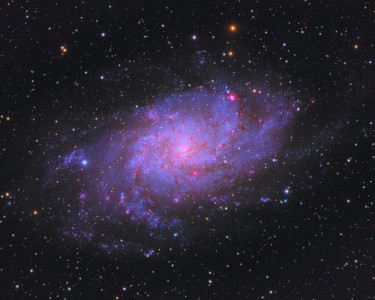
To finish the session, I went through some Northern showpieces - M31, M33, M45, M42 which was in zenith and looked like a giant bird. The last target was the Rosette nebula. I found its cluster with naked eye; to my surprise, I could see the tenuous wreath around it in the binocular without any filters!! Amazing.
Dmitri
